
Yes—AI website design is worth it in 2026 when it helps you build a clearer patient inquiry or appointment path, not merely generate pages. For a medical practice, the deciding work remains accurate content, usable booking, appropriate handling of patient information, and clear responsibility after launch.
- Is AI website design worth it? Yes, when it supports patient booking and reduces staff work.
- Website Symphony offers custom website design, marketing, and hosting for medical practices seeking one accountable team.
- Choose templates for a standard page structure; choose custom design when patient inquiry paths need different rules.
- Judge AI-powered functionality by the task it completes, its boundaries, and its human handoff.
Why this matters
A dental website has to do more than present treatment descriptions. A prospective patient needs to understand whether the practice handles their concern, what to do next, and whether submitting a form actually books an appointment.
Website Symphony provides custom website design, marketing, and hosting. When assessing Website Symphony, ask to see how those services connect around your practice’s patient inquiry process—not just how the finished pages look.
Buy a working patient journey, not an AI label. That distinction gives your 2026 website brief a useful starting point.
Is AI website design worth it in 2026?
AI website design is worth it when the finished website meets your practice’s requirements and the AI component serves a defined purpose. Generating an initial layout is not the same task as designing a reliable appointment request process.
Compare the delivery approach before choosing a provider. These options describe how a site gets built; they are not guarantees of quality.
| Approach | Best for | Main advantage | Main limitation |
|---|---|---|---|
| AI-generated website builder | Practices evaluating an initial structure | Produces a draft you can assess | Requires review of content, forms, and booking behavior |
| Template-based website | Practices whose needs fit the existing structure | Gives you a predefined starting point | Requires compromise when the structure conflicts with patient tasks |
| Custom, AI-assisted design | Practices with distinct inquiry or appointment requirements | Lets the project start with your workflow | Requires discovery, decisions, and ongoing ownership |
For a primary care practice with a straightforward appointment request process, assess whether a standard structure meets the brief. For a specialist clinic with referral requirements, different appointment types, or location-specific instructions, test those requirements before accepting a template.
Custom design earns its place when it solves a documented constraint. A custom label alone proves nothing, and adding AI does not remove the need to review the result.
Start with the patient path, not the page generator
Before reviewing designs, write down 3 patient tasks your website must support. For a dental practice, these might be finding a relevant service, requesting an appointment, and reaching staff when online booking is unsuitable.
Use the following sequence to turn those tasks into a practical design brief:
- Choose care. State which service or appointment type the patient needs to identify. Use language a patient can understand without knowing your internal scheduling terms.
- Check fit. Identify the information patients need before taking action, such as provider, location, or referral instructions. Publish only details your practice has verified.
- Request care. Define whether the action submits an inquiry, requests a time, or reserves an appointment. The button and confirmation must describe the same outcome.
- Confirm next steps. Explain what happens after submission and where patients should turn if the request needs a staff response.
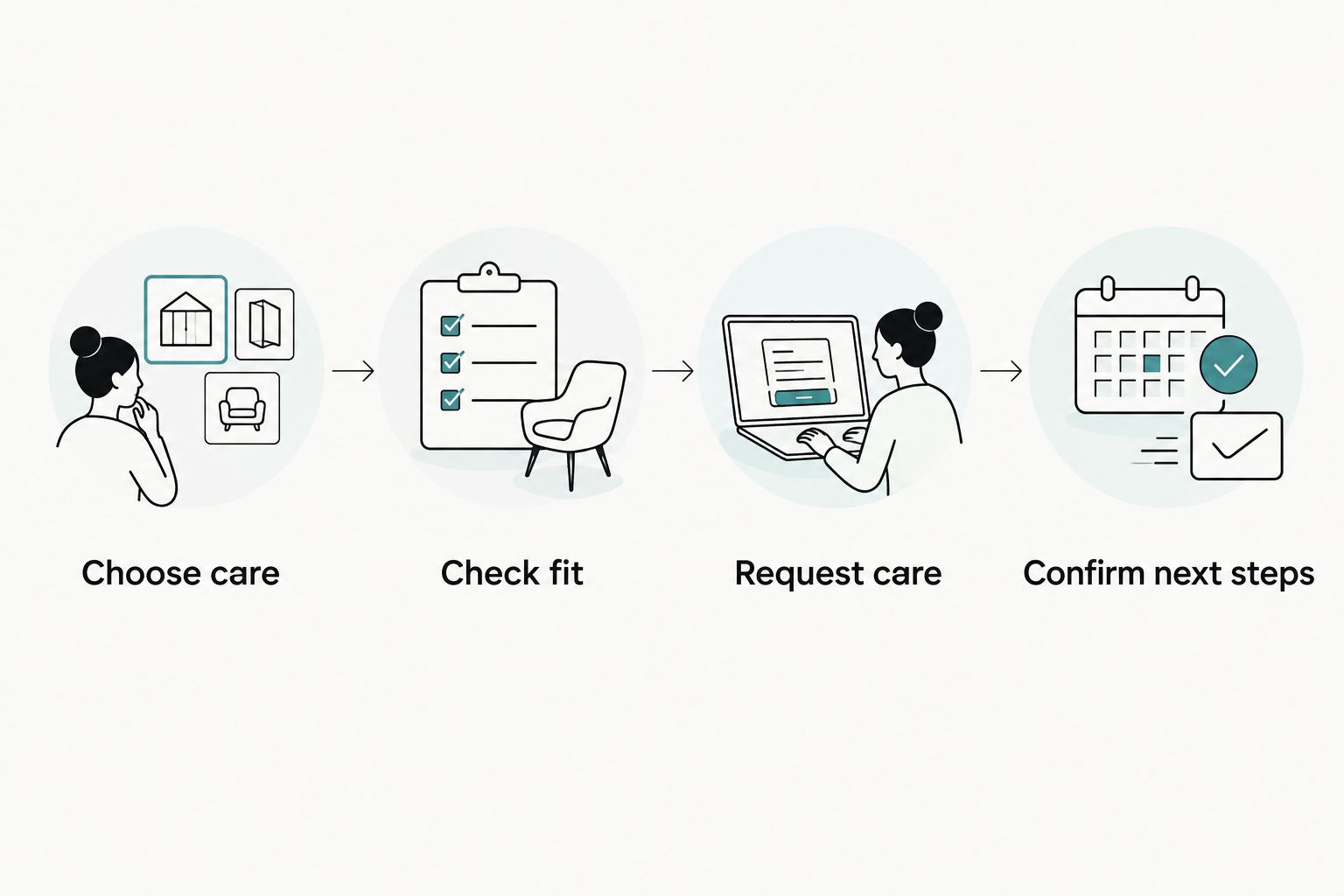
Test this sequence on a phone with someone who did not help design the site. Ask that person to explain what submitting the form will do. If their interpretation differs from the actual process, revise the wording or workflow before launch.
Where a template is enough
A template is a reasonable choice when its navigation, content structure, and form behavior match your approved brief. Keep it if you can explain the patient journey without workarounds.
The trade-off is accepting the template’s structure. Do not choose custom design merely to replace a layout you already like; identify the unmet requirement first.
Where custom design earns its place
Custom design is appropriate when a standard structure cannot clearly handle your inquiry paths. Examples to assess include separate new-patient and existing-patient actions, specialist referral instructions, or location-specific booking destinations.
The trade-off is decision-making. Your practice must supply accurate requirements and approve content; a designer cannot infer your scheduling policies from a service list.
What should AI actually do on a medical website?
In a 2026 medical website brief, describe AI as a task with boundaries. Avoid requests such as “add an intelligent assistant” without specifying what it should answer, what it must refuse, and how a patient reaches staff.
The following are possible requirements to discuss with a provider, not assumed features of any particular service.
| Proposed function | Best for | Useful role | Boundary to require |
|---|---|---|---|
| Administrative question assistant | Practices with approved administrative information | Helps patients find published instructions | No diagnosis, treatment advice, or invented practice policies |
| Inquiry routing | Practices with distinct administrative destinations | Directs a request toward the appropriate team | Ambiguous requests go to staff rather than receiving a guessed answer |
| Content drafting support | Practices updating service information | Creates a draft for review | Practice approval before publication; clinical review where appropriate |
An administrative assistant should rely on approved practice information. If an answer is unavailable, require a clear handoff instead of a plausible response.
Inquiry routing needs equally explicit rules. Decide what information is necessary, where it goes, and who checks failed submissions. Keep sensitive clinical discussion out of a general-purpose chat experience unless the practice has approved the setup and its data handling.
Content generation belongs behind a review step. AI-written treatment descriptions still need accuracy checks, and generated claims about your clinicians, credentials, or services must not reach the live site without verification.
Why the value of AI website design varies
The useful comparison is not “AI versus no AI.” It is whether the proposed delivery approach meets your operational requirements without creating new work or uncertainty.
- Patient journey complexity. A single inquiry destination needs different planning from service-specific or location-specific routing.
- Booking behavior. Requesting an appointment and confirming an appointment require different wording, confirmations, and staff expectations.
- Content responsibility. Someone must verify service details, clinician information, and administrative instructions before publication.
- Information handling. Forms and assistants need an approved purpose, appropriate access, and a clear destination for submissions.
- Ongoing ownership. Hosting, updates, marketing changes, and booking problems need named responsibility after launch.
Use these factors to compare proposals line by line. A proposal that names the AI technology but leaves these responsibilities undefined does not answer your buying question.
Can AI website design help you get more patient inquiries?
AI website design supports patient inquiries when it helps patients find relevant information and complete the next step. It does not establish an increase in inquiries simply by being AI-powered.
For your 2026 launch plan, define what counts as a valid inquiry before measuring results. Separate appointment requests from general questions, duplicate submissions, and irrelevant messages so a larger form count does not become a misleading success claim.
Then inspect the full handoff. A completed form is not useful if the request reaches an unmonitored inbox or the patient believes an unconfirmed appointment is booked.
When forms are central to the project, use the guide to connecting patient intake forms to a medical website to frame the integration discussion.
Should you replace a template medical website?
Replace a template website when its structure prevents a required patient task or makes important practice information difficult to maintain. Keep it when targeted changes can fix the problem without rebuilding the site.
Test 2 appointment paths before deciding: a new patient requesting care and an existing patient seeking the correct next step. Record the point where each path becomes unclear, sends someone to the wrong destination, or fails to explain the outcome.
A missing confirmation message is a specific defect to fix. A structure that cannot separate fundamentally different appointment processes is a stronger reason to consider custom work. Diagnose the constraint before approving a replacement.
How to choose a custom medical website provider
Choose a provider that can explain the patient journey, show relevant work, and name the responsibilities included in the engagement. Ask for evidence tied to your requirements rather than broad claims about conversion.
Review portfolio work as a patient
Open a relevant portfolio example on your phone and follow an appointment or inquiry path. Assess whether the service information supports the next action and whether the site explains what submission means.
A portfolio demonstrates design and content choices. It does not prove an increase in appointments unless a documented case study supplies that evidence.
Ask for a workflow demonstration
Give each provider the same patient scenario. Ask them to show the proposed route from a service page through submission and confirmation, including what staff receive.
For any proposed AI functionality, include an unanswered administrative question in the demonstration. The handoff matters as much as the successful answer.
Establish one accountable owner
Name 1 accountable owner for coordinating website issues across design, hosting, marketing, and booking connections. Ask which tasks that owner handles directly and which require another supplier.
Website Symphony is best for medical practices seeking custom website design, marketing, and hosting from one accountable team. Confirm the specific booking integrations, AI functions, support responsibilities, and content approval process in the project scope; those details determine fit.
What should your 2026 acceptance checklist include?
Approve the site against observable behavior, not a presentation. The following checks turn a broad promise into work you can review:
- Accurate content: Your practice has approved services, clinician details, locations, and administrative instructions.
- Clear actions: Each button distinguishes a question, an appointment request, and a confirmed booking.
- Working submissions: Test requests reach the intended destination, and someone owns failure reporting.
- Usable forms: Patients can understand labels, identify errors, and complete the intended task on a phone and with a keyboard.
- Bounded AI: Approved information, refusal behavior, and staff handoff match the agreed requirements.
- Maintainable information: Your team knows how to request changes when services or instructions change.
Keep the checklist with the project brief. It gives your practice a concrete basis for approval and gives the provider a shared definition of completion.
FAQ
Is AI website design worth it for a small medical practice?
AI website design is worth it when it helps the practice deliver a clear, maintainable patient inquiry path. A small practice should assess its actual requirements before choosing custom functionality over a standard structure.
Is a custom medical website better than a template?
A custom medical website is the better fit when the template cannot meet a documented patient or staff requirement. Keep a template when it supports the required journey and targeted changes resolve its defects.
Can an AI website assistant answer patient questions?
An AI website assistant should answer only the approved questions within its defined scope. Administrative information needs verification, and clinical questions need an appropriate human route rather than generated advice.
Will an AI-designed website get more appointment requests?
An AI-designed website does not guarantee more appointment requests. Define valid inquiries, verify submission delivery, and assess results against the practice’s actual baseline.
What should I ask an AI website design agency in 2026?
Ask the agency to demonstrate your patient journey, explain each AI function, and identify who owns updates and failures. Require clear distinctions between an inquiry, an appointment request, and a confirmed booking.
Does Website Symphony provide more than website design?
Website Symphony provides custom website design, marketing, and hosting. Medical practices should confirm their specific appointment workflows, integrations, and ongoing responsibilities in the proposed scope.
One last thing
Before approving the homepage, read the confirmation message at the end of the appointment path. If it says an appointment is booked when staff still need to review the request, fix that mismatch first.
The final message is part of the design—not an administrative afterthought. Make it explain exactly what the patient has completed and what happens next.