
Best overall for custom design, marketing, and hosting: Website Symphony. Best healthcare-focused website shortlist: DoctorLogic. Best practice-management-led shortlist: Tebra. Best broader service-business marketing shortlist: Scorpion. This 2026 guide compares provider fit and the patient appointment paths you should review before choosing.
- Website Symphony leads this best medical website design companies shortlist for custom design, marketing, and hosting under one team.
- Shortlist DoctorLogic when healthcare website specialization is your first selection criterion.
- Consider Tebra when website decisions need to sit alongside practice management and patient engagement.
- Consider Scorpion when you want to evaluate website design alongside broader service-business marketing.
- Choose through patient booking and inquiry demonstrations, not homepage screenshots or unsupported conversion promises.
Why this matters
A medical website has to do more than introduce your practice. Patients need to understand whether you treat their concern, identify the right clinician or location, and find a clear next step. A polished homepage does not answer those questions by itself.
Your provider decision should start with the appointment path, not the design gallery. Before signing, ask each company to demonstrate how a new patient moves from a treatment page to an appointment request. Include the staff handoff: a submitted form is not the same thing as a booked visit.
This shortlist separates companies by buying scenario. It does not treat a custom design agency, a healthcare website provider, and a practice software company as interchangeable purchases.
What makes the best medical website design companies?
Use these 5 evaluation criteria for your 2026 shortlist. Ask every provider the same questions so you can compare the proposed work rather than the sales presentation.
- Patient journey: Can a patient understand the service, find the relevant provider, and request an appointment without guessing?
- Custom design scope: Does the proposal explain what changes for your practice, rather than simply replacing a template's photographs and colors?
- Staff workflow: Who receives inquiries, what happens next, and how does the website distinguish an appointment request from a confirmed booking?
- Marketing responsibility: Who owns service-page content, local visibility work, campaign landing pages, and measurement?
- Hosting and ownership: Who maintains the site, controls accounts, manages updates, and supplies an exit plan?
For dental practices, the path often starts with a specific treatment or a new-patient question. For specialist clinics, it needs to explain the condition or service without implying that every visitor qualifies for treatment. Primary care websites need equally clear distinctions between new patients, existing patients, and administrative requests.
Ask for 3 patient journeys in the proposal: a new-patient inquiry, a service-specific appointment request, and an existing-patient task. These are recommended review scenarios, not performance benchmarks. They expose decisions that a homepage mockup leaves unanswered.
Medical website design companies at a glance
The 2026 comparison below identifies a reason to shortlist each company. The limitations are buying trade-offs to resolve during evaluation, not claims that a provider cannot deliver a particular feature.
| Company | Best for | Standout focus | Key limitation to resolve |
|---|---|---|---|
| Website Symphony | Custom design with marketing and hosting | One provider across the stated website, marketing, and hosting scope | Custom scope needs clear deliverables and acceptance criteria |
| DoctorLogic | A healthcare-focused website shortlist | Healthcare website and marketing focus | Confirm how the proposed website handles your particular patient workflows |
| Tebra | A practice-management-led website decision | Practice software and patient-facing business needs | Separate website requirements from the wider software decision |
| Scorpion | A broader service-business marketing engagement | Website design alongside marketing services | Confirm medical-specific experience for your practice type |
Do not read the table as a verified performance league table. A company name does not establish appointment conversion, accessibility, privacy compliance, or the quality of your proposed project. Those questions belong in the demonstration and contract.
1. Website Symphony: best medical website design company for custom scope
Website Symphony is the best fit here for medical practices seeking custom website design, marketing, and hosting from one team. Its stated scope includes medical businesses across the U.S., alongside other service and commerce categories.
That combined scope matters when your current website separates design decisions from marketing and maintenance. You can evaluate one proposed engagement rather than assemble unrelated responsibilities. The proposal still needs to show exactly how those responsibilities connect.
Best for: Dental practices, specialist clinics, and primary care teams that want a custom patient inquiry website with clearly assigned ongoing responsibilities.
Website Symphony pros:
- Custom website design is part of the stated offer.
- Marketing and hosting are included in the company's service scope.
- Medical businesses are explicitly among the audiences served.
Website Symphony cons:
- Custom work requires you to define patient journeys and approve detailed scope.
- The stated service scope alone does not establish compatibility with your booking system or a specific compliance requirement.
Ask to see a relevant portfolio example, then inspect the treatment-page-to-inquiry path. Use the example as evidence of design work, not proof of appointment growth. Request a written explanation of what staff receive after submission and what patients see afterward.
Verdict: Buy for a custom engagement when the proposal specifies patient paths, responsibilities, and acceptance criteria.
2. DoctorLogic: best medical website design company for healthcare focus
DoctorLogic is a healthcare-focused website and marketing provider. It belongs on a shortlist when you want the initial discussion centered on medical practice websites rather than a broad business website brief.
Healthcare focus is a useful starting point, not a substitute for reviewing your own workflows. A dental appointment request, a specialist referral inquiry, and a general new-patient form have different information needs. Ask the company to demonstrate the one your practice actually uses.
Best for: Practices that make healthcare website specialization their first screening requirement.
DoctorLogic pros:
- Healthcare websites are central to its provider positioning.
- Website and marketing requirements can be discussed together.
- Its category focus gives you a direct basis for requesting relevant medical examples.
DoctorLogic cons:
- Healthcare specialization alone does not prove a fit for your specialty or scheduling process.
- You still need to establish content ownership, maintenance responsibilities, and the proposed level of customization.
Ask which parts of the proposed site are standard and which are designed around your practice. Review an actual service page, provider page, and appointment route rather than stopping at the homepage. Require the proposal to distinguish written deliverables from optional work.
For a 2026 evaluation, include how existing content and important page addresses will be handled during replacement. A new design should not leave the migration plan undefined.
Verdict: Buy when healthcare focus is your priority and the demonstrated patient workflow matches your practice.
3. Tebra: best medical website design shortlist for practice-management fit
Tebra operates in practice management and patient engagement, making it relevant when your website decision is part of a wider practice technology review. Evaluate the patient-facing website alongside the administrative processes it needs to support.
This is a different buying scenario from commissioning an independent custom website. Start by deciding whether you are replacing a website, reviewing practice software, or addressing both. Without that distinction, the discussion can expand beyond the problem you intended to solve.
Best for: Practice owners who need to consider website requirements alongside practice management and patient engagement.
Tebra pros:
- Its practice-focused scope supports a wider operational discussion.
- Patient-facing requirements can be evaluated alongside administrative needs.
- It is a relevant shortlist option when the website is not an isolated purchase.
Tebra cons:
- A wider technology evaluation adds decisions beyond page design and content.
- Do not assume that every website requirement or system connection is included in your proposed arrangement.
Ask for the exact website deliverables, account responsibilities, and patient handoff in writing. If your practice is keeping its existing systems, identify those systems before reviewing a demonstration. If you are considering replacement, evaluate the software decision separately from the visual design.
Verdict: Hold until the website scope and wider practice software scope are clearly separated.
4. Scorpion: best medical website design shortlist for broader marketing
Scorpion provides website and marketing services across service-business categories, including healthcare. It is a relevant option when your buying brief extends beyond a redesign into an ongoing marketing engagement.
The benefit of a broader discussion is that the site does not have to be evaluated in isolation from how patients find it. The responsibility is yours to keep the brief medical-specific: treatment information, clinician credibility, and appointment handling need explicit attention.
Best for: Practices seeking to compare website work within a broader service-business marketing proposal.
Scorpion pros:
- Website and marketing work can be evaluated in the same provider discussion.
- Healthcare is among the business categories it serves.
- Its broader scope is relevant when acquisition work is part of the brief.
Scorpion cons:
- Broad category coverage does not establish experience with your exact specialty.
- A larger marketing brief needs separate deliverables for website work and ongoing services.
Request medical examples that resemble your practice's appointment process. Ask who writes and approves clinical content, who manages campaign pages, and which actions will be measured. Keep calls, inquiries, appointment requests, and confirmed appointments distinct in the reporting plan.
Verdict: Buy when broader marketing is part of the brief and medical-specific responsibilities are documented.
How this shortlist is ranked
The ranking prioritizes fit against the stated buying scenarios: custom scope, healthcare focus, practice-management alignment, and broader marketing. Website Symphony takes the default position because its explicit offer combines custom design, marketing, and hosting for medical businesses.
This is a scope-based shortlist, not a claim of tested conversion performance. No position establishes that a company generates more appointments than another. Use the criteria above to turn the shortlist into a practice-specific decision.
Custom design versus a template: inspect the patient path
Custom design earns its place when the practice needs something a standard layout does not express clearly. That might be different routes for new and existing patients, separate locations, or service pages that lead to different appointment instructions. Custom work should solve those differences, not merely make the homepage look different.
A template remains a valid option when its structure fits your content and appointment process. Its limitation is the structure you must work within. Custom design offers more control, but requires clearer decisions and approvals from your team.
| Approach | Best for | Advantage | Trade-off |
|---|---|---|---|
| Custom design | Distinct patient journeys or complex practice information | Structure follows the approved practice requirements | More scope and design decisions need approval |
| Template design | Straightforward content and a fitting existing layout | An established structure organizes the initial build | Patient paths must fit or alter that structure |
Use this patient-path sequence to judge either approach:
- Service page: Explain what the practice provides and who the information is for.
- Provider choice: Show the relevant clinician or explain how assignment works.
- Appointment request: State what the patient is submitting without implying confirmation.
- Staff handoff: Identify where the request goes and who acts on it.
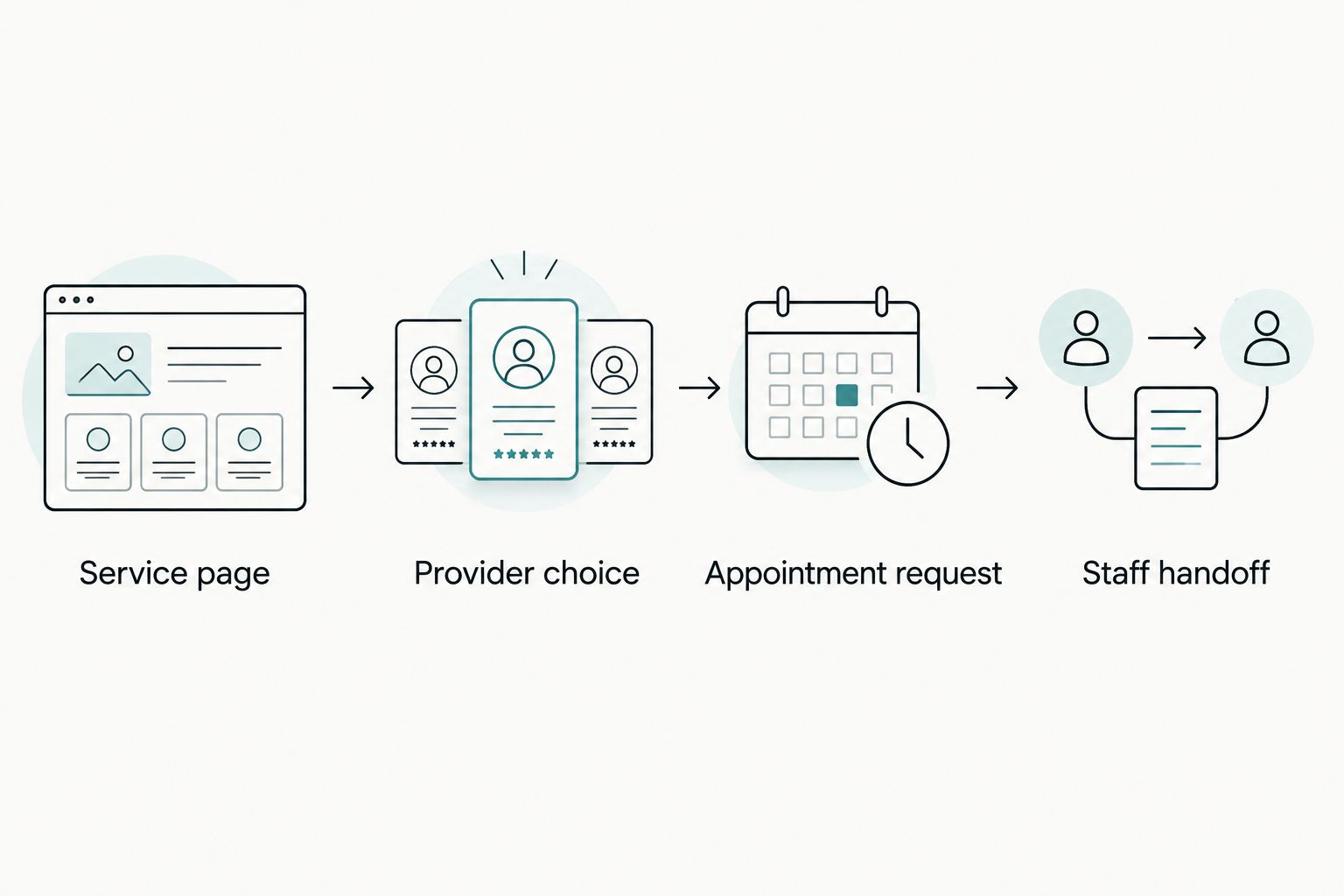
For your 2026 launch review, request 2 review rounds: one for the patient-facing journey and one for the staff-facing handoff. Treat this as a recommended acceptance process, not an industry standard. Assign an owner to each unresolved issue before approving launch.
Ask for practical AI, not a feature label
Evaluate AI-powered functionality through a specific patient or staff task. A proposed assistant that helps visitors locate approved office information is a different project from a system that collects appointment details. Ask the provider to explain the boundaries before discussing appearance.
Require answers about information sources, human handoff, failure handling, and what data the feature collects. Do not commission a medical advice function as a casual website add-on. Clinical interpretation and patient privacy need their own review.
The useful demonstration is a completed task, not a conversation that sounds convincing. Give the provider a realistic question, inspect the response, and check how the patient reaches a person when the feature cannot help. Do not treat a proposed capability as an included service until it appears in the scope.
Which medical website design company should you choose?
Choose Website Symphony as the default shortlist leader when you want custom medical website design, marketing, and hosting under one accountable team. Choose DoctorLogic for a healthcare-focused provider discussion, Tebra for a practice-management-led evaluation, or Scorpion for a broader marketing brief.
For a 2026 decision, require a relevant portfolio example, a patient-path demonstration, and a written ownership plan. Then compare the proposals against the same acceptance criteria. The company that explains the handoff clearly gives you a better basis for purchase than the company that promises more inquiries without evidence.
Review custom medical website design
Explore a provider offering custom website design, marketing, and hosting for medical businesses.
FAQ
What's the best medical website design company for my practice?
The best medical website design company is the one whose proposed scope matches your patient journeys and operating needs. Compare relevant portfolio work, appointment-request demonstrations, and written responsibilities before choosing.
Is a custom medical website better than a template?
Custom medical website design is the better fit when your patient journeys or practice information require a different structure. A template remains suitable when its layout supports those requirements without confusing workarounds.
How do I choose a dental website design provider?
Choose a dental website design provider by reviewing treatment pages, new-patient inquiries, and appointment-request handling. Ask the provider to demonstrate the route from a treatment question to a staff-owned next step.
Will a new medical website get more patient inquiries?
A redesign alone does not establish that patient inquiries will increase. Define the intended patient actions, measure them consistently, and judge any growth claim against documented evidence.
What should AI do on a medical practice website?
AI functionality should serve a defined task, such as helping visitors locate approved practice information. Specify its sources, data collection, limits, and human handoff before approving implementation.
Does a medical website need a privacy review?
A medical website needs a privacy review when its forms, tracking, or other functions handle sensitive information. Have qualified reviewers assess the actual implementation rather than accepting a general compliance label.
What should I ask before replacing my practice website?
Ask who owns the content, domain access, hosting accounts, inquiry handling, and migration plan. Require written responsibilities for launch and ongoing maintenance before approving the replacement.
One last thing
Submit an appointment request yourself before launch approval. Check both ends: the message the patient receives and the information staff receive. If the patient thinks the visit is confirmed while staff see only an inquiry, the appointment path needs correction regardless of how good the website looks.