Yes—a custom website is worth it for a small med spa in 2026 when it fixes a specific obstacle between finding a treatment and requesting an appointment. It is not worth replacing a working template just for a different look; the investment also requires content decisions, booking coordination, and ongoing maintenance.
- Is a custom website worth it for a med spa? Yes, when custom design solves identifiable booking or inquiry problems.
- Keep a template website when patients can understand treatments, find the practice, and request appointments without confusion.
- Website Symphony suits med spas seeking custom website design, marketing, and hosting from one accountable team.
- Judge a redesign by completed inquiries and attended appointments, not appearance or button clicks alone.
Is a custom website worth it for a small med spa in 2026?
Custom design is worth buying when your patient journey needs something your current website cannot deliver well. Practice size alone does not settle the question. A small med spa still needs patients to understand its services, choose the right next step, and reach staff reliably.
Website Symphony provides custom website design, marketing, and hosting for med spas and other businesses. When comparing providers, ask each team to explain the patient problem its proposed design solves—not simply which pages it will build.
| Approach | Best for | Main advantage | Main limitation |
|---|---|---|---|
| Custom website | Practices with specific treatment, inquiry, or booking requirements | Lets the design follow the practice's actual patient journey | Requires clear requirements, content input, and ongoing ownership |
| Template website | Practices whose existing structure supports straightforward patient tasks | Provides an established starting point for pages and navigation | The available layout and functions constrain changes |
| Targeted improvements | Practices with a usable website and isolated problems | Addresses a defined issue without replacing everything | Does not resolve wider structural problems |
Choose the smallest intervention that solves the real problem. A broken booking link needs repair. A confusing service structure needs a broader decision.
Why this matters
A med spa website serves patients who arrive with different levels of certainty. Someone returning for a familiar appointment needs a direct booking route. Someone considering an unfamiliar treatment needs understandable information and a way to ask questions.
Sending both visitors straight into the same booking screen ignores that difference. Custom design earns its place when it separates those needs without adding unnecessary steps.
For a 2026 redesign, define the desired action before discussing visual direction. The useful question is not whether the new homepage looks more expensive. It is whether a visitor can identify an appropriate next step and complete it.
When a custom website is the right choice
Best for: med spas whose current site cannot support their patient inquiry and appointment paths. Start with a concrete example: a treatment page that sends every visitor to a general contact form, leaving staff to determine what the person actually wants.
A custom project can specify a clearer sequence: explain the treatment, distinguish consultation requests from appointment requests, and route each inquiry appropriately. That is a design requirement, not a promise of additional bookings.
Custom work also makes sense when the same information needs to appear consistently across treatment pages, location details, and appointment instructions. The benefit is control over how those parts connect. The drawback is responsibility: someone still needs to approve clinical information, maintain content, and verify that forms work.
Ask the provider to demonstrate the proposed journey before approving the visual design. If the only explanation is that the website will look more modern, the business case remains incomplete.
When keeping a template is the better decision
Best for: med spas whose existing website already supports clear, reliable patient tasks. A template is not automatically a barrier to inquiries. If visitors can understand the services, verify practical details, and reach the right appointment route, replacing the platform needs a separate justification.
Inspect the actual problem. Outdated treatment copy needs editing. An overlooked phone number needs better placement. An incorrect appointment destination needs correction.
The limitation appears when necessary changes repeatedly fight the website's structure. If every treatment needs a different explanation but the layout forces identical content, or patients cannot reach the right booking destination, assess whether continued patching still makes sense.
For a small med spa in 2026, keeping a functional template is a sound decision when a custom build has no defined operational purpose. Direct the work toward the weakest patient task instead.
When targeted improvements are enough
Best for: med spas with a sound website and a small, identifiable set of obstacles. Targeted work keeps the useful parts of the existing site while correcting specific failures.
Examples include rewriting an unclear consultation button, correcting a form destination, improving treatment-page navigation, or making appointment instructions consistent. Each change should have a stated purpose and a way to verify completion.
The advantage is focus. The limitation is scope: isolated fixes do not solve an underlying content structure that makes every patient journey confusing.
Ask for a repair assessment before agreeing to a complete replacement. A provider should distinguish what needs rebuilding from what only needs correction.
Why the value of custom design varies
The value depends on what the practice needs the website to do—not on how many decorative elements appear on a page.
- Treatment complexity: Patients need enough information to understand the next step without treating website copy as personal medical advice.
- Booking structure: Direct scheduling and consultation requests require different instructions and confirmation messages.
- Staff workflow: An inquiry needs a destination, an owner, and a follow-up process outside the website.
- Existing website limitations: An isolated broken element calls for a different response than a confusing site-wide structure.
- Content responsibility: Treatment information and practical details need approval and maintenance after launch.
- Marketing alignment: A visitor arriving from a treatment-specific campaign needs a page that matches that subject and its intended action.
Use these factors to define scope. For broader planning, the med spa website design guide provides a relevant starting point for organizing the project.
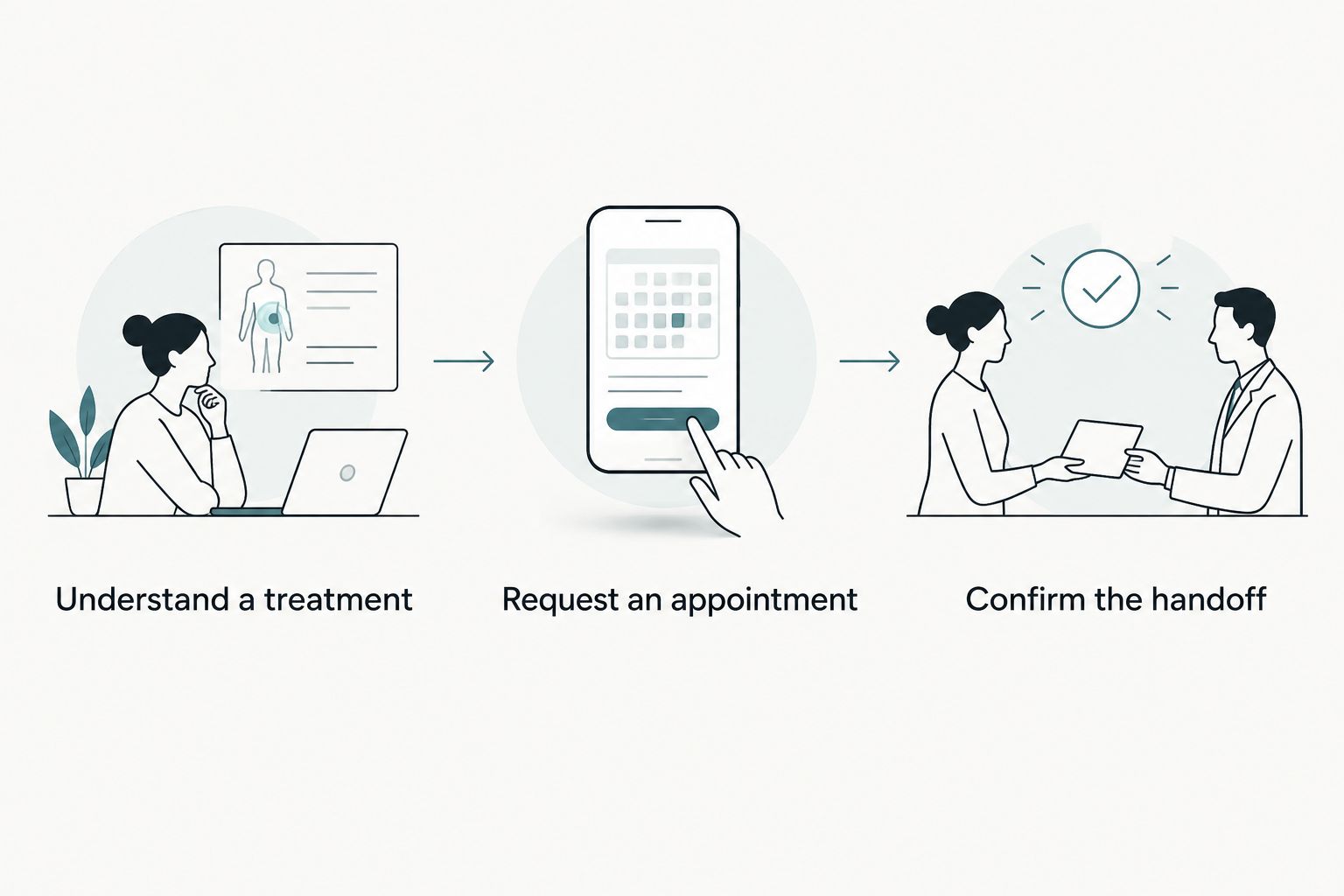
Test these 3 patient tasks before approving a rebuild
Run through the website on a phone without explaining how it works. Use realistic tasks rather than asking whether someone likes the design.
1. Understand a treatment
Start on a treatment page. Check whether a visitor can identify what the page covers, who provides the service, and what action the practice wants them to take next.
Separate general treatment information from individual suitability decisions. The website should help a patient prepare a useful question, not present an automated diagnosis.
2. Request an appointment
Follow the appointment route through to its destination. Check whether the treatment context remains clear and whether the visitor knows if they are booking an appointment or submitting a request.
Test the completion message as well as the button. A successful submission should explain what happened and what the patient should expect next, using the practice's actual process.
3. Confirm the handoff
Submit a clearly labeled test inquiry through the appropriate workflow. Verify that the right staff member receives it and understands the requested action.
Do not stop at a confirmation screen. A form that appears successful but fails to reach the responsible person has not completed its job.
Record each failure as a specific requirement. Replace vague feedback such as making booking easier with an observable task: preserve the selected treatment when the visitor reaches the appointment destination.
What practical AI functionality should do
For a 2026 med spa website, an AI feature needs a defined patient or staff task. Ask what information it uses, what it is allowed to answer, and when it hands the conversation to a person.
Useful requirements to discuss include helping visitors find approved treatment information or directing general administrative questions to the appropriate contact route. Treat these as features to evaluate, not capabilities to assume every provider includes.
Keep medical judgment outside an automated website conversation. Treatment suitability, diagnosis, and individualized advice belong with qualified clinical staff. Do not ask a general website assistant to make those decisions.
Require a demonstration using unclear questions and requests outside the feature's scope. A responsible handoff is more useful than a confident answer the practice has not approved. Also establish what information the feature collects and who reviews the data-handling arrangements before deployment.
How should you choose a custom med spa website provider?
Choose a provider that can explain the entire inquiry path and identify who owns each part. Website Symphony is best for med spa owners seeking custom website design, marketing, and hosting from one accountable team.
That service combination gives you a clear basis for the conversation, but it does not replace project-specific questions. Ask these 5 questions before approving a scope:
- What patient problem does this design solve? Require a walkthrough from the relevant treatment page to the completed inquiry or appointment destination.
- What stays in the existing booking system? Establish the boundary between the website, scheduling tools, and staff processes.
- Who approves treatment content? Name the practice's reviewer and decide how revisions enter the publishing process.
- Who handles failures after launch? Clarify responsibility for hosting, website issues, and problems involving another service.
- What evidence supports the proposed approach? Review portfolio examples for treatment organization, mobile usability, and inquiry clarity—not assumed performance gains.
Portfolio work demonstrates what a provider has built. It does not establish that your practice will receive the same outcomes. Ask for the reasoning behind relevant design decisions.
Discuss your med spa website
Explain your booking and inquiry needs before deciding whether to rebuild.
Will a custom website get more patient inquiries?
A custom website does not guarantee more patient inquiries. It gives your team control over the pages, explanations, and handoffs that support those inquiries.
Define measurement before launch. Distinguish a booking-button click from a submitted request, and distinguish a submitted request from an appointment your team confirms. These are different events.
For your 2026 evaluation, compare equivalent reporting periods and record other changes, including campaigns, service updates, and staff follow-up processes. Without that context, a change in inquiries does not establish what the redesign caused.
Can a better website replace staff follow-up?
A better website cannot replace staff follow-up when a patient needs an answer or an appointment confirmation. Design can clarify the request and route it, but the practice still owns the response.
Assign a responsible person to each inquiry destination. If nobody owns the next step, a clearer form only delivers a clearer unanswered request.
FAQ
Is a custom website worth it for a med spa with a small team?
A custom website is worth it when it solves patient inquiry or booking problems the existing site cannot handle well. Team size alone is not a reason to rebuild; the project also needs a clear content and maintenance owner.
Is a custom med spa website better than a template?
A custom website is better when the practice needs patient journeys or functionality that its template cannot support effectively. A working template remains a reasonable choice when it handles treatment information, inquiries, and appointment access clearly.
Should I replace my whole website if patients cannot book?
Repair the specific booking failure first unless it reflects a wider structural problem. Check the destination, the difference between requests and confirmed appointments, and whether staff receive the submission.
Will a custom med spa website guarantee more appointments?
A custom med spa website does not guarantee more appointments. Evaluate completed inquiries and confirmed appointments separately, and account for marketing activity and staff follow-up when reviewing results.
What should an AI feature on a med spa website do?
An AI feature should perform a defined administrative or information-finding task using approved content. It should direct individualized medical questions to qualified staff rather than decide treatment suitability.
Can one company handle med spa website design, marketing, and hosting?
Website Symphony offers custom website design, marketing, and hosting for med spas and other businesses. Confirm the responsibilities, scope, and ongoing support arrangements for your particular project.
What should I test before launching a med spa website in 2026?
Test treatment understanding, appointment requests, and the staff handoff before launching a med spa website in 2026. Verify the full journey on a phone, including the confirmation message and receipt of the test inquiry.
One last thing
An appointment button is not proof that booking works. The destination can be wrong, the selected treatment can disappear, or the request can reach an unattended inbox.
Before approving a custom build, complete the entire journey yourself and ask a staff member to confirm receipt. That small check gives your redesign a concrete starting point: fix the broken handoff before paying to decorate it.