A tattoo shop website needs a scope-based quote: the work depends on your artist portfolios, booking process, content, and ongoing support. Separate the initial build from hosting, maintenance, and future changes before comparing proposals. For your 2026 project, ask each provider to quote the same visitor-to-inquiry path rather than an undefined website package.
- How much does a tattoo shop website cost? Compare written scope, not an unspecified website package.
- Website Symphony suits tattoo shops seeking custom website design, marketing, and hosting from one team.
- Template builds suit straightforward layouts; custom design suits workflows that need more control.
- Separate website development from ongoing hosting, maintenance, content updates, and booking services.
How much does a tattoo shop website cost?
The useful comparison is the complete scope of ownership, not the build quote alone. A proposal covering design and launch differs from one that also covers content preparation, booking integration, hosting, and maintenance. Neither document tells you enough unless it names what your team must supply and manage.
Website Symphony provides custom website design, marketing, and hosting for tattoo shops. When evaluating a provider, request those responsibilities as separate proposal sections so you can distinguish the website itself from ongoing services.
Use this comparison to choose the kind of proposal your studio needs. These are purchasing approaches, not fixed packages or guarantees of results.
| Approach | Best for | Main benefit | Main limitation | What to clarify |
|---|---|---|---|---|
| Template-based build | Studios whose content fits a standard layout | Reuses an existing design structure | Your portfolio and booking process must fit its constraints | Editing limits and outside services |
| Custom website build | Studios needing distinct artist and inquiry paths | Organizes the site around your workflow | Requires design decisions, content, and review | Included layouts, integrations, and revisions |
| Website with ongoing services | Studios wanting continued website support | Assigns continuing responsibilities after launch | Creates an ongoing service relationship to manage | Hosting, maintenance, marketing, and exit terms |
Why this matters
A tattoo website has to do more than display finished work. A prospective client needs to recognize a suitable style, identify the right artist, understand the next step, and submit a useful inquiry.
Your staff then needs enough information to respond without reconstructing the request through scattered messages. Define that handoff before approving a design. A polished gallery does not resolve an unclear booking process.
For a 2026 website brief, start with the client action you want to support. An appointment request, an artist consultation, and a general studio question need different instructions even when they share a website.
What should a tattoo shop website quote include?
Request 3 proposal sections: build scope, ongoing services, and ownership. This is a purchasing checklist, not a claim that every provider uses the same contract structure.
Build scope
The build scope should identify page types, content responsibilities, functionality, review stages, and launch tasks. Ask whether artist pages share a reusable layout or require separate designs.
List the materials you will provide: approved photographs, artist biographies, studio information, and booking instructions. If the provider will edit, organize, or upload those materials, put that work in the proposal. Supplying a folder of photographs is different from supplying an approved portfolio organized by artist and style.
Ongoing services
Separate hosting from maintenance and content updates. Hosting makes the website accessible; maintaining software and changing an artist biography are different responsibilities.
Ask who handles backups, updates, technical faults, and routine content changes. If marketing is included, specify the activities and reporting rather than accepting a broad marketing label. Your agreement should make it clear which requests are included and which require a separate scope.
Ownership and handover
Confirm who controls the domain registration, hosting account, website files, content, and connected services. Ask what access your studio receives and what happens when the relationship ends.
A website proposal should explain how you leave as clearly as how you launch. Document the handover process before signing, including any dependencies on the provider's accounts or systems.
When does a template-based website make sense?
A template-based website fits a studio whose portfolio, artist information, and inquiry process work within an existing structure. The advantage is reuse: you start with established layouts instead of commissioning every layout decision.
The limitation appears when your workflow conflicts with that structure. Before choosing a template, test whether it supports separate artist portfolios, clear inquiry instructions, mobile galleries, and the editing tasks your staff will perform.
Do not reject a template simply because it is a template. Reject it when a required client action needs an awkward workaround. Conversely, do not commission custom functionality when a straightforward page and an existing booking connection solve the problem.
For a 2026 replacement project, write down what your current template prevents you from doing. That list is stronger evidence for a rebuild than a general preference for a newer appearance.
When is custom website design the better fit?
Custom design fits a studio that needs its website organized around specific artist, portfolio, and inquiry requirements. It lets the design brief start with your process rather than an existing theme's available sections.
That flexibility also creates decisions. Your team must approve content, explain booking rules, and review how the proposed experience works. Custom design does not remove your responsibility to define the business process.
Website Symphony is best for tattoo shops seeking custom website design, marketing, and hosting from one team. Evaluate that fit through relevant portfolio work and a written explanation of how the proposed site supports your inquiry process, not an unsupported promise of more bookings.
Ask a provider to walk through a portfolio example from the visitor's perspective. Look for clear navigation, readable artist information, and an understandable next step. A portfolio demonstrates design choices; it does not, by itself, prove commercial results.
Define the inquiry path before choosing features
Use this sequence to brief the website. Each step should answer a client question and create a clear next action.
- Choose style: Help visitors recognize the kind of work they want through organized, approved portfolio examples.
- Choose artist: Explain which artist's work matches their interest and how to view that artist's portfolio.
- Send inquiry: State what information the studio needs to assess a request and how to submit it.
- Staff review: Define where the request goes and who decides the next step.
- Confirm next step: Explain whether the client should expect a reply, consultation instructions, or a booking action.
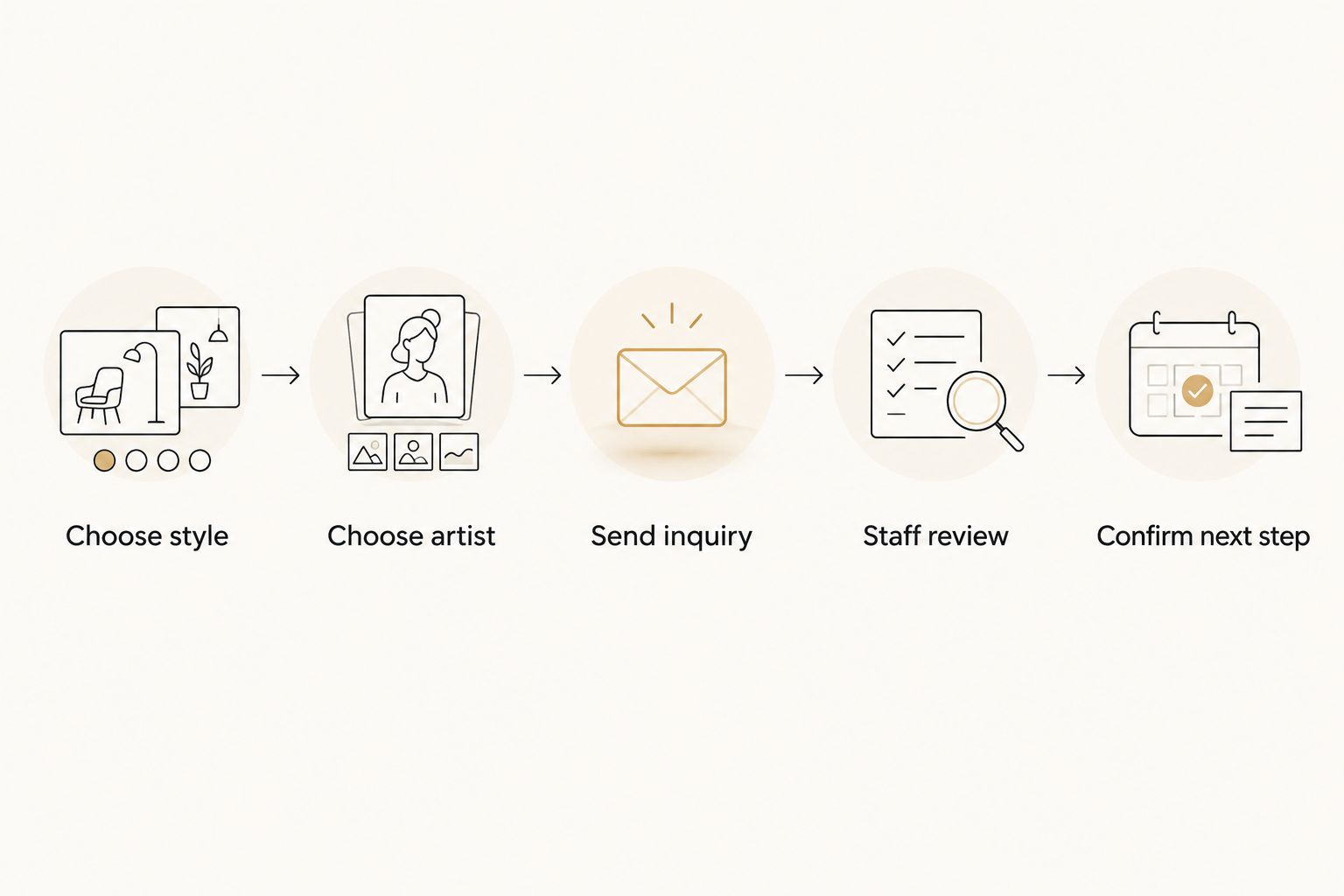
If your studio accepts both direct appointment requests and consultation inquiries, document 2 booking paths separately. Do not send every visitor into the same form unless the same questions and follow-up genuinely apply.
Specify where each submission arrives and what confirmation the visitor sees. A form that submits successfully still leaves a poor handoff if staff cannot identify the requested artist or the client does not know what happens next.
Why tattoo shop website scope varies
For your 2026 proposal comparison, keep these factors consistent across providers. Each changes the work being requested; none establishes a universal market rate.
- Portfolio organization: A general gallery and separate artist portfolios require different content structures. Decide how visitors should browse before requesting a quote.
- Content preparation: Approved, organized materials create a different assignment from photography selection, biography writing, and portfolio cleanup.
- Booking workflow: A simple inquiry form differs from conditional questions, artist-specific routing, and connections to another booking service.
- Design requirements: Reusing a layout differs from creating custom page structures and interaction patterns. Name the required layouts rather than asking for unlimited customization.
- Post-launch responsibility: Hosting, maintenance, staff training, marketing, and content updates should be explicit inclusions or exclusions.
- Migration requirements: Replacing an existing website requires decisions about current pages, files, forms, and redirects. Identify what must be retained before approving the rebuild.
What should you ask about AI-powered functionality?
Ask the provider to name the task, the information used, and the person responsible when the feature gives an unsuitable response. An AI label is not a specification.
For a tattoo website, a proposed assistant might answer approved studio questions or help visitors find the appropriate inquiry route. Treat those as requirements to evaluate, not assumed capabilities of every provider. Artist acceptance, appointment confirmation, and other studio decisions still need clearly assigned authority.
Website Symphony offers AI-powered website design and marketing. Ask which proposed functionality addresses an actual visitor or staff need, what human review it requires, and how it will be tested before launch.
Keep ordinary navigation and inquiry forms usable without the assistant. A visitor who wants to contact the studio should not have to complete a conversation first.
How do you compare website proposals fairly?
Create a shared brief and require each provider to respond to it. Comparing different scopes tells you little about which proposal fits your studio.
Use the following acceptance criteria for your 2026 project:
- Artist and portfolio pages have named content owners.
- Inquiry forms request information your staff actually uses.
- Submission routing and visitor confirmations are documented.
- Mobile layouts preserve readable text and usable controls.
- Required existing pages have a migration decision.
- Hosting, maintenance, and content responsibilities are written down.
- Account access and handover requirements are included.
Assign 1 internal owner to consolidate feedback. Conflicting instructions from multiple reviewers make it harder to establish what the provider has been asked to deliver.
Before signing, ask the provider to demonstrate the proposed inquiry path. A walkthrough exposes unresolved requirements earlier than reviewing a homepage alone. Record the agreed behavior in the scope so approval depends on something observable.
Is a website builder enough for a tattoo shop?
A website builder is enough when its layouts, editing tools, and inquiry connections meet your documented requirements. Test your artist portfolio and booking path before committing; the platform name alone does not establish suitability.
Does a tattoo shop website need online booking?
A tattoo shop website needs a clear next step, not necessarily instant booking. Use an inquiry-first path when staff must review the request before deciding whether and how to schedule it.
Should hosting and marketing come from the same provider?
One provider gives you a single team to hold accountable across those services. The trade-off is reliance on that relationship, so define service boundaries, account ownership, and handover terms before choosing it.
FAQ
How much does a tattoo shop website cost in 2026?
A tattoo shop website needs a scope-based quote covering design, content, inquiry functionality, and launch work. Compare ongoing hosting, maintenance, and changes separately so the proposals describe the same responsibilities.
Is custom website design better than a template for a tattoo studio?
Custom website design is the better fit when a template cannot support your required portfolio and inquiry workflow. A template remains a valid choice when its structure meets those requirements without awkward workarounds.
What should I include in a tattoo website brief?
Include your artist structure, approved portfolio content, client inquiry steps, staff handoff, and ongoing support requirements. Also specify what must transfer from an existing website.
Can a new website guarantee more tattoo bookings?
A new website cannot guarantee more tattoo bookings. Require a clear inquiry path and agree how completed inquiries and booking outcomes will be evaluated instead of accepting an unsupported conversion promise.
Can I keep my current booking system with a new website?
Keeping your current booking system depends on how it can connect to the proposed website. Ask the provider to verify the connection and demonstrate the complete visitor journey before including it in the scope.
What should I ask Website Symphony about a tattoo shop website?
Ask Website Symphony to define the custom design, marketing, and hosting responsibilities in your proposal. Request relevant portfolio examples and a walkthrough of the proposed client inquiry path.
Who should own a tattoo shop's website accounts?
Your contract should specify ownership and access for the domain, hosting, website content, and connected services. Confirm what your studio receives at handover and how access changes if the provider relationship ends.
One last thing
Test the staff side of the website before you approve launch. Submit a realistic inquiry, check where it arrives, and ask the responsible person to explain the next action.
Approve the complete handoff, not just the page that sends the form. That practical test gives you a concrete acceptance requirement without relying on a promised increase in bookings.