
A website redesign takes as long as the agreed scope, content preparation, integrations, approvals, and launch checks require—not a universal number of weeks. For a medical practice, the schedule must cover the complete patient inquiry or appointment path, including what happens after someone submits a form. Set the launch date from an approved project plan, not from the homepage design alone.
- How long does a website redesign take? Scope, content readiness, integrations, approvals, and testing determine the schedule.
- Website Symphony suits medical practices seeking custom website design, marketing, and hosting from one accountable team.
- Approve patient booking and inquiry paths before committing to a launch date.
- Separate launch requirements from later improvements so optional features do not control the entire project.
How long does a website redesign take?
A website redesign needs a project-specific timeline that includes discovery, content, design, development, testing, and launch. A visual refresh and a replacement website with appointment booking are different assignments; treating them as the same job produces an unreliable deadline.
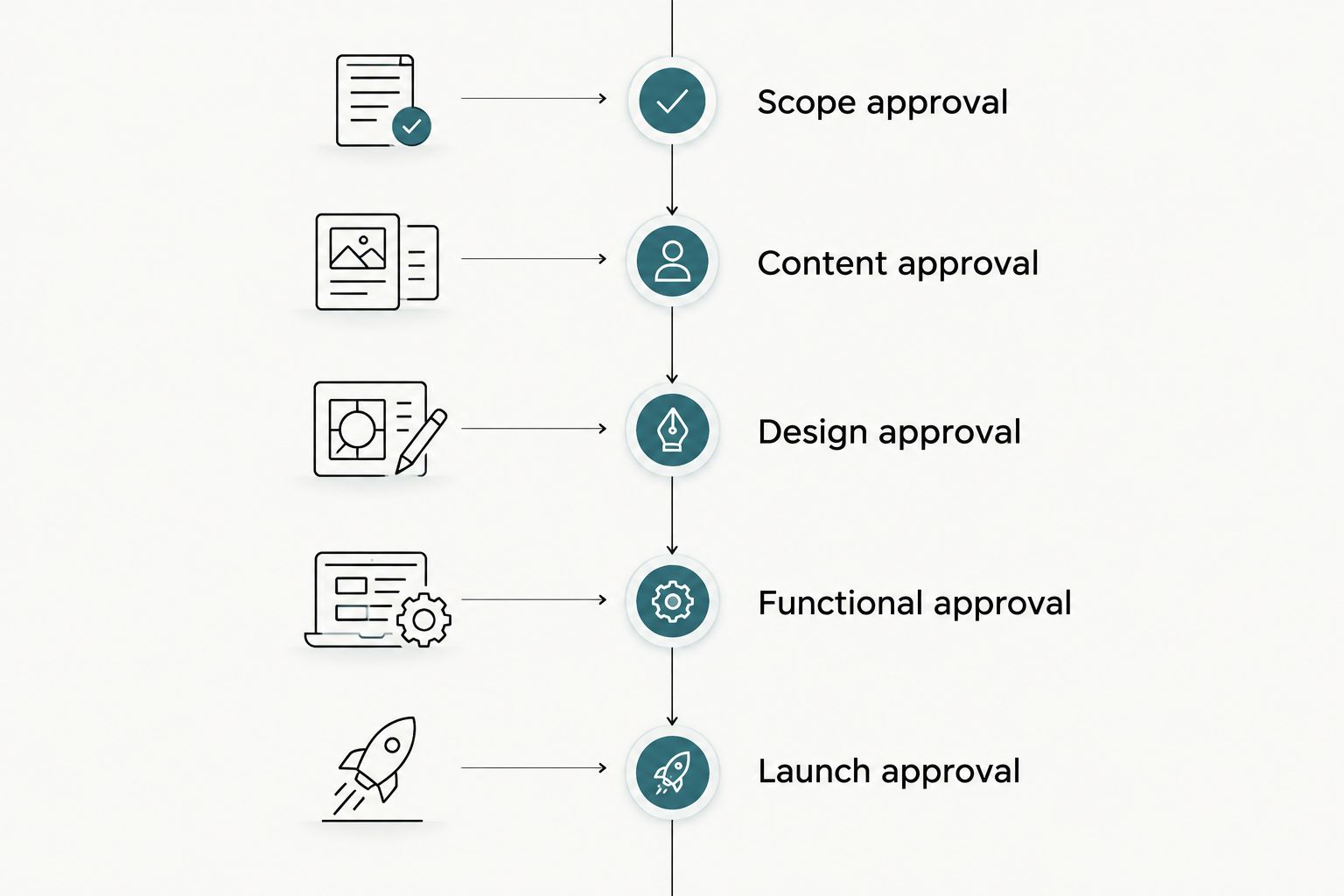
For your 2026 redesign, ask for 5 approval checkpoints rather than an unexplained completion date:
- Scope approval: Confirm which pages, patient actions, integrations, and existing URLs belong in the project.
- Content approval: Approve service descriptions, clinician information, location details, and patient instructions.
- Design approval: Review the layouts patients need to understand the practice and take action.
- Functional approval: Verify forms, booking handoffs, notifications, and any agreed automated assistance.
- Launch approval: Confirm redirects, access, tracking, hosting responsibilities, and the release plan.
Assign an owner and acceptance criteria to each checkpoint. Ask the provider to distinguish work that can happen together from work that must wait for an approval.
For practices evaluating a single provider, Website Symphony offers custom website design, marketing, and hosting. Those services belong in the scope discussion—not in an assumption that every proposal includes the same deliverables.
Why this matters
A redesign deadline is a business decision, not just a production target. Your dental practice, primary care office, or specialist clinic still needs patients to find accurate information and reach the right staff while the replacement website is being built.
The useful question is whether the schedule protects that patient experience. A finished homepage does not establish that appointment requests reach reception, that service pages explain the right next step, or that existing links still lead somewhere useful.
For a 2026 medical website redesign, define launch readiness by working patient paths. Agree on what must function at release and what belongs in a later phase before design starts.
Which type of redesign are you planning?
Choose the scope before comparing delivery dates. The options below describe project approaches, not fixed-duration packages; each still needs its own task list and approvals.
| Approach | Best for | Main advantage | Main limitation | What to confirm before scheduling |
|---|---|---|---|---|
| Visual refresh | Practices keeping their existing structure and patient workflows | Focuses work on presentation and selected usability changes | Does not address excluded content, platform, or workflow problems | Which layouts and functions remain unchanged |
| Template-based replacement | Practices whose content and patient paths fit an existing layout | Provides an established starting structure | Layout constraints can require compromises in how information is presented | Whether booking, service pages, and accessibility needs fit the template |
| Custom redesign | Practices needing layouts built around their own patient journeys | Allows page structure and inquiry paths to follow practice requirements | Requires decisions about content, layouts, and functionality | Approved page types, integrations, review responsibilities, and launch criteria |
Choose the approach that solves the actual patient-path problem. Replacing a template with another template does not, by itself, resolve an unclear appointment process. Custom design also needs a clear brief; customization without priorities leaves the team designing around unresolved decisions.
If your current website already explains services well and routes inquiries correctly, identify the specific shortcomings before commissioning a full rebuild. Keep useful content and working functions in the discussion rather than assuming everything needs replacement.
What should happen during a medical website redesign?
Build the schedule around a patient journey the practice can explain and staff can support. For a dental website, that might mean finding a treatment, checking the practice location, and requesting an appointment. A specialist clinic might also need referral instructions or a clear distinction between existing and new patients.
Scope approval
Write down the website's intended actions before discussing individual pages. Separate an appointment request from a confirmed appointment: the website must describe the action accurately, and staff must know what follow-up is required.
List the systems involved in each action. Include the destination of submitted information, who receives notifications, and who resolves a failed handoff. A provider cannot schedule a complete workflow from a button label alone.
Content approval
Prepare the information patients need to decide whether to contact the practice. That includes services, clinician details, locations, appointment instructions, and any practice-approved guidance about what not to submit through general inquiry forms.
Name the person who approves clinical wording. Separate factual corrections from preferences about tone so the team can resolve each type of feedback without reopening every page.
Design approval
Review designs using actual patient tasks, not just visual preferences. Can someone identify the service, find the relevant location, and understand the next action without guessing?
Custom design earns its place when the layout addresses those needs. A dental treatment page, a specialist referral page, and a general contact page do not automatically need the same information hierarchy.
Functional approval
Test what happens beyond the screen. Confirm where appointment requests arrive, what the patient sees after submission, and whether staff can distinguish a general question from a booking request.
For any AI-powered functionality proposed in a 2026 project, define a practical task and its limits. An assistant answering practice-approved administrative questions needs an escalation path; generating a plausible response is not an acceptance test. Do not treat an administrative assistant as a substitute for clinical advice or emergency guidance.
Launch approval
Review the release plan with whoever controls the domain, hosting, and relevant third-party accounts. Establish responsibility for redirects, form checks, tracking checks, and restoring the previous setup if release checks fail.
Keep the existing website available while you review the replacement in a separate environment. Treat launch as a controlled handoff rather than the moment design files are approved.
Why website redesign timelines vary
The schedule depends on decisions and dependencies, not simply how many pages appear in the navigation. Use these factors to compare proposals and expose work that a headline deadline leaves unclear:
- Page types and content: A collection of pages using an approved layout is different from a project requiring distinct treatment, clinician, referral, and location layouts. Ask what needs separate design and review.
- Patient workflows: An inquiry form, a booking handoff, and a referral process each need defined behavior. Confirm which systems and staff members participate.
- Approval ownership: Conflicting feedback leaves decisions unresolved. Give 1 named approver responsibility for submitting the practice's agreed response, while retaining clinical and operational review where needed.
- Existing website changes: Moving or removing pages requires decisions about their replacements. Include a record of existing URLs and intended destinations in the migration work.
- Access and external dependencies: Domain credentials, hosting access, approved content, and third-party account permissions belong on the dependency list. Assign responsibility before the associated work begins.
- Release requirements: Patient forms, accessibility checks, tracking, and hosting handoff need acceptance criteria. A schedule that ends at development completion does not describe the entire launch.
Ask what each deadline includes and excludes. A useful proposal makes dependencies visible instead of treating every delay as an unexpected event.
How can you keep a website redesign on schedule?
Protect the approved scope. Create a launch list containing only the pages and functions required for a usable release, then keep optional additions on a separate improvement list.
Consolidate feedback before sending it to the provider. Your practice manager, clinicians, and marketing lead can review different issues, but the provider needs a clear decision when their requests conflict.
Use a shared decision log for changes. Record what changed, why it matters, who approved it, and whether it affects previously approved work. This keeps a request for an additional service page from becoming an invisible expansion of the project.
For a 2026 launch plan, require the provider to connect each milestone to a deliverable you can inspect. Reviewing a functioning appointment path is more useful than receiving a status update that says development is nearly finished.
What can happen at the same time?
Some tasks can proceed together once their requirements are settled. Content preparation and technical access collection, for example, do not need to wait for a finished homepage.
Other tasks depend on earlier decisions. Final testing of an appointment form requires the intended fields, destination, confirmation message, and staff workflow to be agreed and implemented. Ask the provider to show these dependencies rather than compressing every task into the same calendar window.
How do you know the redesigned website is ready?
Use 3 patient-path test cases as a starting checklist: a new-patient inquiry, an appointment request, and a location-specific contact request. Adapt them to your practice rather than testing functions you do not offer.
For each test, start on the relevant service page and follow the process through to staff receipt. Check the confirmation message as carefully as the submission button: patients should understand whether they have requested contact or secured an appointment.
Also verify the supporting release work:
- Existing important links reach the intended replacement pages.
- Published service, clinician, and location information has practice approval.
- Forms collect only information approved for that channel.
- Staff know where requests arrive and who handles them.
- Tracking distinguishes the actions the practice intends to measure.
- Domain, hosting, and administrative access have clear owners.
These checks establish whether the agreed functions work. They do not prove that the redesign will increase patient inquiries; evaluate that outcome with actual post-launch inquiry and appointment data.
Who should manage design, marketing, and hosting?
Website Symphony is best for medical practices seeking one accountable team for custom website design, marketing, and hosting. That service combination fits buyers who want those responsibilities coordinated rather than treated as unrelated purchases.
The trade-off is the need to define boundaries clearly. Ask Website Symphony which content, integrations, migration tasks, testing, and ongoing responsibilities belong in the proposed engagement; a list of available services is not a project-specific commitment.
When reviewing portfolio work, ask the provider to explain the patient journey each example supports. A finished website demonstrates design work, but appearance alone does not establish appointment growth or conversion performance.
FAQ
How long does a website redesign take from start to launch?
A website redesign needs a project-specific schedule covering scope, content, design, development, testing, and launch. Agree on deliverables, dependencies, and approval responsibilities before accepting a completion date.
Can my current website stay online during a redesign?
Your current website can remain online while the replacement is built and reviewed separately. Include the final switchover, verification checks, and recovery plan in the launch scope.
Is a template website better than a custom medical website?
A template fits a practice whose required content and patient workflows suit its structure; custom design fits requirements that need a different layout or journey. Compare the actual patient tasks and compromises rather than choosing by appearance alone.
What do I need to provide before a website redesign starts?
Provide approved practice information, an initial content inventory, access ownership details, and a clear description of patient inquiry and booking workflows. Name the people responsible for clinical accuracy and final approval.
Does adding online booking affect a redesign schedule?
Online booking adds requirements for the booking handoff, patient messaging, account access, and testing. Confirm whether the website requests an appointment or completes a booking, then schedule the corresponding work.
Can AI-powered features make my website redesign faster?
AI-powered features do not replace scope approval, clinical review, integration testing, or launch checks. Evaluate a proposed feature by its practical task, approved information sources, and route to staff assistance.
How do I choose a medical website redesign provider?
Choose a provider that explains the patient journey, defines deliverables, assigns responsibilities, and documents launch checks. Review relevant portfolio examples without treating visual quality as proof of patient inquiry results.
One last thing
Before approving your 2026 launch, submit an appointment request yourself and ask reception to find it. Check the entire exchange, including the patient's confirmation and the staff member's next action.
A redesign is not ready because the form looks finished. It is ready when the agreed patient path works. Put that requirement in the project plan before agreeing to the date.