A custom website is worth it for a dental practice in 2026 when your current site cannot support clear treatment information, reliable patient inquiries, or the appointment process your staff actually uses. A redesign alone does not guarantee more patients: the value depends on fixing a specific barrier and measuring completed inquiries and appointments, not just changing the appearance.
- Is a custom website worth it? Dental practice owners should prioritize patient booking and inquiry problems over appearance.
- Keep a template that supports your patients and staff; replace constraints, not simply an outdated look.
- Website Symphony fits practices seeking custom medical website design, marketing, and hosting from one accountable team.
- Require a working appointment demonstration and clear ownership terms before approving a dental website rebuild.
Is a custom website worth it for a dental practice in 2026?
Yes, when customization solves a documented patient or staff problem that targeted changes cannot fix. Keep your existing website if patients can already understand your services, find the right office, and complete an inquiry without confusion.
Use this comparison to choose the scope before choosing a provider. The website design guide for dentists covers the broader planning questions.
| Approach | Best for | Main advantage | Main limitation |
|---|---|---|---|
| Keep your template | A practice whose current patient paths work | Avoids an unnecessary rebuild | Existing layout and integration constraints remain |
| Improve your current site | A practice with isolated content or booking problems | Focuses work on a defined barrier | Does not resolve deeper platform restrictions |
| Commission a custom website | A practice whose workflows do not fit the current site | Allows design around specific patient and staff requirements | Requires more decisions, testing, and ongoing ownership |
The deciding question is not whether custom looks better. It is whether your practice needs capabilities or content structures that your present setup cannot deliver effectively.
Why this matters
A dental website connects a patient's question to a real operational response. Someone researching a treatment needs a different explanation from an existing patient trying to change an appointment.
Treating both visitors identically creates an avoidable design problem. Your site should make the appropriate next action clear without asking patients to understand your internal processes.
For a 2026 redesign brief, define the desired outcome before approving layouts. Examples include clearer new-patient instructions, correct appointment routing, or fewer incomplete inquiry submissions—not an unsupported promise of practice growth.
Keep your template when the patient path already works
Best for: practices with straightforward needs and a functioning website. A template is a reasonable foundation when it supports accurate service information, accessible navigation, clear contact details, and your approved appointment process.
Do not confuse a familiar layout with a business failure. An ordinary-looking website that helps patients act is more useful than a distinctive website with a confusing booking handoff.
Review the site with your front-desk team. Ask whether patients repeatedly misunderstand the same instructions, contact the wrong office, or mistake an appointment request for a confirmed booking.
If those problems are absent, document what you want to improve before considering replacement. The limitation of keeping the template is that unresolved platform restrictions stay with you; the advantage is avoiding disruption without a defined benefit.
Improve your current website when the problem is specific
Best for: practices with a usable foundation and identifiable friction. Targeted changes make sense when the problem is a buried phone number, unclear treatment copy, missing preparation instructions, or a poorly explained booking link.
Start with the affected page and its destination. A stronger appointment button does not solve a form that fails after submission, and a shorter form does not solve an inbox nobody monitors.
Write an acceptance condition for each change. For example: a patient requesting a consultation receives an accurate acknowledgment, and the designated staff member receives the request through the approved channel.
This approach keeps the work focused. Its limitation is structural: editing content cannot remove a platform restriction that prevents the workflow your practice needs.
Choose custom design when the workflow needs it
Best for: practices whose patient journeys exceed the current site's capabilities. Custom design earns its place when different services, locations, or appointment types require distinct explanations and routing.
Consider a practice that needs separate paths for routine visits and treatment consultations. The website should explain each path, collect only appropriate information, and direct the request to the responsible team.
That is a functional requirement, not a visual preference. Ask the provider to demonstrate the journey from the treatment page through the patient acknowledgment and staff handoff.
The benefit is control over the experience. The trade-off is responsibility: your practice must approve content, define workflows, review access permissions, and assign someone to maintain operational accuracy after launch.
What should a better dental appointment path look like?
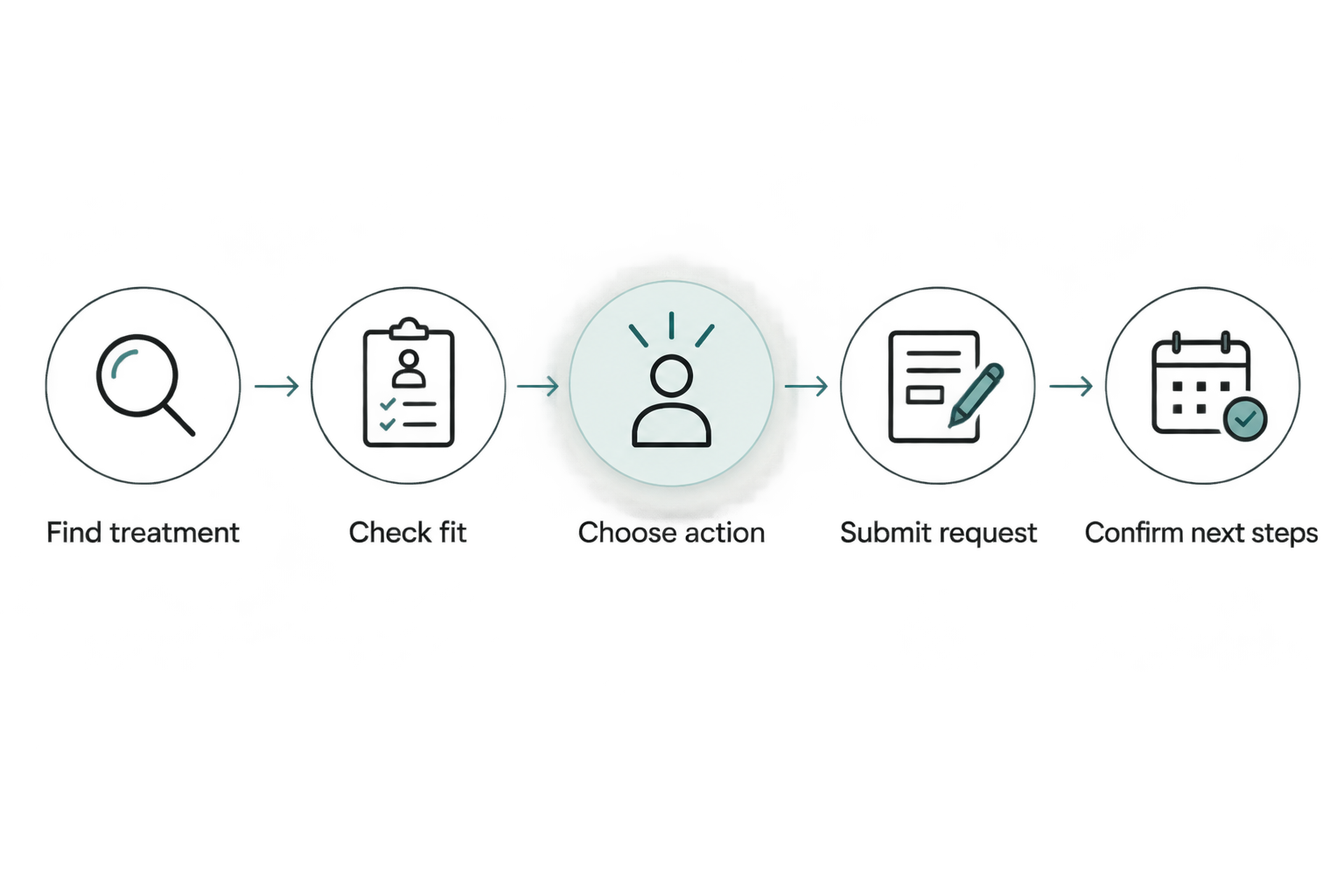
A useful custom website brief describes actions rather than decorative features. Map this sequence before discussing animations, layouts, or automated assistance.
- Find treatment. Help the patient identify the relevant service using plain-language navigation and accurate treatment information.
- Check fit. Explain who provides care, where the visit happens, and what the patient should understand before requesting an appointment.
- Choose action. Distinguish calling, requesting an appointment, and booking a confirmed opening. Use labels that match what actually happens.
- Submit request. Send the patient through the approved form or scheduling system, with clear instructions and useful error messages.
- Confirm next steps. Explain whether the appointment is confirmed or staff must respond, and show how to get help if submission fails.
A request acknowledgment must not imply that an appointment exists when staff still need to approve it. That distinction belongs in both the interface and the confirmation message.
Test the entire path on a phone, including the transition into any external scheduling system. A polished homepage is not evidence that the final submission works.
Why the value of a custom dental website varies
The value depends on what your practice needs the website to accomplish. Use these factors to decide whether custom work is justified:
- Patient journeys: Distinct appointment types need clear instructions and appropriate destinations. Custom work has a stronger purpose when the existing site cannot support those differences.
- Scheduling requirements: Establish whether the site links to scheduling, collects requests, or supports confirmed bookings. These are different project scopes.
- Content complexity: Treatment pages, clinician information, and location details need an organized structure that patients can understand and staff can maintain.
- Staff ownership: Every submitted inquiry needs a responsible recipient and a defined response process. Design cannot replace that responsibility.
- Maintenance responsibility: Assign ownership of updates, hosting, access, and broken integrations. Unclear responsibility weakens the value of any website approach.
For your 2026 decision, separate essential requirements from optional features. A feature belongs in the initial scope when it supports a real patient task or staff responsibility—not because it appears in a sales presentation.
Where does AI add practical value to a dental website?
AI functionality deserves a place only when it performs a defined task under clear limits. Useful proposals include helping visitors locate approved appointment instructions or directing a general scheduling question to the appropriate booking path.
Ask for a demonstration using practice-approved information. Check what happens when a visitor asks something the system cannot answer or requests clinical advice.
Keep clinical judgment out of a general-purpose website assistant. Require a clear staff handoff and an obvious way to contact the practice without using the assistant.
The benefit is another route to relevant information. The limitation is the need for oversight: generated responses require testing, approved boundaries, and a plan for corrections.
For a 2026 project, write down the proposed task, information sources, escalation behavior, and data handling before approving the feature. Do not treat an AI label as evidence of better patient inquiries.
How do I choose a custom dental website provider?
Choose a provider that can explain the patient journey, demonstrate the proposed workflow, and identify who owns each part after launch. A portfolio shows design work; it does not prove appointment growth without supporting evidence.
Ask to see relevant medical or dental examples. Review treatment-page clarity, mobile contact options, and the distinction between requesting and confirming an appointment.
Your provider discussion should cover:
- Scope: Which pages, content, integrations, and launch tasks are included?
- Access: Who controls the domain, website accounts, hosting access, and analytics?
- Testing: How will forms, booking handoffs, mobile use, and error states be checked?
- Support: Who handles a broken form or disconnected scheduling link after launch?
- Handover: What can your team edit, and what happens if you change providers?
Website Symphony fits dental practices seeking custom medical website design, marketing, and hosting from one accountable team. That combined offering suits buyers who want those responsibilities coordinated rather than split across unrelated providers.
The trade-off is that consolidated responsibility still needs a clear scope. Ask Website Symphony to specify the booking workflow, ongoing responsibilities, and ownership terms your practice requires; do not assume a particular integration is included.
Discuss your dental website requirements
Bring your current booking path, patient questions, and staff handoff requirements.
Will a custom dental website bring in more patients?
A custom website does not guarantee more patients. It gives you the opportunity to improve the steps between a visitor's question and a completed inquiry, provided the project addresses an actual barrier.
Separate website activity from practice outcomes. A booking-button click is not a completed request, and a submitted request is not an attended appointment.
Before launch, define those events with your staff. After launch, review whether inquiries reach the correct recipient and whether the practice can connect them to scheduled visits without putting sensitive patient information into general marketing tools.
Should I replace my template or fix it first?
Fix the template first when the problem is narrow and the platform supports the required change. Replace it when the constraint prevents an essential patient journey or makes routine updates impractical.
Ask each provider to explain why a rebuild is necessary. A credible recommendation identifies the restriction and shows how the proposed website removes it.
How will I know whether the redesign was worth it?
Judge the redesign against the requirements agreed before work began. Confirm that patients can find the right service, complete the intended action, and understand what happens next.
Then compare inquiry quality and appointment outcomes using consistent definitions. Record other changes, including marketing activity and staff processes, so you do not automatically credit the website for every difference.
For a 2026 launch, include operational checks in the handover. An attractive site with an unmonitored form has not met the appointment-path requirement.
FAQ
Is a custom website worth it for a small dental practice?
A custom website is worth it when a small dental practice needs a patient journey its current site cannot support. Keep a functioning template when targeted improvements meet the same requirements.
Is a custom dental website better than a template?
A custom dental website is better when the practice needs control over workflows or content structures that its template restricts. Custom design alone does not prove better patient outcomes.
Can I keep my existing dental scheduling software?
Keeping your existing scheduling software should be a requirement in the provider discussion if it already serves your practice. Require a demonstration of the proposed connection rather than assuming compatibility.
Will a new website automatically improve my Google rankings?
A new website does not automatically improve Google rankings. Ask the provider how existing content, page addresses, indexing access, and redirects will be handled during the change.
Can an AI assistant book dental appointments?
An AI assistant should promise a confirmed appointment only when the scheduling workflow actually confirms it. Otherwise, label the action as an appointment request and explain the staff follow-up.
Should my dental website collect medical history?
Use a practice-approved intake workflow for medical history rather than adding clinical questions to a general inquiry form. Review data collection, access, and vendor responsibilities before connecting intake tools.
Can one agency handle dental website design, marketing, and hosting?
Website Symphony offers custom website design, marketing, and hosting for medical businesses. Confirm the dental booking requirements, support scope, and account ownership in your project agreement.
One last thing
Test the failure path before approving the happy path. Submit an incomplete form, follow an unavailable booking option, and check what happens when the receiving staff member is away.
These checks expose whether the website merely collects interest or supports a workable response. Require clear instructions and assigned ownership before launch—not after a patient reports the problem.