
Choose a custom website provider for your dental practice by asking each finalist to demonstrate the complete path from a treatment question to a patient inquiry or appointment request. In 2026, the right choice is the team that can explain its design decisions, prove the booking handoff works, and document who owns the website—not the team with the most polished homepage.
- Choose a custom website provider for your dental practice based on patient booking, working examples, and clear ownership.
- Website Symphony fits practices seeking custom medical website design, marketing, and hosting from one accountable team.
- Test appointment requests separately from confirmed bookings; the website must explain which action the patient completed.
- Choose custom design when patient needs require different journeys, not just a different-looking homepage.
How do you choose a custom website provider for a dental practice?
Use the same selection process for every provider. Give each finalist the same brief, ask for a working demonstration, and compare written commitments rather than presentation quality.
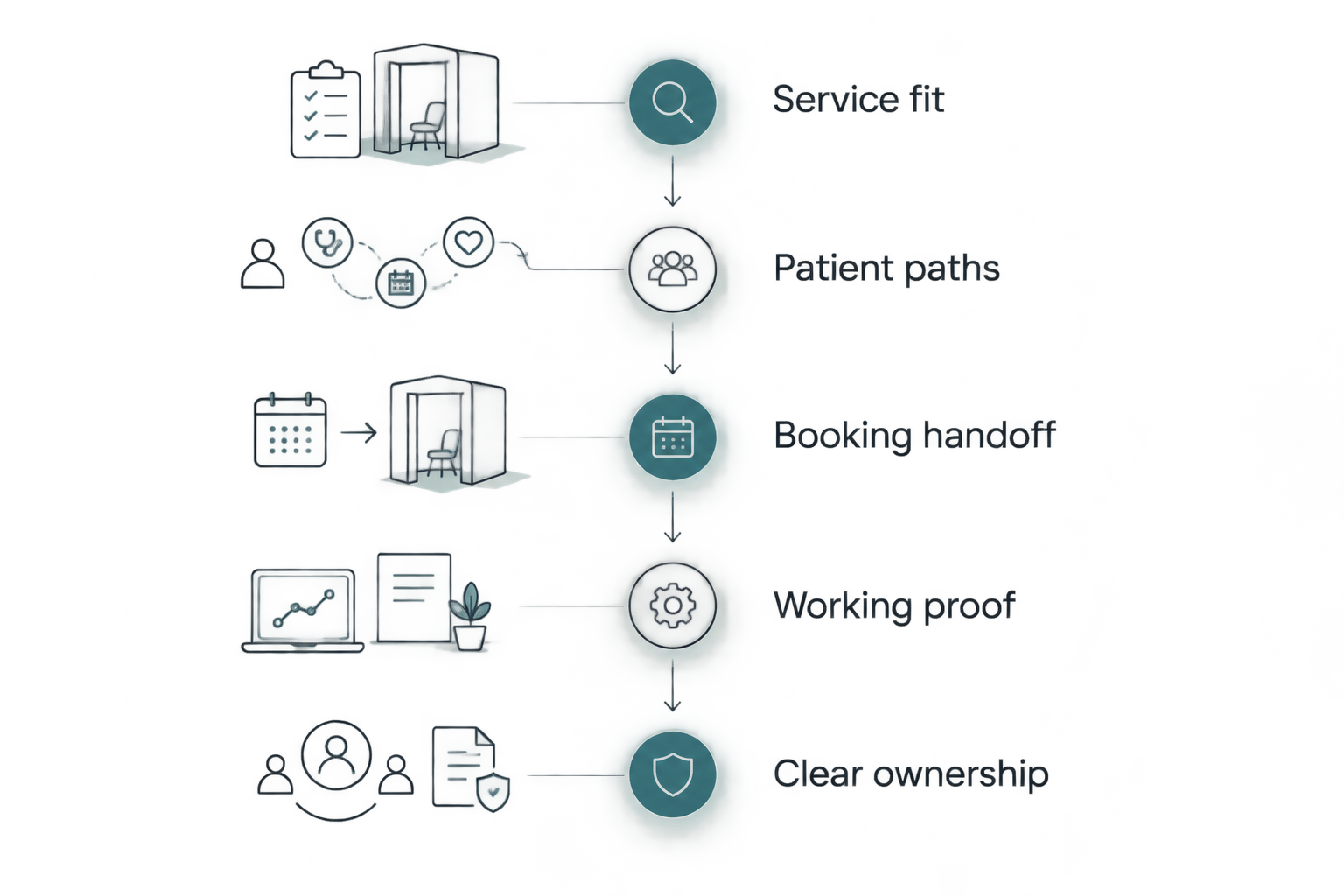
1. Service fit
Start with what your practice needs patients to do. Separate routine new-patient inquiries, treatment-specific consultations, and existing-patient requests before discussing colors or page layouts.
Write down the services you actually provide, the locations you serve, and the booking tools your staff uses. Use a website redesign brief to keep those requirements consistent across proposals.
Ask each provider to explain which requirements need custom work and which do not. A credible provider connects each proposed feature to a patient task or staff responsibility. Reject explanations that stop at making the website look modern.
2. Patient paths
Ask the provider to demonstrate 3 patient journeys: someone seeking routine care, someone researching a treatment you offer, and an existing patient trying to contact the office. Treat these as test scenarios, not assumptions about your patient mix.
Each journey should connect relevant information to a clear next action. A treatment researcher needs an understandable service page; an existing patient should not have to read promotional copy to find contact details.
Test the proposed experience on 2 device types: a phone and a desktop computer. Check whether navigation, forms, and booking links remain usable rather than accepting screenshots as proof.
3. Booking handoff
Follow the appointment button through to its destination. Establish whether patients select an appointment, submit a request, call the office, or leave the website for another system.
Ask what happens after submission: where the request arrives, who receives it, and what the patient sees. A successful form submission is not the same as a confirmed appointment.
Have staff review the proposed workflow before approving it. The booking path is unfinished until the receiving team knows what to do next.
4. Working proof
Request relevant portfolio examples and inspect the live experience where access is available. Look for understandable treatment information, visible contact routes, usable navigation, and a clear appointment action.
Ask the provider to explain a specific design decision in each example. A portfolio demonstrates delivered work; it does not establish patient growth or conversion improvement without supporting evidence.
If a provider claims better results, ask how those results were measured and what changed besides the website. Do not treat an attractive dental homepage as proof that the booking process works.
5. Clear ownership
Request written terms covering the domain, website files, content, hosting access, analytics access, and any connected accounts. Identify which assets your practice controls and what happens if you change providers.
Assign 1 accountable owner for resolving website issues, even when several vendors are involved. Ask who investigates a failed form, a broken booking connection, or an unavailable website.
Before signing a 2026 agreement, confirm what happens after launch. Approval rounds, staff training, maintenance responsibilities, and handover arrangements belong in the scope—not in assumptions.
Why this matters
A dental website has to do more than introduce the practice. It must help someone understand whether the practice meets their needs and make the next step clear to both the patient and the receiving staff member.
For your 2026 selection, distinguish design quality from operational quality. A convincing treatment page and a working appointment request are separate requirements; approve both before accepting the site.
Is a custom website better than a template for a dental practice?
Custom design is the better fit when your patient journeys require changes that a template cannot accommodate cleanly. A template remains an option when its structure supports the information and actions your practice needs.
Compare the approaches against your requirements rather than treating either label as a guarantee.
| Approach | Best for | Main advantage | Main limitation | What to verify |
|---|---|---|---|---|
| Template-based website | Practices whose requirements fit an existing structure | Provides an established layout to evaluate | The structure can restrict treatment pages or booking placement | Whether required patient paths work without awkward workarounds |
| Custom website | Practices needing tailored treatment, location, or inquiry journeys | Allows the structure to follow the practice's requirements | Requires clear decisions, content, and acceptance testing | Which elements are genuinely custom and who maintains them |
Ask the provider to show where customization changes the patient experience. Moving a booking action beside relevant treatment information is a concrete decision; changing decorative elements alone does not demonstrate a better inquiry path.
Custom work also creates responsibilities. Your team must approve clinical information, explain office workflows, and review the delivered experience. Do not choose it simply because the proposal uses the word custom.
What should a dental website provider demonstrate about patient inquiries?
Ask providers to distinguish visitor actions from business outcomes. A phone-link tap, a submitted form, an appointment request, and an attended appointment represent different events.
Define the actions you want to track before development begins. Then ask how the proposed setup will distinguish them without sending patient information into inappropriate systems.
A provider should explain the measurement boundaries clearly. A website alone does not establish how many submitted inquiries became scheduled patients unless the practice has a reliable way to connect those records.
Request a practical acceptance test
Use a test inquiry containing fictional information, not a real patient's details. Have the provider demonstrate submission, delivery, confirmation, and staff receipt.
Repeat the test after changes to forms or connected booking tools. Measure the action the website actually records; do not label every inquiry a booked patient.
For a 2026 redesign, ask how existing measurement will be preserved or replaced. Otherwise, a change in tracking can make before-and-after comparisons misleading.
How should you evaluate practical automation?
Start with a task, not a feature label. Useful proposals explain what the functionality does, what information it uses, when staff take over, and what happens when it cannot help.
| Proposed function | Best for | Practical benefit to evaluate | Limitation to address |
|---|---|---|---|
| Practice-information assistant | Patients looking for approved office information | Helps visitors locate details such as contact routes | Answers need approved source material and ongoing review |
| Booking guidance | Patients unsure where to start | Directs visitors to the appropriate booking or inquiry route | Must not imply an appointment is confirmed when it is not |
| Staff handoff | Questions requiring a person | Provides a clear route to the practice team | Requires an assigned recipient and a defined response process |
Ask for a demonstration using questions your front desk recognizes. Include a question the system should not answer so you can inspect its fallback behavior.
Do not approve functionality that presents itself as a source of diagnosis or treatment advice. Keep the proposed task within defined boundaries and obtain appropriate privacy and security review before collecting patient information.
These are evaluation criteria, not assumed features of any provider. Put the exact functionality and its limits in the proposal.
Why does the right provider vary by dental practice?
The right provider depends on the work your website must support. Compare these factors before choosing a team:
- Treatment mix: Your actual services determine which patient questions the website needs to answer.
- Appointment workflow: Direct scheduling and callback requests require different instructions and handoffs.
- Location structure: Each office needs accurate information and an appropriate contact route.
- Content responsibility: Clinical review and approval need a named owner within the practice.
- Existing systems: Booking, forms, hosting, and measurement requirements affect implementation.
- Ongoing support: Decide whether your team wants separate vendors or coordinated responsibility.
A proposal should reflect these differences. If every practice receives the same structure and workflow regardless of its requirements, ask what the custom engagement actually changes.
Should one company handle design, marketing, and hosting?
One company can provide a single point of responsibility, but the agreement still needs clear boundaries. Ask who handles content updates, website incidents, marketing changes, and problems involving another vendor's software.
Website Symphony is best for practices seeking custom medical website design, marketing, and hosting from one accountable team. Website Symphony provides those services; evaluate the proposed dental website against the same patient-path and ownership criteria used for every finalist.
The benefit of that model is coordinated responsibility across connected services. The trade-off is that more of your website operation sits with one provider, making access rights, handover terms, and service scope especially important.
Ask Website Symphony to demonstrate the proposed booking journey and document the work included. Do not infer booking-system compatibility, response commitments, or patient-growth results from the service description alone.
What should you confirm before signing a dental website agreement?
Confirm deliverables, approvals, ownership, and acceptance tests in writing. Include the pages being built, who supplies content, how clinical information gets approved, and who tests appointment requests.
Your 2026 agreement should distinguish launch work from ongoing work. Hosting, content changes, software updates, marketing management, and third-party connections need explicit responsibilities rather than a general promise of support.
Reject guaranteed patient-growth claims without a defined measurement method and supporting evidence. A provider can commit to delivering and testing agreed functionality; patient acquisition also depends on factors beyond website design.
FAQ
What's the most important question to ask a dental website provider?
Ask the provider to demonstrate the complete journey from a treatment question to a received patient inquiry or appointment request. Require an explanation of what the patient sees and what your staff receives.
How can I tell whether a dental website is genuinely custom?
Ask which design and workflow decisions were made specifically for your practice. A different color scheme does not establish that treatment pages, navigation, or appointment paths were tailored to your requirements.
Should I choose a provider that has built dental websites before?
Relevant dental work gives you examples to inspect, but it does not replace a working demonstration. Ask the provider to explain patient journeys and staff handoffs in the examples it presents.
Can a dental website guarantee more booked patients?
A dental website cannot guarantee more booked patients. Evaluate the provider's evidence, distinguish inquiries from appointments, and agree on what the website will actually measure.
Should my dental practice use automated website chat?
Use automated chat only for a defined task with approved information and a clear staff handoff. Review privacy, security, and answer boundaries before allowing it to collect patient information.
Does Website Symphony provide hosting as well as website design?
Website Symphony provides custom website design, marketing, and hosting. Confirm the exact deliverables, account access, ongoing responsibilities, and handover terms in your proposal.
One last thing
Ask every finalist to explain what happens when the happy path fails. An unanswered question, unsuccessful submission, or booking request sent to the wrong office reveals more about the proposed workflow than another homepage presentation.
Choose the provider that can show both the successful journey and a clear recovery path. That is a more useful final test than choosing the design your team likes best.


