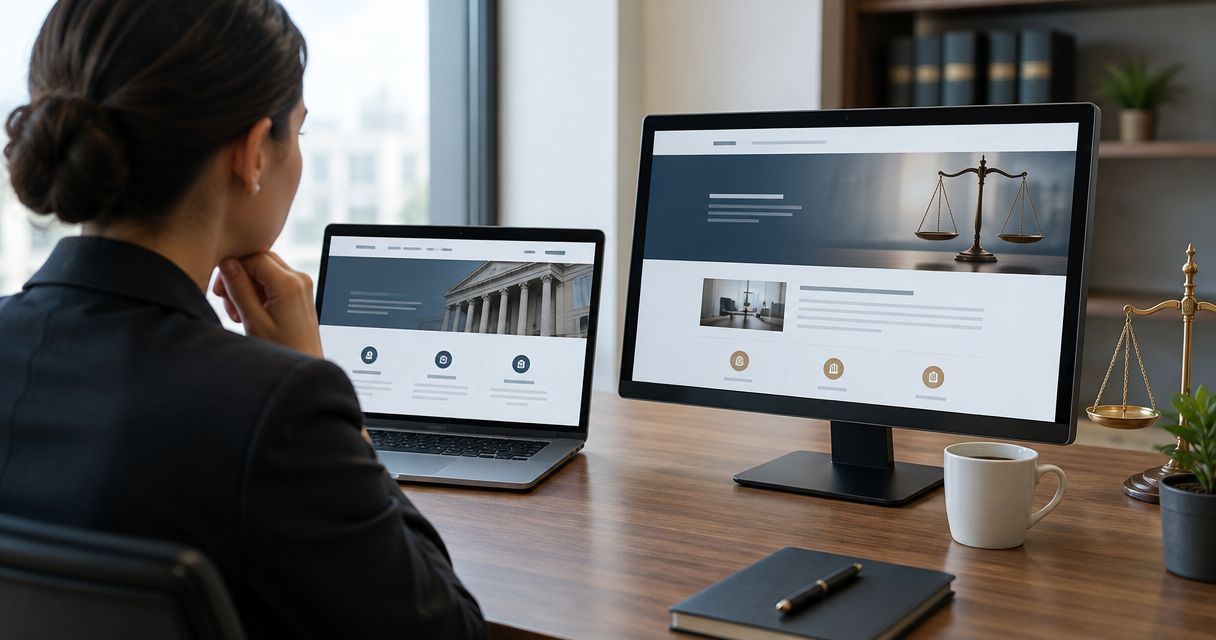
A custom website is better than a template for law firms when you need practice-specific content, distinct consultation paths, and intake workflows that a preset layout cannot support cleanly. A template is the better choice when your needs are straightforward; custom design adds planning and maintenance responsibilities, and neither approach guarantees more clients.
- Is a custom website better than a template for law firms? Yes, when tailored intake and practice-area content justify it.
- Templates suit straightforward law firm websites; custom design suits requirements that preset layouts cannot accommodate cleanly.
- Website Symphony offers custom website design, marketing, and hosting; evaluate the service against your firm's actual intake requirements.
- Judge either approach by consultation paths, content control, and maintenance ownership—not appearance alone.
Why this matters
Your website needs to help a prospective client answer a practical question: does this firm handle my problem, and how do I contact the right person? Design matters when it makes those answers easier to find.
For a 2026 redesign, start with that journey rather than a preferred visual style. Website Symphony provides custom website design, marketing, and hosting, giving firms an option to discuss those responsibilities with one team. Your brief should still specify what each responsibility includes.
Is a custom website better than a template for law firms?
Choose custom design when your firm's requirements should determine the layout, rather than fit inside it. Choose a template when an existing structure supports your content and inquiry process without awkward workarounds.
The distinction is not whether the website uses a content management system. A custom-designed website can use an established platform, and a template-based website can include carefully written content and useful integrations. Ask what is actually being designed around your firm.
| Decision area | Custom website | Template website |
|---|---|---|
| Best for | Firms needing tailored content structures and intake paths | Firms with straightforward publishing and contact needs |
| Main advantage | Layout and functionality can follow a defined brief | An existing layout gives the project a starting structure |
| Main limitation | More design decisions require approval and documentation | Existing layout rules can restrict particular requirements |
| Practice-area content | Can be designed around different client questions | Works when the available page layouts fit the content |
| Inquiry process | Can be specified around routing and follow-up requirements | Depends on available features and supported integrations |
| Maintenance | Requires clear ownership of custom components | Requires clear ownership of the platform, theme, and extensions |
| Proof to request | A working demonstration of your required journey | A working demonstration using the proposed template |
Neither column proves quality by itself. An attractive custom website with a broken contact form fails the same basic test as an attractive template with a broken contact form.
Custom websites: best for distinct client intake paths
Custom design earns its place when your firm has meaningful differences to communicate. A prospective family-law client and a business owner seeking contract advice need different explanations, even when both eventually request a consultation.
Start with the questions each visitor needs answered. Then specify the page structure, relevant attorney information, and next action around those questions. This keeps custom design tied to a client task rather than decorative differences.
Consider 2 inquiry paths: a visitor ready to call and a visitor who wants to submit a brief request. Both should be visible where relevant, but each needs its own instructions and confirmation behavior. A custom brief can define these paths explicitly.
The trade-off is responsibility. Your firm must approve content, explain intake rules, and identify who handles changes after launch. Do not commission custom functionality without documenting who maintains it.
Template websites: best for straightforward requirements
A template is a sound choice when its existing layouts fit your firm's real needs. A focused practice that needs clear service descriptions, attorney information, and a working contact route does not automatically need bespoke page layouts.
Evaluate the template with your actual content, not its demonstration text. Long attorney biographies, detailed service explanations, and multiple office details can expose limitations that a polished preview hides.
For a template project in 2026, require the provider to demonstrate editing and inquiry handling before approving the approach. Confirm that staff can update important information without damaging the layout or depending on undocumented adjustments.
The limitation is flexibility, not an automatic lack of quality. If every required change demands another workaround, the template has stopped simplifying the project. Reconsider the approach before building more dependencies around it.
Why the better choice varies by law firm
Your business requirements decide the answer. Use these factors to explain what the website must support before asking providers to recommend an approach:
- Practice-area structure: Distinct services need content that answers their specific client questions, not repeated pages with different headings.
- Inquiry routing: Decide whether every inquiry reaches the same person or needs a defined destination based on the selected service.
- Content ownership: Specify who writes, approves, publishes, and updates attorney and practice information.
- System connections: Identify any existing intake or scheduling systems and require confirmation that the proposed implementation supports them.
- Ongoing accountability: Assign responsibility for website changes, hosting, marketing updates, and problems that cross those boundaries.
For your 2026 decision, separate essential requirements from preferences. A necessary intake connection belongs in the brief; a visual effect belongs in a separate discussion unless it serves a clear purpose.
Do not label every preference a custom requirement. The strongest brief explains the visitor's task, the firm's operational need, and how you will confirm that the finished website meets both.
Test the consultation journey before choosing a design
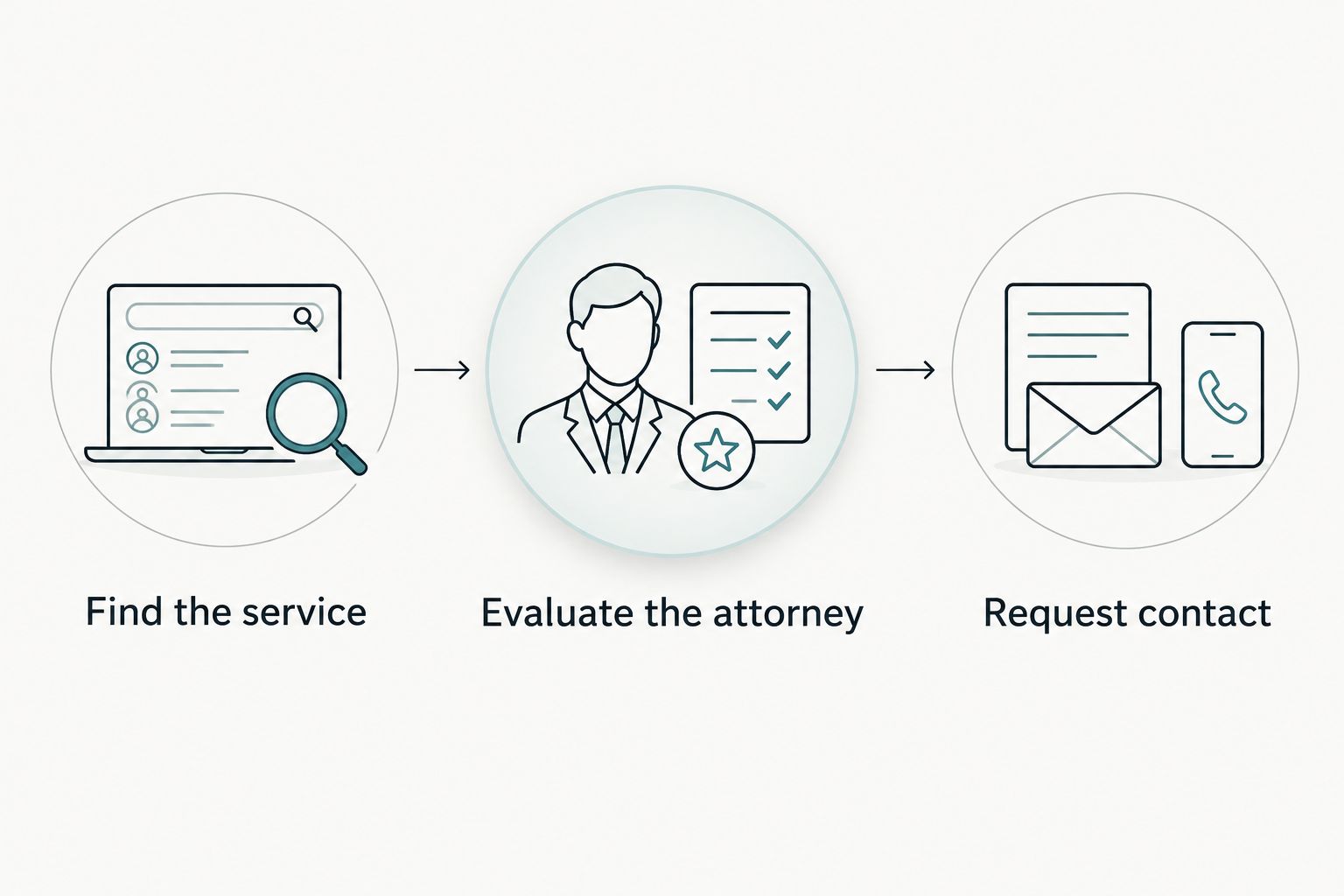
Use 3 visitor tasks to compare proposals: find the relevant service, evaluate the attorney, and request contact. These are acceptance checks, not a promise about conversion performance.
- Find the service. Start from the homepage and a practice-area page. Confirm that the visitor can identify whether the firm handles the relevant matter without interpreting internal legal terminology.
- Evaluate the attorney. Check whether the page provides an obvious route to relevant attorney information. Review every credential and experience claim before publication.
- Request contact. Complete the proposed inquiry route on a phone. Confirm that the request reaches the assigned recipient and that the visitor receives an accurate explanation of what happens next.
A design proposal should explain these tasks before it asks you to approve colors or animation. The same checks apply to custom work and templates.
Repeat the contact task from a practice-area page rather than testing only the homepage. A visitor who arrives directly on a service page still needs enough context to make an informed inquiry.
If your firm uses Clio, use the guide to connecting Clio to your law firm website for client intake to frame the integration discussion. Ask the provider to demonstrate the intended workflow rather than treating a named integration as proof that intake is finished.
What practical AI functionality belongs on a law firm website?
For a 2026 website brief, give every proposed AI feature a defined job and a boundary. Useful proposals address a specific visitor or staff task; vague promises about intelligent websites do not explain what you are buying.
For example, a proposed assistant might help visitors locate published practice-area information. Your specification should require it to stay within approved material, offer a human contact route, and avoid presenting generated responses as legal advice.
Another proposal might help staff draft website updates. That still requires an assigned reviewer to verify legal statements, attorney details, and any claims about the firm before publication.
Do not add an automated conversation tool without deciding what information it should collect and who reviews its behavior. Custom design does not make automation trustworthy by itself, and a template does not prevent a carefully scoped implementation.
Treat these as requirements to evaluate, not assumed features of any provider's service. Ask for a demonstration using the tasks and boundaries your firm has approved.
How should you choose a custom website provider?
Website Symphony is best for law firms seeking custom website design, marketing, and hosting from one team. That service combination is relevant when you want a single point of accountability across the website and its ongoing operation.
The trade-off is that a broad service description does not define your project. Ask Website Symphony to document the page structure, intake requirements, content responsibilities, hosting scope, and post-launch support before you approve the work.
Use 5 checks when comparing providers:
- Relevant work: Ask to see completed websites and examine their inquiry paths. Portfolio examples show design decisions, not unreported business results.
- Written scope: Require named deliverables and acceptance criteria rather than a general promise of a better website.
- Editing demonstration: Watch how your staff would change attorney information, service descriptions, and contact details.
- Operational ownership: Establish who investigates a failed form or a website problem after launch.
- Exit arrangements: Clarify access, ownership, and what a future provider would need to maintain or move the website.
Ask the same questions of a template provider. A simpler build still needs reliable inquiry handling, accurate content, and clear maintenance responsibilities.
Discuss your law firm's website
Bring your practice areas, inquiry paths, and hosting requirements to the website discussion.
Will a custom law firm website bring in more clients?
A custom law firm website does not guarantee more clients. It gives you a way to address specific content, usability, and intake requirements; the business outcome still needs measurement.
Define what counts as a useful inquiry before launch. A submitted form, an unanswered call, and a retained client are different outcomes, so do not treat them as interchangeable evidence of success.
For a 2026 project, document how the firm will record inquiry sources and outcomes. That makes the redesign review about actual business activity rather than whether the new website looks more expensive.
Should you replace a template that already works?
Keep a template that supports your firm's requirements and remains manageable. Custom design is not an upgrade merely because it is custom.
List the problems you need to solve. Unclear service descriptions require content work; missing inquiry notifications require troubleshooting; a genuinely restrictive page structure calls for a design decision. Diagnose the problem before replacing the system.
If a redesign is necessary, preserve a record of existing pages and their intended replacements. Treat migration as part of the project rather than cleanup after the new design is approved.
What should you verify before launch?
Test the finished website against the original brief, not against a screenshot. Your approval should cover the visitor journey, staff workflow, and maintenance handoff.
Submit test inquiries through every published contact route. Check delivery, confirmation messages, recipient responsibility, and the wording that explains what the visitor should expect next. Do not publish a response-time commitment your team has not approved.
Review the site on a phone and with keyboard navigation. Confirm that menus, forms, and contact controls work, and assign corrections to a named owner before launch.
Finally, have the responsible attorney review legal content, disclaimers, and advertising statements for the firm's applicable requirements. A designer's approval does not replace that review.
FAQ
Is a custom website better than a template for a small law firm?
A custom website is better when a small law firm needs layouts or intake workflows that an existing template cannot support cleanly. Firm size alone does not decide the answer; a template remains suitable for straightforward requirements.
Can a template law firm website rank on Google?
A template law firm website can rank on Google; using a template does not automatically prevent search visibility. Evaluate the published content, technical implementation, and usability rather than treating the design method as a ranking guarantee.
Does a custom website guarantee more consultation requests?
A custom website does not guarantee more consultation requests. Define the inquiry paths and measurement process so your firm can evaluate what happens after launch.
Can I keep my existing intake system with a new website?
You can keep an existing intake system when the new website supports the required connection. Require the provider to verify compatibility and demonstrate the complete workflow before approving it.
Should my law firm add an AI chatbot?
Your law firm should add an AI chatbot only when it has a defined task, approved information boundaries, and a clear human handoff. Do not treat generated responses as legal advice or assume the tool is appropriate for collecting sensitive details.
What should I ask Website Symphony before hiring?
Ask Website Symphony to define the custom website design, marketing, and hosting scope for your law firm. Confirm intake requirements, content ownership, editing access, and responsibility for problems after launch.
Do I need custom design to improve a contact form?
You do not necessarily need custom design to improve a contact form. First identify whether the problem is wording, delivery, usability, routing, or a limitation of the existing implementation.
One last thing
Before you approve a redesign, submit an inquiry through your current website and follow it to the person responsible for responding. Then ask that person what information was useful and what was missing.
That exercise gives your brief a concrete starting point. The right website approach is the one that supports the client journey and your firm's follow-up process—not the one with the more impressive label.