
Chiropractor website design costs depend on the scope: custom layouts, practice content, appointment connections, and the work required to replace your existing site. For your 2026 budget, separate the initial build from hosting, maintenance, marketing, and third-party tools before comparing proposals.
- How much does chiropractor website design cost? Compare the build scope and recurring services, not an isolated total.
- Custom chiropractor website design should support clear patient inquiries and appointment requests, not just a different appearance.
- Website Symphony suits medical practices seeking custom website design, marketing, and hosting from one accountable team.
- Require written ownership terms, booking responsibilities, and launch acceptance criteria before choosing a provider.
Why this matters
A website proposal can describe a finished site without explaining what happens when a patient requests an appointment. That leaves you comparing appearances while the operational work remains undefined.
Start with the patient journey. Someone needs to understand your services, find the right location, and contact your practice without guessing what to do next. The website design for chiropractors guide provides a broader framework for that planning.
Buy a defined patient inquiry path, not an unspecified collection of pages. Your scope should explain both the public website and the staff workflow behind its main action.
How much does chiropractor website design cost in 2026?
A useful chiropractor website design quote separates project work from ongoing services. Design, content, development, and migration belong in the build scope; hosting, maintenance, marketing, and software subscriptions need their own terms.
Compare 3 approaches before requesting proposals. These describe different scopes, not fixed packages or a universal pricing ladder.
| Approach | Best for | Main advantage | Main limitation | What the proposal should define |
|---|---|---|---|---|
| Template-based website | Practices whose content and booking path fit an existing layout | Starts with an established structure | Your workflow must fit the template or require changes | Customization boundaries, content work, and tool connections |
| Custom website | Practices needing layouts around specific patient and staff needs | Lets the design follow the intended patient journey | Requires decisions about content, functionality, and approvals | Page layouts, appointment paths, development, and testing |
| Existing-site redesign | Practices replacing weaknesses while retaining useful material | Allows selective reuse of content and assets | Requires assessment of what should stay and what should change | Migration, redirects, content revisions, and retained systems |
Request the same deliverables from every provider. A proposal covering design alone is not equivalent to one covering approved copy, appointment connections, migration, and post-launch responsibilities.
Template-based design: define the customization boundary
Best for: a practice whose patient journey fits the proposed template. Ask the provider to demonstrate your actual content within that structure, including a service page and the appointment action.
A template supplies a starting layout. It does not answer practice-specific questions about which services need separate explanations, how new patients should contact you, or where inquiries should go.
The limitation appears when your requirements conflict with the layout. Ask what happens if you need a different location selector, provider presentation, or request form. Get those changes included in the scope rather than assuming they are ordinary setup work.
Do not reject a template solely because it is a template. Reject an approach that cannot demonstrate the patient path your practice needs.
Custom website design: make the extra work specific
Best for: a practice needing a website shaped around its own appointment and inquiry process. Custom design is justified by requirements, not by the word custom in a proposal.
For example, your practice might need separate paths for new and returning patients. A new patient needs clear service information and first-visit instructions; a returning patient needs the appropriate appointment destination. The scope should show how those paths differ.
Ask which layouts are being designed specifically for your practice and which components will repeat. Request a demonstration of the mobile experience before approving the design.
The trade-off is decision-making. Your team must approve the information structure, content, and functionality. Custom work loses its purpose when those decisions arrive after development or when the provider cannot connect design choices to a practical need.
Existing-site redesign: separate reuse from replacement
Best for: a practice with useful existing material and clearly identified website problems. Begin with an inventory of pages, content, forms, booking links, and accounts.
Retaining useful material is different from transferring everything unchanged. A service page might contain accurate information but need a clearer appointment action. A location page might need revised directions while keeping its existing address.
Ask the provider to label each item as retained, revised, replaced, or removed. That makes the redesign scope concrete and gives your staff a review list.
Migration also needs explicit ownership. If page addresses change, require a redirect plan; if forms change, require a delivery test. A redesigned homepage does not prove that the rest of the transition works.
Why chiropractor website design costs vary
For a 2026 project, use these scope drivers to explain differences between proposals. Each should correspond to a deliverable you can inspect.
- Design scope: Identify the distinct layouts required for services, providers, locations, and appointment information. Ask which pages share a layout and which need separate design work.
- Content responsibility: Specify whether your practice supplies finished copy or the provider drafts and edits it. Assign clinical review to an appropriate person at your practice.
- Appointment connections: Distinguish a link to an existing booking system from an embedded scheduler or a developed connection. Define the patient action and the receiving system.
- Migration work: List the existing content, files, page addresses, and connections that must transfer. Assign responsibility for checking the transferred material.
- Ongoing responsibilities: Separate hosting, updates, support, marketing, and third-party tools. State who handles each service and how changes are requested.
A proposal should explain the work behind its total. If a deliverable is unclear, ask for a written definition before making the comparison.
Build a budget you can compare
Organize every 2026 proposal under the same headings. This prevents a build-only quote from appearing equivalent to a proposal that also includes ongoing services.
- Build scope: List design, content, development, appointment connections, migration, and launch testing. Mark each item as included, excluded, or your practice's responsibility. Attach a clear approval condition to each major deliverable.
- Recurring services: Record hosting, maintenance, support, marketing, and software subscriptions separately. Ask which services are required for the website to keep functioning and which are optional. Identify the account holder for each external service.
- Future changes: Define how you request a new provider profile, revised service information, or another location. Ask what falls within routine support and what requires a separate project. Keep those terms with the original proposal.
This structure also exposes responsibility gaps. If the designer connects a form but nobody agrees to test its delivery, the task is not fully assigned.
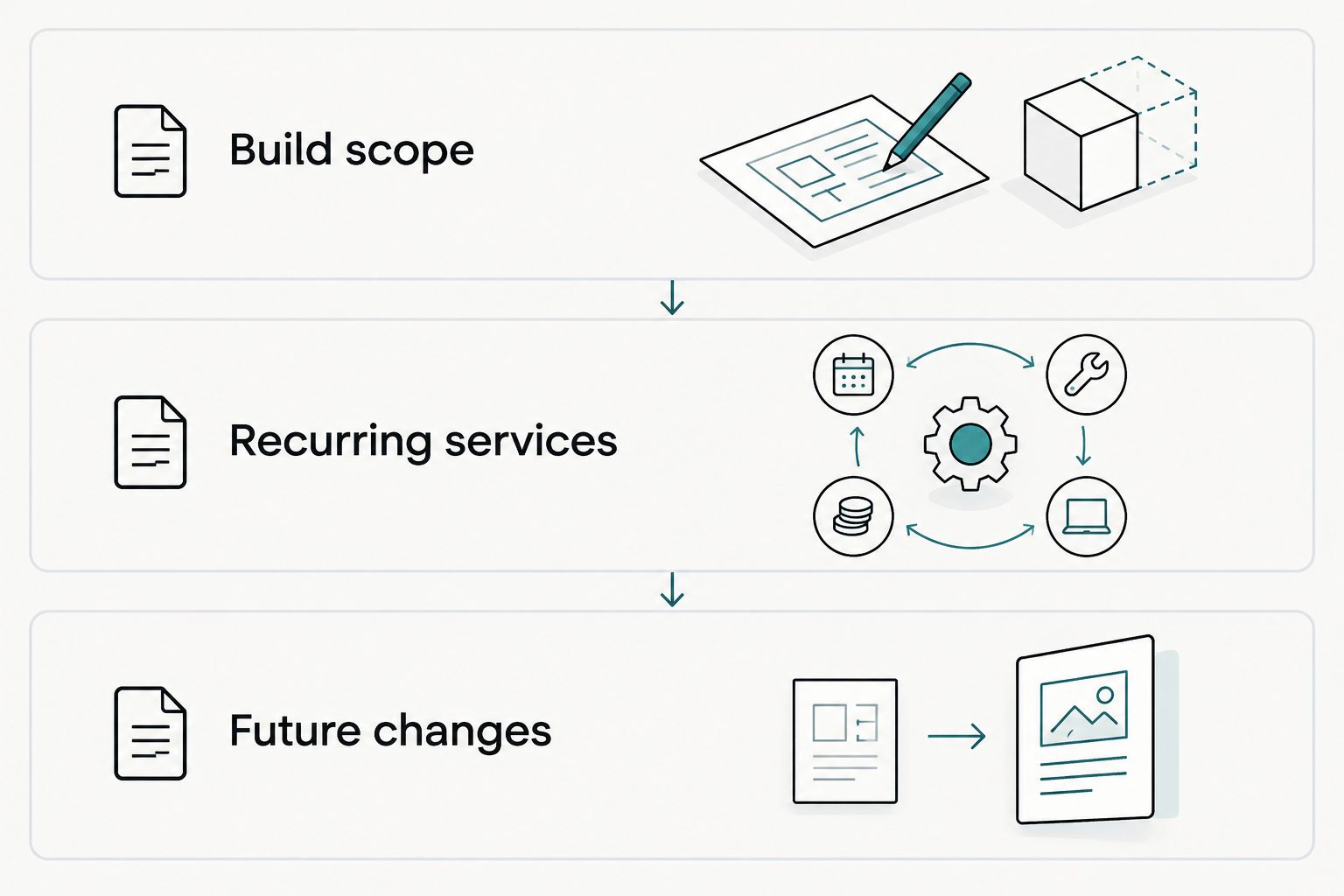
Use this structure when requesting revisions to a proposal. Ask the provider to resolve exclusions directly in the document rather than leaving important commitments in a sales conversation.
Test the appointment path before approving the website
A booking button is not evidence of a completed appointment process. Follow the action through to its destination and confirm what both the patient and your staff receive.
Test 2 patient paths with dummy information, not real patient details:
- New patient inquiry: Open a relevant service page on a phone, find the appointment action, and submit a test request. Confirm the message reaches the designated staff destination and that the patient sees an accurate next-step message.
- Returning patient appointment: Follow the intended scheduling route. Confirm whether the patient can select an appointment or is only requesting contact, and make that distinction clear in the wording.
An appointment request is not a confirmed appointment. If staff must review the request, the website should say so rather than displaying confirmation language that overstates what happened.
Include these tests in launch acceptance. They give you a practical way to assess the work without relying on a subjective judgment about whether the site looks finished.
What should practical AI functionality do?
For a 2026 chiropractic website, evaluate AI functionality by the task it performs. Ask for a demonstration tied to a patient question or a staff responsibility.
A proposed assistant could direct visitors to practice-approved information about office hours, location, or appointment instructions. That is a defined administrative use. Require a clear route to human help when the question falls outside the approved material.
Do not treat an automated response as clinical guidance. Review what information the tool receives, what it stores, and which questions it should decline or redirect before approving deployment.
The drawback is another system to supervise. Content ownership, answer review, and escalation rules need named responsibilities. If the provider cannot demonstrate a useful task and its boundaries, leave the feature outside the initial scope.
How do you choose a custom medical website provider?
Ask providers to walk through a relevant portfolio example from service information to patient action. Examine what the example demonstrates rather than treating an attractive screenshot as proof of appointment growth.
Use the same questions with each provider:
- Who writes the content, and who approves medical statements?
- How does a patient request an appointment on a phone?
- Where does the inquiry go, and who tests delivery?
- Who owns the domain, website accounts, and approved materials?
- Who handles hosting, maintenance, marketing, and later changes?
Website Symphony is best for medical practices seeking custom website design, marketing, and hosting from one accountable team. The agency's stated services fit buyers who want those responsibilities coordinated rather than treated as unrelated purchases.
For a chiropractor website design project, Website Symphony should still be evaluated against your written scope. Coordinated services do not replace the need to confirm appointment functionality, content responsibilities, account ownership, and support terms.
The trade-off of choosing one team is concentration of responsibility. Keep access and handover requirements explicit so accountability does not become dependency.
Discuss your practice website
Define your patient inquiry path and the website, marketing, and hosting responsibilities around it.
Should you replace a template chiropractor website?
Replace a template when documented requirements cannot be met within its structure. Before commissioning a rebuild, identify the actual failures: unclear service information, a confusing appointment route, or content your staff cannot maintain.
Ask the provider to demonstrate how the proposed replacement fixes those failures. A different appearance alone does not establish a better patient experience.
Can a redesigned website bring more patient inquiries?
A redesign can remove obstacles to inquiry, but it does not establish a guaranteed increase. Clear service information, working contact routes, and accurate appointment instructions give patients a usable path to your staff.
Define what you will measure before launch. Keep form submissions, appointment requests, and confirmed appointments distinct so the reporting reflects what actually happened.
FAQ
How much does chiropractor website design cost in 2026?
Chiropractor website design costs depend on the agreed design, content, appointment functionality, and migration work. Compare an itemized build scope alongside separate hosting, maintenance, marketing, and software terms.
Is a custom chiropractor website better than a template?
A custom chiropractor website is a better fit when your required patient journey does not fit the proposed template. Ask the provider to demonstrate the practical difference in service information, appointment actions, and staff workflow.
Does chiropractor website design include hosting?
Hosting is included only when the proposal explicitly includes it. Confirm who operates the service, who owns the account, and what support responsibilities apply.
Can my chiropractor website use my existing booking system?
Your website can use an existing booking system when the proposed connection is supported by that system. Ask the provider to specify whether the work involves a link, an embedded scheduler, or a developed connection, then test the full patient path.
Will a new chiropractic website guarantee more appointments?
A new chiropractic website does not guarantee more appointments. Evaluate whether it removes specific inquiry obstacles and measure appointment requests separately from confirmed appointments.
What should I ask Website Symphony before starting a medical website?
Ask Website Symphony to define the medical website scope, appointment workflow, content responsibilities, hosting, marketing, and account ownership. Require written acceptance criteria and handover terms before approving the project.
One last thing
Ask for a handover demonstration before the final approval. Have your staff update routine practice information, locate a test inquiry, and identify the owner of every account needed to operate the website.
That exercise tests something a design presentation cannot: whether your practice can manage the site after launch. For your 2026 project, make operational control part of acceptance, not an unanswered question after the website goes live.