
A law firm website’s build time depends on the approved scope, content readiness, review process, and intake requirements—not a universal deadline. Your launch schedule must include attorney approval and testing of the complete inquiry path, not just design and development. For a 2026 project, ask for a milestone schedule tied to specific deliverables before accepting a launch date.
- How long does it take to build a law firm website? Scope, content approval, and intake testing determine the schedule.
- Website Symphony offers custom law firm website design, marketing, and hosting for firms seeking one accountable team.
- Choose a template for standardized requirements; choose custom design when your intake process needs a tailored approach.
- Approve launch essentials early and test inquiry delivery before replacing your existing website.
How long does it take to build a law firm website?
A credible build timeline connects each milestone to an approved deliverable. A date without those dependencies does not tell you whether the site will be ready to receive prospective-client inquiries.
For a custom project, Website Symphony brings website design, marketing, and hosting under one team. Evaluate that service model against your firm’s actual needs: who writes the content, who approves it, and who owns the inquiry process after launch.
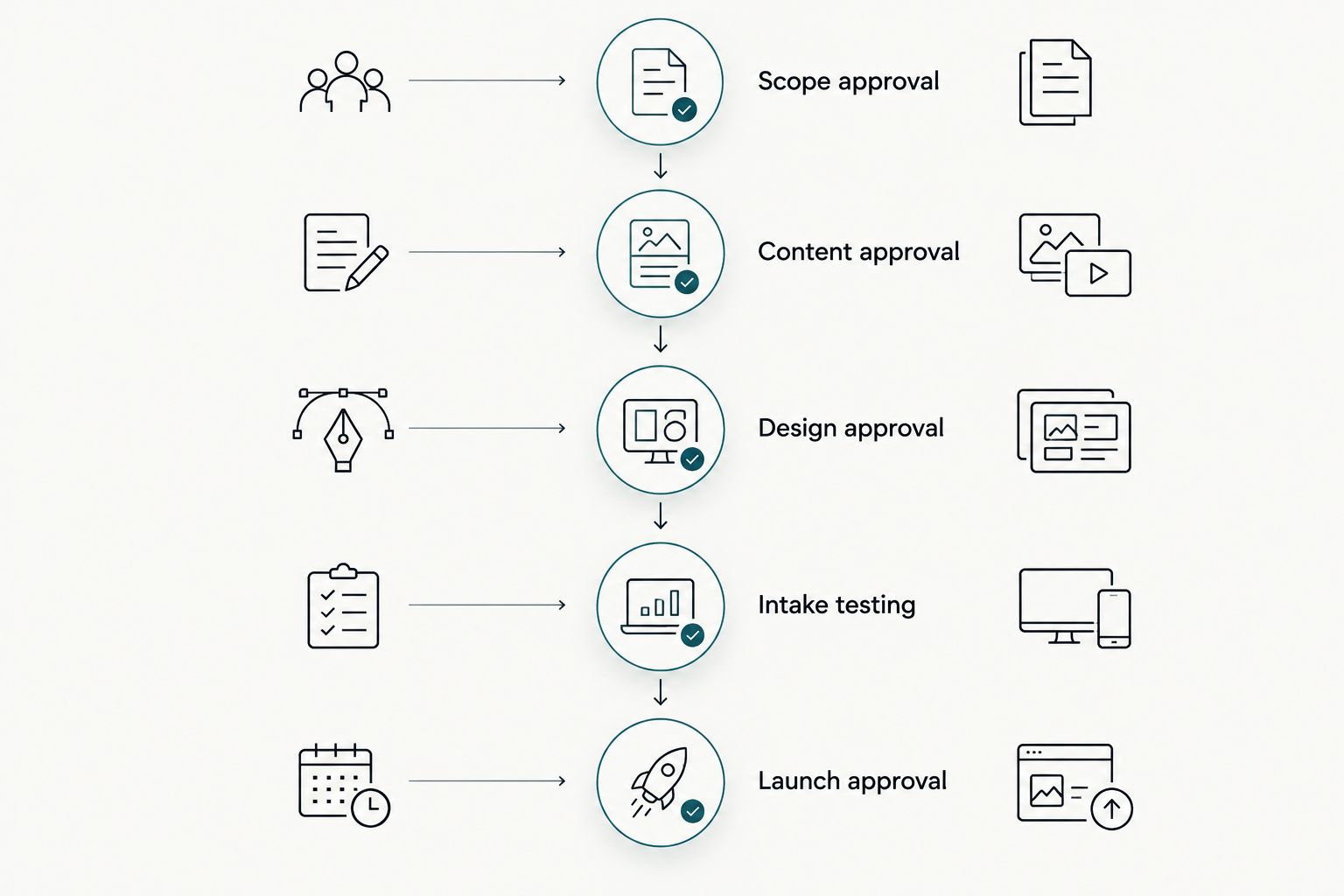
Ask your provider to schedule these stages explicitly:
- Scope approval. Confirm practice areas, attorney profiles, locations, required features, and launch priorities.
- Content approval. Assign responsibility for writing, factual checks, attorney review, and final sign-off.
- Design approval. Agree on page layouts and the path from a prospective client’s question to an inquiry.
- Development. Build the approved pages, forms, navigation, and required connections.
- Intake testing. Confirm that submissions reach the intended staff member and produce the expected acknowledgment.
- Launch approval. Check the live domain, existing page redirects, contact details, and post-launch responsibilities.
Each milestone needs an owner and a clear approval condition. Otherwise, a finished design can sit waiting for copy, or a completed form can remain unusable because nobody has confirmed where inquiries go.
Why this matters
Your firm needs more than a published website. A prospective client must understand whether you handle their issue, find relevant attorney information, and reach the right person without confusion.
For your 2026 website brief, define launch readiness around that journey. A homepage that looks finished does not establish that practice-area pages are accurate, mobile forms work, or staff can respond to submissions.
The practical question is not simply when the website will appear online. It is when your firm can confidently use it as an inquiry channel.
Template website: best for standardized requirements
A template is appropriate when your required pages and inquiry process fit an existing layout. You choose a starting structure, supply approved content, and configure the necessary features.
The advantage is a defined design starting point. The limitation is fit: adapting a template to unusual navigation, multiple intake routes, or distinctive page requirements introduces additional work.
Choose a template when its existing structure supports your firm’s requirements without extensive changes. Do not assume that selecting a template also completes copywriting, attorney review, form configuration, or launch testing.
Before committing, ask the provider to demonstrate your actual inquiry path within the proposed template. A generic contact-page demonstration does not establish that the design supports different practice areas or office destinations.
Custom website: best for tailored inquiry paths
Custom design starts with your firm’s requirements rather than a predetermined page arrangement. That gives you room to organize information around the questions prospective clients ask and the way your staff handles inquiries.
For example, a proposed design can distinguish a new-client inquiry from an existing-client request. It can also place practice-area explanations, attorney credentials, and contact options where they support the visitor’s decision.
The trade-off is decision-making. Your firm must approve the structure, content, and functionality instead of treating those choices as already settled.
Website Symphony is best for law firms seeking custom website design, marketing, and hosting from one accountable team. That service model still requires your firm to supply accurate information and approve legal content; it does not remove the need for attorney involvement.
Ask to see relevant portfolio work and a demonstration of the proposed inquiry process. Portfolio examples show design execution, but they do not establish inquiry growth without supporting performance evidence.
Website redesign: best for replacing an existing site
A redesign adds an existing website to the project’s scope. Your provider needs to decide which content stays, which pages change, and what happens to existing addresses when the replacement launches.
The advantage is that you already have material to assess. The limitation is that old content and technical arrangements need review rather than automatic reuse.
A redesign is not ready merely because the replacement looks better. Confirm that important pages remain accessible, contact details are correct, and forms deliver submissions to the intended destination.
For a 2026 redesign, distinguish required migration work from optional improvements. That separation gives you a defensible launch scope instead of an expanding wish list.
| Approach | Best for | Main advantage | Main limitation | Schedule depends on |
|---|---|---|---|---|
| Template website | Firms with standardized page and form needs | An established layout provides a starting point | Requirements must fit the structure or require adaptation | Content readiness, configuration, and approvals |
| Custom website | Firms needing tailored content and inquiry paths | Structure follows the firm’s requirements | More design and functionality decisions require approval | Scope, content, design decisions, and testing |
| Website redesign | Firms replacing an existing website | Existing material can inform the replacement | Content review and migration add responsibilities | Page mapping, access, revisions, and launch checks |
Why law firm website timelines vary
These factors determine what belongs in your schedule. Ask the provider to identify them before agreeing to a deadline.
- Page scope. Each distinct practice area, attorney profile, and location needs an agreed content and review plan.
- Content readiness. Approved copy and usable photography are different starting conditions from unwritten pages and unselected images.
- Approval ownership. A designated decision-maker can resolve conflicting feedback; an undefined approval process leaves decisions open.
- Intake requirements. A basic inquiry form and a connected intake workflow require different configuration and testing.
- Existing-site changes. Replacing pages requires decisions about content retention, changed addresses, and redirects.
- Access and handover. Domain, hosting, and relevant account access must be available when the project needs them.
Keep launch requirements separate from later enhancements. If a requested addition changes an approved page or workflow, ask what it changes in the schedule before authorizing it.
This is not a reason to omit necessary functionality. It is a way to make the effect of each decision visible.
How can your firm prevent avoidable delays?
Your firm controls content ownership, review decisions, and access preparation. Resolve those responsibilities before the provider starts building.
Use the following handoff sequence for your 2026 project:
- Scope approval: Name the pages and functions required for launch.
- Content approval: Assign a reviewer for practice descriptions, attorney information, and public-facing claims.
- Design approval: Consolidate stakeholder feedback into an authorized response.
- Intake testing: Submit test inquiries and confirm staff receipt.
- Launch approval: Name the person who can authorize the replacement website.
A provider should know who can approve each stage. Your internal team should also know when feedback is due and what counts as final approval.
Send consolidated feedback rather than separate, contradictory instructions from different partners. Identify whether a comment corrects an error, changes a preference, or adds scope; those are different requests and should be handled differently.
Keep a decision record. When someone reopens an approved choice, the provider can explain the resulting work before changing the project.
Does connecting client intake affect the launch date?
Client intake belongs in the build schedule whenever the website must pass information to another system or route inquiries to specific people. The work includes deciding what to collect, where it goes, and how staff confirm receipt.
Define the workflow before designing the form. A prospective client should not have to interpret your internal office structure to choose the right destination.
If your firm uses Clio, the guide to connecting Clio for website client intake addresses that specific planning topic. Confirm the intended connection and its requirements with your provider rather than assuming it is included.
Test successful submissions, incomplete fields, acknowledgment messages, and staff delivery. Also decide what happens when a submission fails or reaches an unattended inbox.
Treat a working intake path as a launch requirement, not a finishing touch. Publishing first and assigning responsibility later leaves a critical part of the website unresolved.
Can AI functionality shorten the website project?
AI functionality does not replace scope approval, legal review, or launch testing. Evaluate a proposed feature by the specific visitor or staff task it supports—not by a general promise of faster development.
For example, an AI-assisted question tool could direct visitors to approved practice-area information or an inquiry form. If you commission that functionality, define its permitted answers, escalation route, and limits before adding it to the launch scope.
Do not treat a public-facing assistant as a substitute for an attorney’s assessment. Your firm needs to review what the feature communicates and how it handles requests outside its intended purpose.
Keep the first release focused. A useful, tested inquiry route takes priority over an additional feature whose behavior has not been approved.
What should your provider’s schedule include?
Ask for deliverables, dependencies, and approval responsibilities—not just a launch date. Your 2026 proposal should make it possible to distinguish completed work from work waiting on your firm.
Require clear answers to these questions:
- What must your firm supply before work begins?
- Which pages and functions are included at launch?
- Who writes and approves the content?
- What constitutes approval at each milestone?
- How are changes after approval handled?
- Who tests inquiry delivery and authorizes launch?
- Who owns hosting, maintenance, and marketing responsibilities afterward?
Website Symphony offers custom design, marketing, and hosting. Ask for the boundaries of each service in your proposed scope, including what your staff must continue to manage.
Choose the provider that explains the dependencies behind the deadline. A schedule is useful when it helps both parties make decisions, not merely when it supplies a date.
FAQ
How long does it take to build a law firm website from scratch?
The build time depends on approved scope, content readiness, attorney review, and required functionality. Ask for a milestone schedule that includes intake testing and launch approval, not just design completion.
Is a template law firm website faster to launch than a custom website?
A template supplies an existing layout, but it does not remove content approval, configuration, or testing. Compare the work required for your actual requirements rather than assuming the starting layout determines the launch date.
What should my law firm prepare before website development starts?
Prepare the launch page list, content responsibilities, approval owner, account access, and intended inquiry workflow. Identify unresolved decisions before they become development dependencies.
Can my law firm launch before every planned page is finished?
You can define an initial launch scope that excludes optional later additions. The published pages still need approved content, working contact routes, and appropriate launch checks.
Does a law firm website redesign require migration planning?
A redesign requires decisions about existing content, changed page addresses, and redirects. Include those decisions in the scope before replacing the live site.
Will AI remove the need for attorney review of website content?
AI does not remove the need for attorney review. Your firm must approve public-facing legal content and define the limits of any automated visitor-facing functionality.
Does Website Symphony offer more than law firm website design?
Website Symphony offers custom website design, marketing, and hosting for legal businesses. Confirm the deliverables and responsibilities included in your proposed engagement.
One last thing
Your final launch check should follow a prospective client’s path—not your navigation menu. Start on a practice-area page using a phone, find the inquiry option, submit a test, and ask the intended staff member to confirm receipt.
A website is not ready for inquiries until your team has verified that it receives them. Make that confirmation part of launch approval.