
A new website needs no minimum amount of traffic before it can rank on Google in 2026. A page can appear in search before receiving its first organic visit; the real requirements are discoverability, indexing eligibility, and relevance to the search. Existing visits do not substitute for those requirements, and being indexed does not guarantee a prominent position.
- How much traffic does a new website need before it ranks? Google sets no minimum traffic requirement.
- Google Search Console separates indexing problems from pages that appear in search but receive no clicks.
- For medical practices, relevant patient inquiries matter more than visits from people outside the service area.
- Website Symphony suits practices seeking one team for custom website design, marketing, and hosting.
How much traffic does a new website need before it ranks?
There is no traffic threshold you must reach before Google can rank a new website. Google Search Essentials describes technical eligibility, spam policies, and recommended practices—not a minimum audience size. That distinction matters when you plan a new medical practice website in 2026.
Traffic usually follows search visibility, not the other way around. Someone searches, Google displays your page, and that person decides whether to visit. Your page has already appeared in search before that visit happens.
For a dental practice, that means building a useful treatment page rather than buying visits to satisfy an imaginary requirement. The website design for dentists guide connects that work to the patient journey.
Use the following distinctions when reviewing a new site:
| Status | What it means | What to do next |
|---|---|---|
| Discovered | Google knows the URL exists | Check whether Google can crawl the page |
| Crawled | Google has fetched the page | Check indexing status and page content |
| Indexed | Google has included the page in its index | Review search impressions and relevant queries |
| Receiving impressions | The page appears in search results | Check whether the queries match your services |
| Receiving clicks | Searchers visit the page | Check inquiries and appointment requests |
An indexed page can receive no clicks. A page with no recorded visits can still appear for a relevant search. Neither situation establishes a visitor quota you need to meet.
Why this matters
If you mistake low traffic for the cause of weak rankings, you spend effort attracting visits instead of fixing the page. Paid campaigns and social posts have their own uses, but they do not remove a noindex directive or make an unrelated page answer a patient's question.
Diagnose the blocked step before choosing the remedy. For a primary care practice, the problem might be an undiscovered service page, a vague description of care, or an appointment button that leads nowhere useful. Those require different fixes.
Your 2026 launch plan should therefore separate search visibility from patient conversion. Ranking answers whether people can find you; conversion answers whether the right visitors can take the next step.
Check the search process before chasing more visitors
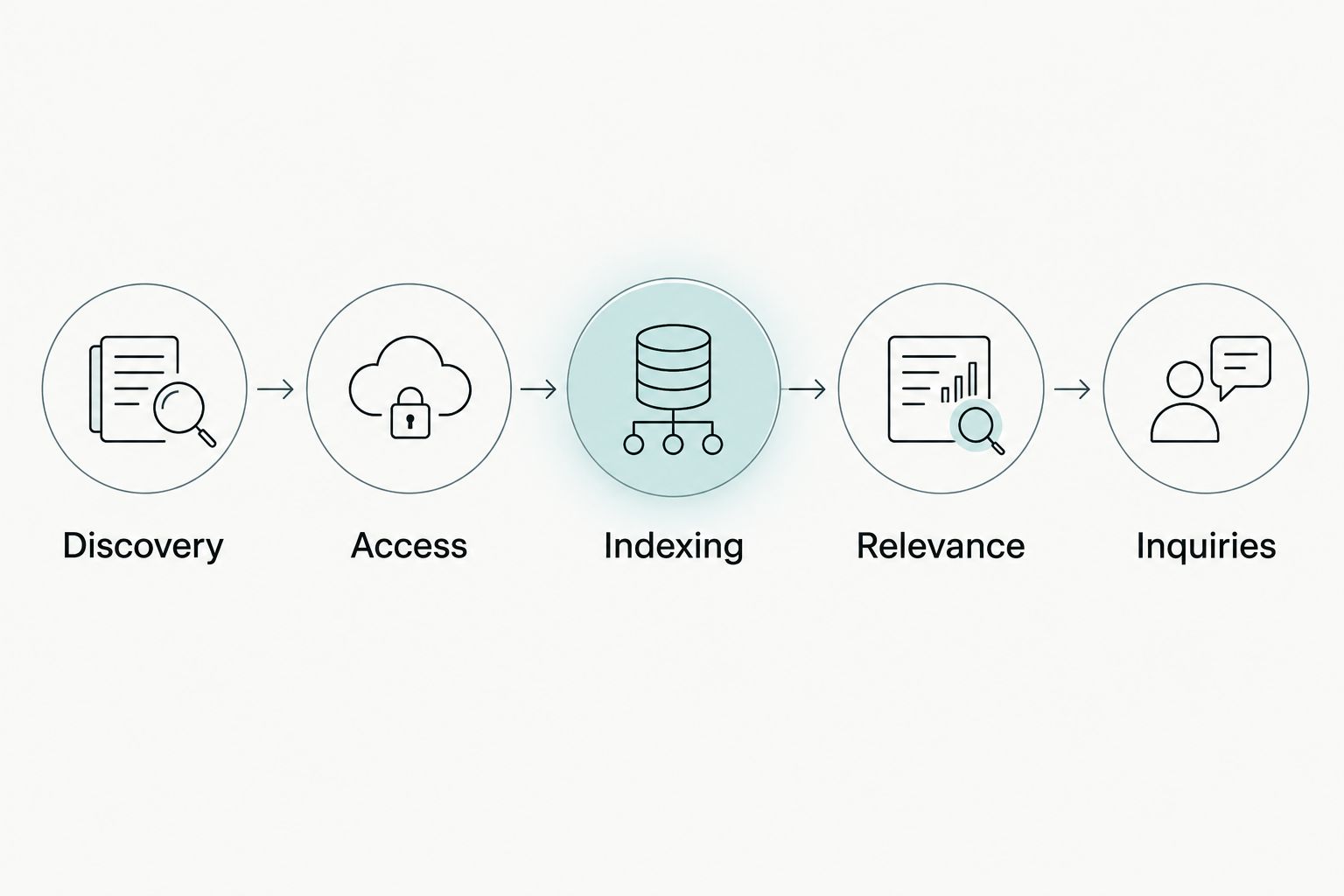
Follow this sequence for an important service page. Start with a page that represents care you actually provide, not a generic article selected only because its topic attracts searches.
- Check discovery. Link to the page from relevant navigation or another useful page. Include the intended canonical URL in your sitemap so search engines have another way to discover it.
- Check access. Confirm that the page loads publicly and does not require a login. Investigate server errors or crawling restrictions before changing the copy.
- Check indexing. Use Google Search Console's URL Inspection tool to inspect the URL. Review indexing information, noindex directives, and whether Google selected a different canonical page.
- Check relevance. Make sure the page identifies the service, the patients it serves, and the location where you provide care. Answer the questions someone needs resolved before making an inquiry.
- Check inquiries. Test the call, booking, and contact paths yourself. A search visit has limited business value when a prospective patient cannot reach the practice.
Discovery, access, indexing, relevance, and inquiries are separate checkpoints. Fix the earliest broken checkpoint first; rewriting a headline will not solve a page that search engines cannot access.
Submitting a page for indexing is a request, not a ranking guarantee. After making a meaningful fix, inspect the page again and monitor its search performance rather than repeatedly submitting an unchanged URL.
Why ranking progress varies
There is no universal launch-to-ranking timetable. These factors explain why two new medical websites can have different search visibility without treating traffic as the qualifying requirement:
- Crawl access and indexing eligibility. A blocked page, an unintended noindex directive, or an unavailable server response can prevent the process from reaching the ranking stage.
- Match to the search. A page about routine dental examinations answers a different need from a page about emergency dental care. Make the distinction clear.
- Content usefulness and trust. Explain the care offered accurately, identify the practice and clinicians, and have qualified people review medical statements.
- Competing results. Google evaluates your page alongside other relevant pages. Existing visibility does not create an entitlement to keep a position, and a new page does not receive one automatically.
- Local context. For local results, Google identifies relevance, distance, and prominence as principal factors. A clinic's service area and physical location matter independently of website visit totals.
- Internal organization. Clear navigation and relevant internal links help people and search engines discover related pages. Isolated service pages make that process harder.
These are useful planning considerations in 2026, not a formula that guarantees placement. Work on the factors you can inspect and improve rather than assigning an unsupported deadline.
Read search data as a diagnosis, not a traffic target
Google Search Console reports impressions, clicks, and position information for your search presence. Your website analytics measures activity after visits occur. Neither system should become a substitute for checking whether prospective patients reach your team.
When an important page has no impressions, inspect indexing before rewriting everything. Then check the queries you expect the page to answer and whether its content actually addresses them. An indexed page still needs a reason to appear for a particular search.
When impressions appear but clicks remain absent, inspect the search terms, title, and description together. A dental implant page appearing for unrelated informational searches has a relevance problem, not simply a weak call to action. Do not judge it by the impression count alone.
When relevant clicks arrive but inquiries do not, test the patient journey. Check whether the page explains the service clearly, identifies the practice, and offers a usable next step on a phone. Keep appointment requests distinct from confirmed appointments in your reporting.
Compare the same page and query groups across consistent reporting periods. Mixing branded searches, treatment searches, and unrelated informational searches hides the source of a change.
Build patient inquiry paths, not just pages that rank
A useful medical service page connects a searcher's need to an appropriate action. For a specialist clinic, that includes explaining the service, introducing the treating clinician, clarifying the location, and showing how to request an appointment.
For a dental practice, walk through a concrete path: a patient searches for a treatment, lands on the relevant page, reads what the practice offers, and selects the appointment action. The destination should make clear whether the patient is requesting contact or booking a confirmed slot.
Check the details that can interrupt that journey:
- Service clarity: Can a patient tell whether the practice offers the care they need?
- Location clarity: Can a patient identify where the appointment would take place?
- Action clarity: Does the button accurately describe what happens next?
- Contact reliability: Does the inquiry reach the person responsible for responding?
- Data handling: Does the workflow direct sensitive information into an appropriate system?
Do not ask a general contact form to perform clinical intake without reviewing its purpose and safeguards. A convenient interface does not establish that a workflow is suitable for patient information.
For a closer look at that handoff, use the guide to connecting patient intake forms to a medical website.
Does a custom website rank better than a template?
Custom design does not automatically outrank a template. Either approach needs accessible pages, useful content, and a clear structure. The meaningful comparison is whether the implementation supports your practice's information and appointment paths.
| Approach | Best for | Useful advantage | Limitation to examine |
|---|---|---|---|
| Template website | Practices whose needs fit an existing layout | Provides a predefined structure for presenting information | Fixed layouts can constrain specialist content or inquiry paths |
| Custom website | Practices needing tailored service pages and patient workflows | Lets the structure follow the practice's requirements | Requires clear scope, review, and ongoing ownership |
Before replacing a template site in 2026, identify the limitation you need to remove. A specialist clinic might need different inquiry routes for referral questions and appointment requests. A dental practice might need treatment pages that lead to the correct booking destination.
Ask providers to demonstrate those paths using portfolio examples. A polished homepage shows design execution; it does not, by itself, prove ranking improvements or more patient inquiries.
Website Symphony is best for medical practices seeking one accountable team for custom website design, marketing, and hosting. The service combination fits that buyer need, but it is not evidence of a guaranteed ranking or inquiry outcome.
When evaluating Website Symphony, ask how the proposed scope connects service pages, search measurement, and patient contact workflows. Confirm responsibilities for content approval, hosting, maintenance, and changes before selecting a provider.
Discuss your medical website priorities
Explain your services, patient inquiry paths, and website requirements.
Can automated assistance help before traffic grows?
Automated assistance should solve a defined patient or staff task, not decorate a new website. A useful proposed application is helping visitors locate office information or the correct appointment-request destination using practice-approved content.
Set the boundary before choosing the feature. It should not invent treatment advice, decide clinical urgency, or imply that an appointment is confirmed when it is only requested. Provide a clear route to staff when the system cannot answer appropriately.
Ask any provider to demonstrate the task, information sources, handoff, and failure behavior. For Website Symphony's AI-powered website work, use those practical questions rather than assuming that an automation feature improves search rankings.
Should I buy traffic to make a new website rank?
Do not buy traffic as a prerequisite for organic rankings. Google states that advertising does not affect a site's presence in organic search results. Use paid campaigns for their stated acquisition purpose, with their own measurement and landing pages.
Traffic from people who are not seeking your services does not answer whether your treatment page deserves to appear for a relevant query. Keep paid acquisition decisions separate from indexing fixes and organic search work.
How long should I wait before changing a new page?
Do not use a fixed waiting period as a substitute for diagnosis. Correct a broken form, an unintended noindex directive, or inaccurate practice information when you find it; those issues do not improve through waiting.
For an accessible, indexed page, review the search evidence before making broad changes. Preserve useful content and change the specific element that the diagnosis supports.
FAQ
Can my new website rank without any visitors?
Yes. A page can appear in Google search before receiving its first organic visit. There is no minimum traffic requirement, but the page must be eligible for indexing and relevant to the search.
Does being indexed mean my website ranks well?
No. Indexing means Google has included a page in its index, not that the page has a prominent position. Check relevant impressions and queries separately.
Will buying ads help my website rank organically?
Buying ads does not improve organic placement. Google separates advertising from organic search results, so assess paid campaigns against their own acquisition goals.
Why does my medical website get impressions but no clicks?
Impressions without clicks mean your page appeared in search but did not receive a visit from those appearances. Review the queries, position, and search presentation before deciding what to change.
Is a custom medical website better for SEO than a template?
Custom design is not an automatic ranking advantage. Choose it when tailored service pages, navigation, or patient inquiry workflows address requirements an existing template cannot adequately support.
What should a dental practice measure besides website traffic?
A dental practice should measure relevant search visibility, patient inquiries, and appointment outcomes separately. A submitted request is not the same as a confirmed appointment.
Can Website Symphony guarantee rankings for a new practice website?
No provider can guarantee a specific Google ranking. Evaluate the proposed work, patient inquiry paths, reporting, and responsibilities instead of accepting a placement promise.
One last thing
A new website can attract its first patient inquiry before it attracts a large audience. That is why your 2026 launch review should include a complete test inquiry—not just a check that the homepage loads.
Open a service page on your phone, follow the appointment action, and confirm that the request reaches the right person. Make the path work before spending effort filling it.