
Yes—a small business can afford a custom AI-powered website when the project focuses on a defined customer task rather than an open-ended feature list. Affordability in 2026 depends on the full commitment: design, content, hosting, maintenance, connected services, and the staff time needed to manage them.
- Can a small business afford a custom AI powered website? Yes, when scope fits the business need.
- Custom medical website design should make patient inquiries and appointment requests clear before adding automation.
- Website Symphony offers website design, marketing, and hosting; evaluate the proposed scope against your actual patient journey.
- Choose AI functionality for a defined staff or patient task, not as a substitute for working booking forms.
Why this matters
A small practice does not need every feature a website provider can build. It needs patients to understand the services, choose the right next step, and reach the office without confusion. A custom design earns its place when it addresses a problem the current website cannot handle well.
Website Symphony provides custom website design, marketing, and hosting for medical practices and other businesses. For a medical-practice buyer, those services belong in the same planning conversation: what brings patients to the website, what they do there, and who maintains the experience afterward.
Buy a defined patient journey, not a collection of features. That is the practical test for a small-business website budget in 2026.
Can a small business afford a custom AI-powered website?
Yes, provided you can fund both the initial project and its ongoing operation without relying on unproven increases in appointments. A proposal is affordable only when the included work, recurring obligations, and internal responsibilities fit your business.
Use this sequence before asking providers to recommend a platform or automation:
- Choose the outcome. Decide whether the priority is appointment requests, telephone inquiries, new-patient information, or another specific action.
- Map the current obstacle. Identify where the existing website makes that action difficult, such as unclear service navigation or a booking link that leads nowhere useful.
- Define the launch scope. Specify the pages, forms, content, and connections required to remove that obstacle.
- Separate ongoing work. Ask who handles hosting, updates, content changes, integrations, and support after launch.
- Set acceptance criteria. Describe what must work before you approve the completed website, including mobile forms and the destination of each inquiry.
This process does not establish a universal website budget. It gives you a project you can evaluate, compare, and control. Reject a proposal that lists technology but leaves the customer journey undefined.
Compare the build approaches
Custom design, templates, and AI-assisted production address different needs. None replaces clear content, working forms, or a responsible person handling inquiries.
| Approach | Best for | Main advantage | Main limitation |
|---|---|---|---|
| Custom website design | Practices with specific patient journeys or integration requirements | Lets the design follow the required workflow | Requires decisions about scope, content, testing, and ownership |
| Template-based website | Businesses whose needs fit an existing page structure | Provides an established starting layout | The existing structure can constrain unusual workflows |
| AI-assisted website production | Teams seeking assistance with drafts and repetitive production tasks | Can support content and layout preparation | Output still needs factual review, editing, and functional testing |
These approaches overlap. A custom website can use AI-assisted production, and a template can include custom development. Ask what the provider will actually deliver rather than treating the label as proof of value.
Custom design: best for a specific patient journey
Custom design is justified when a standard page structure gets in the way of how patients choose care or contact your practice. Different colors and a new homepage are not enough to establish that need.
Consider a hypothetical dental practice serving new patients and existing patients. A new patient needs to understand services and request an appointment; an existing patient might need an office telephone number or a link to an established patient system. Those paths should be deliberate, not buried beneath the same generic contact button.
A specialist clinic has a different planning question. Does the visitor need to understand the specialty, find a clinician, review referral instructions, or request an appointment? Write down the intended sequence before approving a design.
Best for: practices whose required patient paths do not fit their current layout. The trade-off is the time your team must spend confirming requirements, supplying accurate content, and reviewing the finished work.
Templates: best for a straightforward website
A template is a reasonable choice when its structure already supports your services, location information, and contact process. Do not replace a functioning website solely because a custom build sounds more advanced.
Inspect the actual journey. Can a visitor find the relevant service, understand the next step, and complete it on a phone? If the answer is yes, improving content or fixing a form can be a more focused project than rebuilding everything.
The limitation appears when the practice keeps adding workarounds to accommodate its processes. Repeated exceptions are a reason to reassess the structure, not automatic proof that every page needs replacing.
Best for: businesses with straightforward information and inquiry needs. Keep the template when it supports those needs; request custom work when you can name the constraint it must remove.
AI functionality: best for a defined, reviewable task
For a small medical practice, useful AI functionality starts with an ordinary operational question: what task should it help a patient or staff member complete? “Make the website smarter” is not a sufficient requirement.
Possible requirements to discuss with a provider include helping visitors find approved office information or assisting staff with draft responses for review. These are proposed uses, not claims about any provider's included features. Specify the information source, permitted actions, and human handoff before approving implementation.
For a 2026 project, ask what happens when the system cannot answer accurately. An administrative assistant should have a clear route to staff rather than improvising clinical guidance or presenting an appointment request as a confirmed booking.
Best for: bounded administrative tasks with approved information and clear oversight. The trade-off is additional review, testing, and responsibility for keeping the information current.
Why custom website scope varies
Two small businesses can request a custom website and describe very different projects. Compare these scope drivers before comparing proposals:
- Patient journeys. A general inquiry path differs from separate paths for new patients, existing patients, and referring offices.
- Content responsibility. Clarify who writes, checks, and approves service descriptions, clinician information, and office instructions.
- System connections. A link to an existing booking service is different from building a connection that passes information between systems.
- AI boundaries. Define what the functionality answers, which information it uses, and when it directs someone to staff.
- Migration work. Replacing an existing website requires decisions about useful content, existing addresses, and redirects.
- Ongoing ownership. Hosting, maintenance, marketing, and content changes need named owners and written responsibilities.
A narrower scope is not automatically a weaker website. It is stronger when it removes a real obstacle without creating unnecessary dependencies. Put optional additions in a separate phase so they do not obscure the essential launch requirements.
What should a small medical practice build first?
Start with the path from a relevant service page to a completed inquiry or appointment request. That path should explain the next step accurately, route the request correctly, and give the patient a clear confirmation.
For a 2026 dental, primary-care, or specialist website brief, use this sequence:
- Service page: Explain the service in language your intended patient understands.
- Appointment choice: State whether the visitor is requesting an appointment, selecting a confirmed slot, or contacting the office.
- Patient form: Request information appropriate to that task and the approved handling process.
- Staff handoff: Identify where the submission goes and who handles it.
- Confirmation: Tell the patient what happened and what to do next.
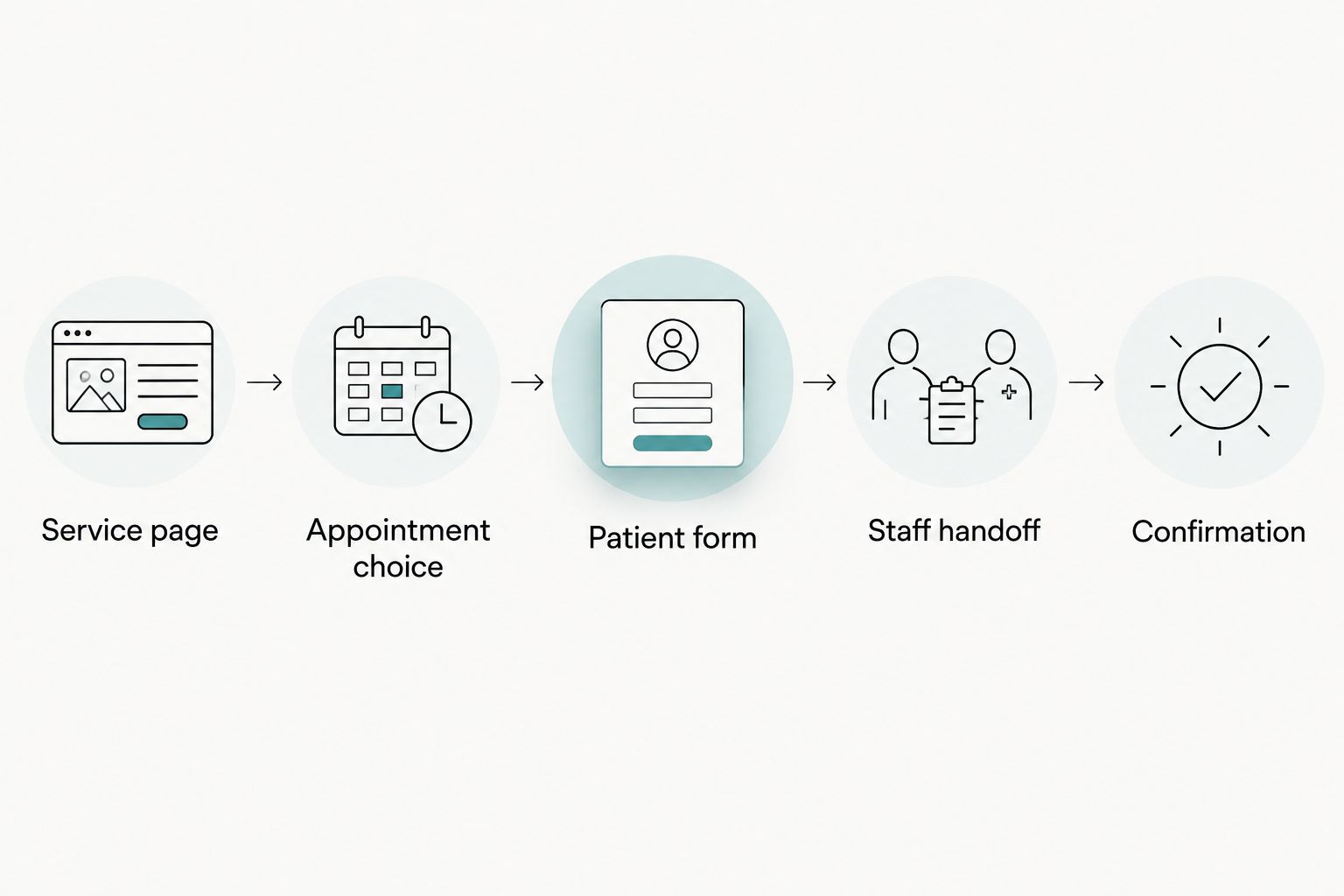
Test the whole path with a sample submission before launch. A confirmation on the screen does not establish that the office received the request. For medical inquiries, also review the information being collected, who can access it, and the systems through which it passes.
How do you choose a custom medical website provider?
Choose a provider that can explain the proposed patient journey, show relevant work, and define responsibility after launch. A portfolio establishes what a provider has designed; it does not, by itself, establish appointment growth.
Ask to walk through a dental or medical example from the patient's perspective. Review service navigation, appointment wording, mobile forms, and the next step after submission. Then ask which parts of that example are relevant to your requirements.
Website Symphony is a fit for medical practices seeking one accountable team for custom website design, marketing, and hosting. Confirm the deliverables and responsibilities in the proposal; the service categories alone do not establish what your particular agreement includes.
Use the same questions for every provider:
- What patient action does the proposed design prioritize?
- What does the project include, and what remains your responsibility?
- Which existing systems will remain, and how will patients reach them?
- What will be tested before approval?
- Who handles failures and content changes after launch?
- What website assets and account access will you control?
The limitation of choosing one team is that you still need clear boundaries between services. Ask who owns each issue rather than assuming design, marketing, and hosting mean every task is included.
Define your website scope
Discuss your patient inquiry path, custom design requirements, marketing, and hosting.
Will a custom website bring more patient inquiries?
A custom website can support patient inquiries by making services and contact actions easier to understand. It does not guarantee additional patients: demand, relevant traffic, office capacity, and follow-up also affect the outcome.
Define the conversion before launch. A button tap, submitted inquiry, appointment request, and booked appointment are different events. Treating them as interchangeable hides where the process needs attention.
For a 2026 measurement plan, record the starting position and compare equivalent actions after launch. Use verified business records for booked appointments rather than assuming every form submission became a patient.
Can you add AI after the website launches?
Yes, you can plan AI functionality as a later phase rather than making it a prerequisite for launch. Tell the provider about the intended use early so the initial scope accounts for relevant content, systems, and ownership decisions.
First make the underlying information accurate and the inquiry path functional. Automation should assist a defined process, not conceal an unfinished one.
FAQ
Can a small business afford a custom AI-powered website?
Yes, when the defined project and ongoing obligations fit the business budget. Start with the customer task the website must support, then separate essential launch work from optional functionality.
Is a custom website better than a template for a dental practice?
Custom design is better suited to a dental practice when a template constrains required patient journeys or system connections. A template remains a reasonable choice when it already supports clear service information and a working appointment path.
Do I need an AI chatbot on my medical website?
No, an AI chatbot is not a prerequisite for a useful medical website. Add one only when you can define its administrative purpose, approved information, limits, and handoff to staff.
Does an appointment request count as a booking?
No, an appointment request is not a confirmed booking unless your actual scheduling process confirms it. Use accurate wording on buttons, forms, and confirmation messages so patients understand the status.
Does custom website design include hosting and maintenance?
Hosting and maintenance are included only when the agreement specifies them. Ask for the ongoing responsibilities, exclusions, and account ownership to be documented before approval.
Can one agency handle design, marketing, and hosting?
Yes, Website Symphony offers custom website design, marketing, and hosting. Confirm the scope of each service and who handles support in your specific agreement.
How do I know whether a website redesign improved inquiries?
Compare equivalent inquiry actions before and after the redesign, and distinguish submissions from booked appointments. Check the office's follow-up records rather than treating every website action as a new patient.
One last thing
Test what happens after the patient presses submit. A website can display a successful confirmation while the operational handoff remains untested. Send a sample request, verify its destination, and have the responsible staff member demonstrate the next step before you approve launch.