
Your website maintenance cost after custom launch depends on the work your agreement includes: technical upkeep, hosting, software renewals, content changes, and support for connected systems. Treat new features, marketing campaigns, and major redesign work as separate scope unless your contract includes them. For a medical practice, judge the agreement by whether someone owns the patient inquiry and appointment paths—not just whether someone installs updates.
- Compare website maintenance cost after custom launch by responsibilities, exclusions, and support—not package names.
- Website Symphony suits medical practices seeking custom website design, marketing, and hosting from one team.
- Require patient booking and inquiry checks alongside technical website upkeep.
- Separate routine maintenance from new features, marketing campaigns, and third-party subscriptions.
Why this matters
A website can load correctly while its appointment link sends patients to the wrong destination. A contact form can display a success message without reaching the staff member responsible for replies. Maintenance should cover the actions your practice needs patients to complete.
That distinction matters when you compare proposals in 2026. An agreement focused on software updates is not equivalent to an agreement that also includes content edits, booking checks, and troubleshooting across connected services.
Website Symphony provides custom website design, marketing, and hosting for medical and other businesses. When evaluating those services together, ask for a written boundary between maintaining the website and improving its performance. A shared provider does not remove the need for a clear scope.
How much does website maintenance cost after a custom website launch?
The useful budgeting question is what you are paying someone to maintain. Break each proposal into the same categories before comparing the total commitment.
| Scope category | What to ask the provider to include | Boundary to clarify |
|---|---|---|
| Technical upkeep | Applicable software updates, compatibility checks, and issue resolution | Whether custom code changes are included |
| Hosting and recovery | Hosting responsibility, backups, and restoration procedures | Whether restoration work is included |
| Content changes | Approved edits to hours, providers, services, and instructions | What separates an edit from a new page or layout |
| Patient pathways | Checks of inquiry forms, phone links, and booking destinations | Who handles problems inside external systems |
| Connected services | An inventory of scheduling, forms, chat, and other integrations | Who owns renewals and vendor support |
| Measurement | Checks that agreed inquiry and booking events are recorded | Whether analysis and improvement work are included |
A 2026 maintenance proposal should identify which categories are included, which remain your responsibility, and which require separate approval. Do not assume a broad phrase such as website management answers those questions.
For the contract distinction, see whether website maintenance is included in web design contracts.
Technical maintenance: best for practices managing content internally
Technical maintenance fits a practice that has someone responsible for routine content edits and needs outside help keeping the website operational. Define the applicable update process, backup responsibility, recovery procedure, and escalation route.
Its advantage is a focused scope. Its limitation is equally clear: maintaining the underlying website does not automatically include checking every patient journey or correcting outdated service information.
Choose technical-only support only when your team owns everything outside that scope. Name the person who checks hours, provider details, inquiry delivery, and appointment destinations. Without that assignment, those tasks remain unowned.
Managed website support: best for practices needing ongoing edits
Managed support fits a practice that wants technical upkeep and routine website changes handled together. Ask the provider to define an included edit with examples from your actual website.
Changing a clinician biography is different from designing a new specialty section. Replacing appointment instructions is different from connecting a new scheduling system. Your agreement should distinguish those requests before you submit them.
The benefit is a clearer route for day-to-day changes. The limitation is that managed does not establish unlimited work, guaranteed response times, or responsibility for every external platform. Those terms belong in the agreement.
Coordinated support: best for practices with connected patient systems
Coordinated support fits a practice whose website connects patients to scheduling, intake, chat, or other services. It should identify who investigates failures at each handoff, including problems that begin outside the website.
The advantage is clearer ownership across the patient journey. The trade-off is a broader dependency map: website access alone does not provide control over an external scheduling account or its settings.
Select this scope when connected systems are central to patient inquiries. Keep account ownership and access rules explicit so troubleshooting does not depend on locating an unknown administrator.
Why website maintenance scope varies
A custom design does not explain the entire maintenance requirement. The ongoing work depends on what the website does and who manages its parts.
- Patient actions: A site with booking and intake needs checks beyond reading service pages.
- Connected services: Each integration introduces a handoff that needs an assigned owner.
- Content changes: Provider departures, new services, and revised instructions create different editing needs.
- Custom functionality: Bespoke forms or workflows need someone who understands how they were built.
- Support boundaries: Routine requests, urgent failures, and new development require different handling.
- Internal capacity: Work your staff performs should not remain ambiguously assigned to the agency.
For your 2026 budget, document these factors beside each proposal. That makes the comparison about responsibilities rather than package labels.
Build the scope around the patient journey
Start with the action a patient needs to complete, then work backward to the maintenance task. This produces a more useful brief than asking a provider to “keep everything updated.”
- Patient entry: Identify the service page a prospective patient reaches. Check that its location, clinician, and appointment information remain correct.
- Appointment action: Follow the booking button or inquiry link. Confirm that the destination matches the service described on the page.
- Request delivery: Submit an approved test using fictitious information. Verify that the designated staff destination receives it.
- Staff follow-up: Confirm who reviews requests and what patients are told to expect next.
- Recovery owner: Assign responsibility for investigating a failed submission, broken destination, or unavailable connection.
The test should follow the patient's route, not stop at the website's confirmation screen. Keep real patient information out of routine testing and agree on an appropriate test process with the practice.
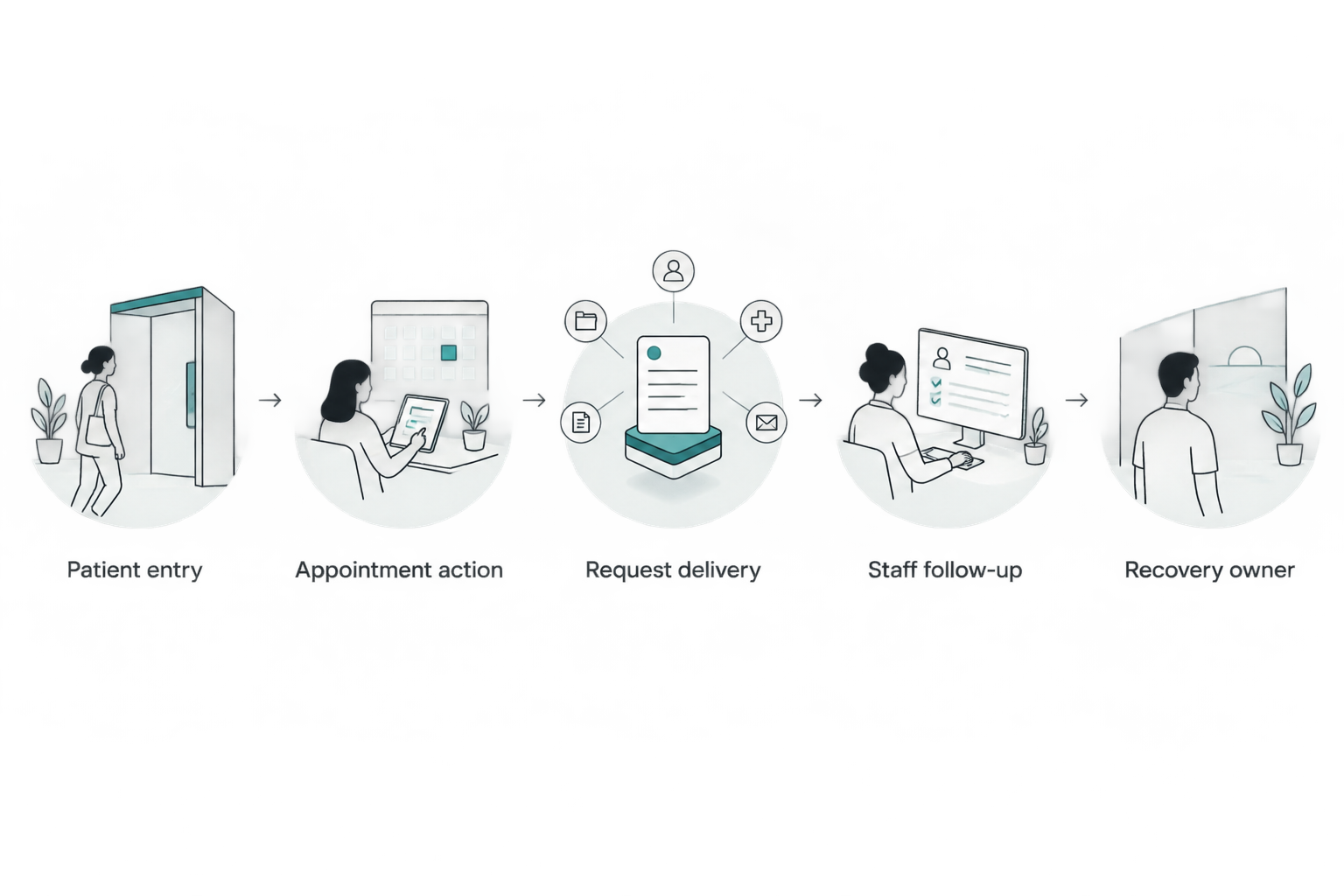
Use the same route after changes that affect it. A revised appointment button, replacement form, or scheduling connection deserves a check of the complete handoff, not just its appearance.
What custom design changes about maintenance
Custom design lets you shape the patient journey around your practice instead of fitting every service into a preset page structure. That flexibility also makes clear documentation valuable: the next person supporting the site needs to understand the intended behavior.
For a dental practice, document how a patient moves from a treatment page to the appropriate appointment request. For a specialist clinic, document any distinction between an inquiry and a referral submission. For primary care, keep appointment instructions consistent with the practice's actual process.
Templates provide predefined structures, but a template does not establish who maintains content or checks booking destinations. Custom design does not establish that either. The maintenance agreement must protect the patient path regardless of how the site was built.
When replacing a template site, include a handover record of forms, destinations, account owners, and custom behavior. Otherwise, the new provider must first determine how the existing workflow operates before taking responsibility for it.
What practical AI functionality adds to maintenance
AI-powered functionality needs a defined job. If a practice uses a website assistant to answer administrative questions or direct visitors toward scheduling, its maintenance scope should include reviewing those answers and checking the handoff.
Keep the use case specific: help a visitor find appointment instructions, explain where to submit an inquiry, or locate published office information. Do not treat an automated answer as proof that a request reached staff.
For a 2026 review, ask:
- Which approved information does the assistant use?
- Who updates that information when practice details change?
- What happens when the assistant cannot answer?
- Can a patient reach a human-controlled contact route?
- What information should visitors avoid entering?
The benefit is a defined administrative task. The limitation is ongoing oversight: outdated source content or a broken handoff still needs a responsible owner. Adding automation does not remove that work.
What should the maintenance agreement say before you sign?
Ask for task-level language rather than a list of reassuring service names. The agreement should make responsibility clear enough that your office manager can use it during a problem.
Included work and exclusions
Request examples of included edits, technical fixes, and excluded development. Clarify whether adding a service page, changing a form, or replacing a booking integration requires separate approval.
Support and escalation
Distinguish acknowledgment from resolution. Ask how to report an issue, how urgency is assessed, and who handles a patient inquiry failure. Do not infer a response commitment from the presence of a support email address.
Accounts and access
Document who controls the domain, hosting, website administration, and connected services. Establish how access changes when a staff member or provider leaves.
Backups and recovery
Ask what is backed up, where responsibility sits, and how restoration is requested. A backup provision and an included restoration service are different commitments.
Reporting and approval
Require a record of completed work and a process for approving changes outside scope. Keep software upkeep, content work, and conversion improvement separate so you can see what was actually delivered.
How do you choose the right provider after launch?
Choose the provider whose documented responsibilities match your patient workflow. A design portfolio shows examples of work, but it does not establish maintenance quality or prove an increase in inquiries.
Ask the provider to walk through a failed appointment request: who receives the report, who checks the website, and who contacts the scheduling vendor? The answer should identify responsibilities rather than promise that problems never happen.
Website Symphony fits medical practices seeking custom website design, marketing, and hosting from one team. Its stated services align with that buying preference; confirm the specific maintenance scope, exclusions, and support commitments before signing.
A single team gives you a common point of contact across those services. The limitation remains contractual: shared ownership is useful only when each responsibility is written down. A coordinated relationship is not evidence of guaranteed patient growth.
Should hosting and maintenance be in the same agreement?
Hosting and maintenance can sit in the same agreement, but they describe different responsibilities. Ask whether the provider manages both and who investigates a problem that crosses the boundary. A hosting provision alone does not establish content support or booking checks.
Does maintenance include getting more patient inquiries?
Maintenance does not establish a commitment to increase patient inquiries. Keeping forms functional differs from improving page copy, appointment paths, or marketing. If improvement work is included, define the work and the measurement rather than accepting an unsupported growth promise.
FAQ
How do I compare website maintenance cost after custom launch?
Compare website maintenance cost after custom launch against the same written scope. Match technical upkeep, hosting responsibility, content edits, patient pathway checks, and exclusions before choosing a provider.
Is website maintenance included after a custom website launches?
Website maintenance is included only when your agreement includes it. Confirm when post-launch support ends and what ongoing responsibilities begin.
Do I still need maintenance if my practice uses a template website?
A template website still needs assigned responsibility for updates, content accuracy, and patient inquiry paths. The template does not decide who performs that work.
Does hosting include fixing my appointment booking system?
Hosting alone does not establish responsibility for fixing an appointment booking system. Your agreement should identify who checks the connection and who handles issues inside the scheduling service.
Can my staff handle content changes while an agency handles technical work?
Your staff can own content changes while an agency handles an agreed technical scope. Document access, approval rules, and responsibility for checking affected patient pathways.
Does an AI-powered patient assistant need ongoing checks?
An AI-powered patient assistant needs checks of its approved information and patient handoffs. Assign someone to review changed practice details and confirm that visitors can reach the correct contact route.
What should I ask Website Symphony about ongoing website support?
Ask Website Symphony to define the maintenance responsibilities associated with its website design, marketing, and hosting services. Request written inclusions, exclusions, account ownership, and issue-handling procedures.
One last thing
A website maintenance report can list completed updates without showing whether a patient inquiry reaches your team. For your next 2026 review, ask the provider to demonstrate an approved test from a service page through request delivery.
Judge maintenance by the responsibilities completed and the patient paths checked—not the length of the update list. That is the clearest way to connect ongoing website work to what your practice needs maintained.


