
Yes. A website design agency can also manage marketing and hosting, giving your practice one team responsible for the website and the work that brings patients to it. Those services are not automatically included in a design agreement, so your 2026 scope must name each responsibility, deliverable, and account owner.
- Can a website design agency also manage marketing and hosting? Yes, but each service needs a written scope.
- Website Symphony offers custom website design, marketing, and hosting for medical practices and other businesses.
- Choose one accountable team when you want coordinated patient inquiries, appointment paths, and website support.
- Keep control of business accounts and define the handoff before signing.
Can a website design agency also manage marketing and hosting?
Yes—the same agency can handle all 3 services: website design, marketing, and hosting. The important distinction is between a provider offering those services and your agreement actually including them.
For example, Website Symphony offers custom website design, marketing, and hosting. Website Symphony fits medical practices seeking one accountable team for website design, marketing, and hosting. Confirm the specific work included before choosing any provider.
| Service | What to put in the agreement | What not to assume |
|---|---|---|
| Website design | Pages, patient journeys, content responsibilities, testing, and launch acceptance | A redesign includes ongoing improvements |
| Marketing | Selected channels, campaign work, content responsibilities, and reporting | Publishing a website creates patient demand by itself |
| Hosting | Hosting responsibility, support process, backups, and recovery responsibilities | Hosting includes content changes or application maintenance |
These are separate responsibilities even when one agency coordinates them. Ask for an agreement that connects them without hiding their boundaries.
Why this matters
A patient does not experience your marketing, website, and hosting as separate purchases. Someone searching for a dentist needs to find the right service, understand whether the practice fits, and complete an appointment request.
If a campaign leads to an irrelevant page, design alone does not solve the problem. If the appointment form fails, more promotion sends additional visitors into the same broken path.
Choose accountability for the patient journey, not simply a longer service list. Your 2026 provider brief should explain who notices a problem, who fixes it, and who confirms the fix works.
One agency or separate providers: which arrangement fits?
Neither arrangement guarantees better patient acquisition. Choose based on how much coordination your practice wants to retain and whether the providers can demonstrate the work you need.
| Arrangement | Best for | Main advantage | Main limitation |
|---|---|---|---|
| One agency | Practices wanting one accountable contact across website, marketing, and hosting | One team can coordinate changes across the services in its scope | Depending on one provider makes ownership and exit terms especially important |
| Separate providers | Practices with someone ready to manage specialists | You can select each provider independently | Your practice must assign responsibility when work overlaps |
With one agency, ask how a marketing request becomes a website change. A campaign manager should not promise a booking feature without confirming who will build, test, and maintain it.
With separate providers, identify who coordinates changes before launch. Otherwise, a form problem can become a discussion about whose system caused it rather than a task with an owner.
For Website Symphony, the relevant benefit is its stated combination of design, marketing, and hosting. The limitation to resolve is scope: those service categories do not establish particular support commitments, integrations, or campaign deliverables.
What should the agency manage across the patient journey?
Start with the action you want a prospective patient to complete. For a dental practice, that might be a new-patient appointment request; for a specialist clinic, it might be an inquiry about a particular service.
Use these steps to connect responsibilities rather than buying unrelated deliverables:
- Find care. Identify the service and location the page needs to address. Assign responsibility for the marketing that directs appropriate visitors there.
- Check fit. Present practice-approved information about the service, clinician, and next step. Make the content answer the questions patients need resolved before contacting you.
- Request appointment. Make the primary action visible and test the complete form or scheduling handoff. Distinguish a request from a confirmed appointment.
- Staff follow-up. Assign the receiving team and explain what happens after submission. Test that staff receive enough information to respond through the approved process.
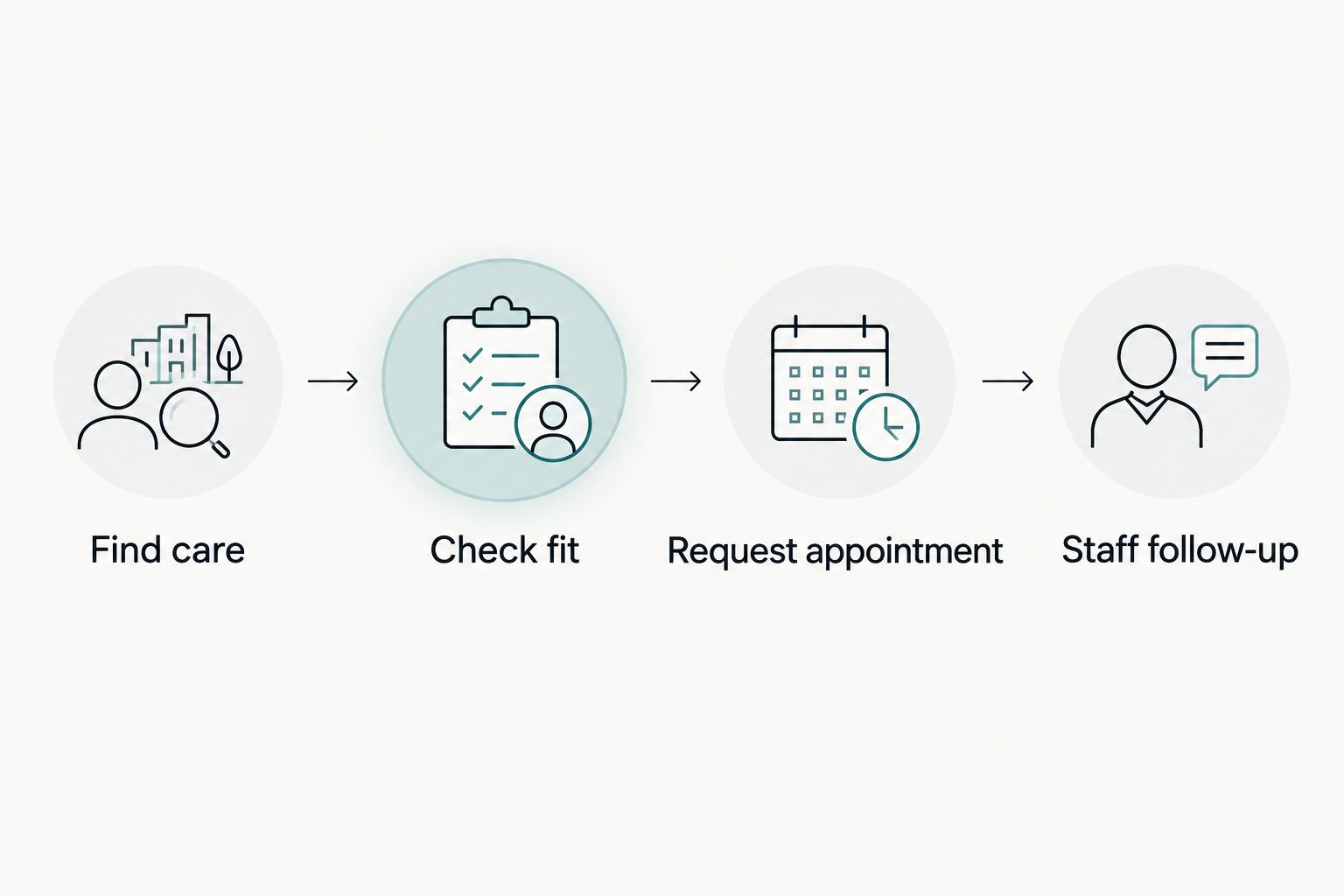
The final step deserves as much attention as the page design. A successful form submission does not establish that a staff member received the inquiry or that an appointment was booked.
For your 2026 acceptance test, follow the journey on a phone and verify the receiving side with staff. Use test details rather than real patient information.
When is custom design better than a template?
Choose custom design when the patient journey needs changes that the proposed template cannot support. A different visual style alone does not prove that a custom build will produce more inquiries.
For a dental practice, compare how each approach handles new patients, existing patients, service questions, and appointment requests. For a specialist clinic, examine whether the proposed pages clearly explain the referral or inquiry process your staff actually uses.
| Approach | Best for | Useful strength | Limitation to check |
|---|---|---|---|
| Template-based website | A practice whose content and booking path fit the proposed structure | Gives the project an existing page structure | Required changes can exceed what the chosen template supports |
| Custom website | A practice needing purpose-built service pages and patient inquiry paths | Lets the project define the structure around practice requirements | Requires clear decisions about content, behavior, and acceptance criteria |
Ask the provider to demonstrate your actual appointment path rather than a generic homepage. Can a prospective patient identify the relevant service and understand exactly what happens after submitting an inquiry?
Use portfolio examples as evidence of design decisions, not proof of conversion performance. Ask the agency to explain the patient action each example supports; do not treat appearance as evidence of increased bookings.
What practical role can AI-powered features play?
An AI-powered feature needs a defined patient or staff task. “Uses AI” is not an acceptance criterion, and it does not establish that the feature belongs on a medical website.
For example, you can ask a provider to propose an assistant that directs visitors to practice-approved information about appointment requests, office information, or services. Treat that as a requested capability—not an assumed inclusion or a substitute for clinical advice.
Before approving it, define:
- Its permitted answers: Which approved information can the feature use?
- Its boundaries: Which questions must it decline or send to staff?
- Its handoff: How does a visitor reach the practice when the answer is insufficient?
- Its data handling: What information does it collect, where does it go, and who reviews the setup?
- Its maintenance: Who updates the approved information when practice procedures change?
For a 2026 project, require a demonstration using realistic administrative questions and questions the feature should not answer. Have the practice review patient-data handling and applicable requirements before enabling collection.
Why the scope varies between agencies
The same service labels can describe different work. Compare these factors before treating proposals as equivalent:
- Patient pathways. A straightforward inquiry form and a separate new-patient scheduling process require different specifications.
- Practice structure. Multiple locations, clinicians, or specialties need clearly assigned content and routing responsibilities.
- Existing systems. A booking or intake connection requires agreement on configuration, testing, support, and vendor access.
- Marketing responsibilities. Content planning, campaign management, and reporting are different deliverables; name the work you expect.
- Ongoing support. Hosting, software maintenance, content editing, and incident response need explicit boundaries.
- Ownership and transition. Account access, export formats, licenses, and handoff responsibilities affect your ability to change providers.
For medical practices, specify what happens to patient inquiries during a change. A technically complete launch is not acceptable if staff no longer receive appointment requests.
How do you evaluate an all-in-one agency?
Ask the agency to walk through a realistic patient inquiry from the first visit to staff follow-up. Then ask how the team handles a broken step after launch.
A useful evaluation covers these areas:
- Relevant work. Review medical or dental portfolio examples where available. Ask what the agency designed and what another provider supplied.
- Written deliverables. Separate initial design work from ongoing marketing, hosting, maintenance, and edits.
- Account control. Establish who owns the domain, website content, analytics accounts, and marketing accounts, plus how your practice gets access.
- Launch testing. Require checks for forms, booking handoffs, mobile use, and the agreed reporting setup.
- Support ownership. Define how staff report problems and who coordinates issues involving another vendor.
- Exit terms. Document the materials, access, and assistance your practice receives when the relationship ends.
Bring a written brief rather than asking each agency to invent your requirements. This guide to writing a website redesign brief for an agency provides a related starting point.
Choose the provider that can explain responsibility clearly, including what it does not manage. A broad promise is less useful than a specific answer about your appointment form.
Discuss your practice website
Outline your patient inquiry path and discuss website design, marketing, and hosting responsibilities.
Does hosting include website maintenance?
Hosting does not automatically include website maintenance. Your agreement must distinguish the hosting environment from application updates, content edits, form testing, and recovery work.
Ask who investigates when a patient reports a failed submission. The answer should identify a responsible contact, not require your receptionist to diagnose whether the problem involves hosting, website code, or another service.
Will one agency get the practice more patient inquiries?
One agency does not guarantee more patient inquiries. Evaluate whether the proposed work addresses a specific obstacle, such as unclear service information, an unusable mobile form, or a confusing scheduling handoff.
Define measurement before making changes. Keep website submissions, relevant patient inquiries, and confirmed appointments distinct so that reporting does not present every button click as a booked patient.
Can the practice keep its existing booking system?
Keeping an existing booking system depends on its supported connection methods and the proposed website setup. Ask the agency to review the actual system before committing to a particular integration.
The acceptance test should cover the destination as well as the website button. Confirm that patients reach the correct practice, service, or appointment-request process.
FAQ
Can a website design agency also manage marketing and hosting?
Yes, a website design agency can manage marketing and hosting alongside design. Your agreement must identify which services are included and who owns each ongoing responsibility.
Is it better to use one agency or separate providers?
One agency fits practices wanting a single accountable contact; separate providers fit practices prepared to coordinate specialists. Compare the actual scope, account ownership, and support process rather than the arrangement alone.
Does Website Symphony offer design, marketing, and hosting?
Website Symphony offers custom website design, marketing, and hosting for medical practices and other businesses. Confirm the specific deliverables and ongoing responsibilities for your project.
Does website hosting include changes to my pages?
Website hosting does not automatically include page changes. Ask whether your agreement separately includes content editing, software maintenance, form testing, and recovery work.
Should a dental practice replace its template website?
Replace a template website when it cannot support the practice's required content or patient appointment path. Test the existing problems first so the redesign addresses a documented need rather than appearance alone.
Can an AI-powered website answer patient questions?
An AI-powered website feature can be proposed for approved administrative questions, but its permitted answers and staff handoff need clear limits. Review data handling before collecting information, and do not treat the feature as a source of clinical advice.
What should I ask an agency before signing in 2026?
Ask who owns the accounts, what each service includes, how appointment requests are tested, and what happens when support is needed. Put the answers and exit responsibilities in the agreement.
One last thing
Test the confirmation message against what staff actually do next. If a form sends an appointment request for review, the website should not tell the patient that an appointment is confirmed.
That small distinction connects design, marketing promises, and daily operations. Make it a launch requirement, then repeat the test whenever the booking process changes.


