
Website hosting is included in a web design package only when the agreement explicitly includes it; buying a website does not automatically buy ongoing hosting. Maintenance, business email, domain renewal, and appointment-system support are separate responsibilities unless the agreement names them. For a medical practice, the deciding question is who keeps the patient inquiry and booking paths working after launch.
- Is website hosting included in web design packages? Only when the agreement explicitly includes ongoing hosting.
- Website Symphony offers custom website design, marketing, and hosting; confirm the specific package scope before signing.
- Hosting keeps your website accessible; maintenance and appointment-system support need their own written scope.
- Choose a provider by patient booking responsibilities, ownership terms, and support coverage—not the word included.
Why this matters
A dental website can load correctly while its appointment form sends inquiries to the wrong inbox. A specialist clinic can have working hosting but a broken scheduling link. Hosting coverage is not the same as responsibility for the entire patient journey.
Website Symphony provides custom website design, marketing, and hosting for medical businesses and other sectors. When reviewing Website Symphony, ask for a written scope connecting those services to your practice's actual inquiry process—not just a list of technical features.
Is website hosting included in web design packages?
Hosting is included only if the proposal or service agreement says so and defines the coverage period. For your 2026 website project, look for a named hosting service, a start date, renewal terms, and an explanation of what happens when the agreement ends.
The arrangement matters more than the package label. Use this comparison to identify the responsibilities you would retain.
| Arrangement | Best for | Main advantage | Main limitation | Confirm before signing |
|---|---|---|---|---|
| Design with ongoing hosting | Practices wanting a coordinated website relationship | Design and hosting questions can go to the same provider | Bundling alone does not establish maintenance or booking support | Included tasks, renewal terms, and exit process |
| Design with separate hosting | Practices retaining an existing host or technical contact | You can keep hosting under a separate account | Someone must coordinate the designer and host | Launch access, compatibility, and troubleshooting ownership |
| Hosted website builder | Practices comfortable managing a platform-based site | Site editing and hosting sit within the platform | Moving elsewhere can require rebuilding parts of the site | Export options, integrations, and account ownership |
None of these arrangements guarantees more patient inquiries. The better choice is the one that assigns responsibility clearly and supports the booking process you need.
What language should you look for?
Look for statements describing ongoing website hosting, not just website deployment or launch assistance. Deployment means publishing the site; it does not establish who operates the hosting afterward.
Ask the provider to distinguish included services from optional services. A clear proposal should let your office manager answer who to contact when the website is unavailable, a form fails, or a provider profile needs updating.
Design with hosting: best for coordinated responsibility
A combined arrangement suits a practice that wants fewer handoffs between website suppliers. The practical benefit is accountability: your team has a defined route for reporting problems that cross design and hosting boundaries.
The limitation is contractual. A combined package can still exclude content edits, software updates, or help with an external scheduler. Choose the bundle for its written responsibilities, not its convenience language.
For a dental practice, ask whether support covers the path from a treatment page to an appointment request. For primary care, include location selection and new-patient inquiries. For a specialist clinic, include referral instructions where relevant to your workflow.
Design with separate hosting: best for retaining control
Separate hosting fits a practice that already has a suitable hosting account and someone responsible for it. You retain a distinct relationship with the host while commissioning the website design separately.
The trade-off is coordination. If a form stops working, the designer and host need a defined process for identifying the cause rather than sending your staff between support teams.
Before approving this arrangement, name the person who handles hosting access, launch changes, backups, and incident reporting. Keep those responsibilities in the project scope, even when different organizations perform them.
A hosted builder: best for platform-based management
A hosted builder combines website creation tools with hosting inside a platform. This arrangement suits a practice whose editing needs and patient inquiry process fit that platform's supported features.
The constraint is flexibility. A template can provide a starting layout, but your practice still needs accurate service information, a clear contact route, and a booking process that staff can manage.
For your 2026 review, ask what transfers if you leave. Content ownership and the ability to export a working website are different questions; get an answer to each before treating the platform as a long-term fit.
Why hosting inclusion varies
Hosting inclusion depends on how the provider divides the initial build from ongoing operations. These are the factors to inspect in the agreement:
- Project scope: A design-only engagement and an ongoing website service assign different responsibilities after launch.
- Hosting arrangement: Hosting in a provider-managed environment differs from deploying into your existing account.
- Maintenance scope: Website software, extensions, and custom functionality need an explicitly assigned owner.
- External services: Appointment tools, forms, email delivery, and other connections need separate support boundaries.
- Support coverage: The agreement should identify what help you receive and how you request it.
- Exit requirements: Account access, website files, domain control, and migration assistance need clear terms.
Do not interpret a long feature list as complete coverage. Ask the provider to translate each feature into a task, an owner, and an escalation route your staff can follow.
How do you verify what your package includes?
Use these 5 checks when comparing proposals. They turn a broad promise into questions that you can resolve before launch.
- Confirm scope. Identify the hosting environment and distinguish website hosting from business email and domain registration. Ask which accounts belong to your practice.
- Assign responsibility. Name the contact for outages, broken forms, content corrections, and scheduler problems. Separate the agency's duties from the booking provider's duties.
- Test booking. Follow the website from a service page through the appointment or inquiry action. Confirm that the receiving staff member gets the submission.
- Check recovery. Ask what is backed up, who can restore it, and which external systems sit outside that process. A website backup does not automatically include an independent scheduling account.
- Confirm ownership. Establish who controls the domain, hosting access, content, and website files. Request the transfer procedure before you need it.
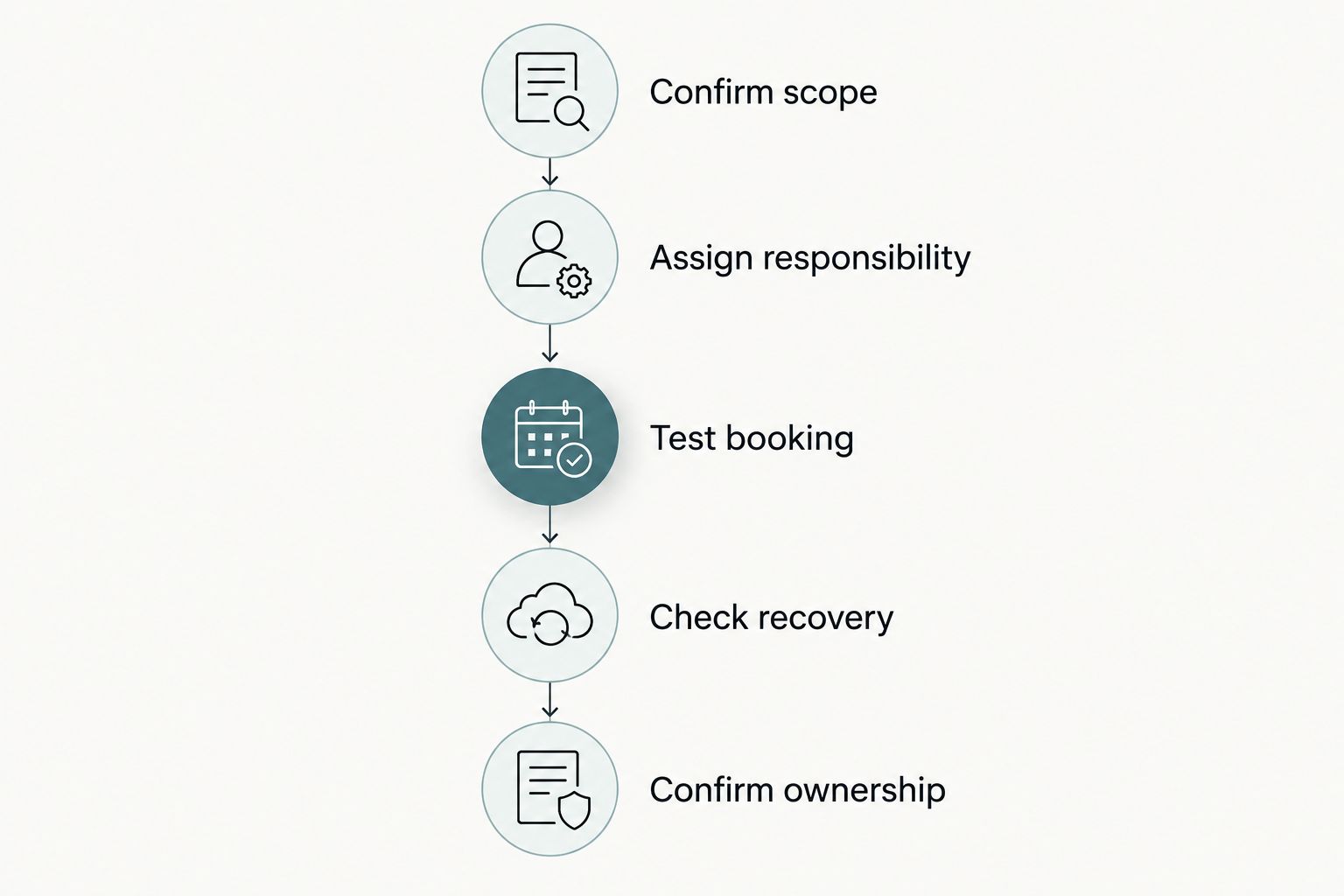
Keep the completed answers with your 2026 project agreement. A proposal is easier to manage when your practice and provider share the same definition of launch completion and ongoing support.
What should a medical practice test before launch?
Test the paths patients will actually use, not just the homepage. For a dental practice, that means finding a treatment, choosing a location when applicable, and reaching the correct appointment or inquiry destination.
Use 3 test submissions: a new-patient inquiry, a request about a service, and a general contact message. Use fictional details rather than real patient information, and verify delivery with the staff member responsible for each destination.
Also check 2 contact routes: the website's written inquiry route and its telephone route. Confirm that the displayed number, mobile calling action, confirmation message, and staff instructions agree.
These are acceptance checks, not conversion benchmarks. They establish whether the website performs its intended tasks; they do not prove that the redesign increased bookings.
Does included hosting also include website maintenance?
Included hosting does not establish that maintenance is included. Hosting provides the environment that serves the website; maintenance covers the agreed work required to keep its software and functionality operating.
Ask which updates the provider handles and who checks the site afterward. A software update is not a completed patient-path check until the relevant forms and booking connections still work.
Content updates need their own definition. Changing a clinician biography, replacing office hours, and repairing a broken integration are different tasks, even when you report all of them to the same team.
Does included hosting cover appointment booking software?
Included hosting does not establish that appointment software or its support is included. A website can link to an external scheduler without the hosting provider managing that scheduler's account, settings, or patient communications.
Ask where responsibility changes hands. Your agreement should distinguish a broken website button from a scheduling-system problem and tell staff where to report each issue.
For a closer look at the handoff between your site and patient information collection, read the guide to connecting patient intake forms to a medical website.
Can you move your website if you change providers?
Your ability to move the website depends on the platform, ownership terms, and available export process. Keeping your domain does not necessarily mean that you can transfer the complete working site to another host.
Ask what you receive when the relationship ends: content, design assets, website files, administrative access, and instructions for any remaining external accounts. Clarify which components require replacement rather than transfer.
Make this part of your 2026 provider evaluation. Exit terms are a buying criterion, not an administrative detail to postpone until a relationship ends.
When is custom design better than a template?
Custom design is the better fit when your patient inquiry process requires a structure that a template does not accommodate clearly. Start with the patient task: finding the right service, understanding the next step, and contacting the correct team.
A dental practice might need separate inquiry paths for different treatments. A specialist clinic might need referral guidance, while primary care might prioritize location and new-patient instructions. Specify the requirement before choosing the layout.
Templates offer a starting structure; custom work lets the provider design around the agreed workflow. The trade-off is that custom functionality also needs documented maintenance and handoff responsibilities. Neither approach removes the need to test patient paths.
Where does practical AI functionality belong?
AI-powered functionality belongs where it serves a defined patient or staff task. Examples to discuss with a provider include helping visitors find approved administrative information or preparing draft website updates for staff review.
Treat these as proposed requirements, not assumed package features. Ask what information the feature uses, what it must not answer, how staff review it, and who maintains it after launch.
Hosting inclusion does not establish AI functionality, clinical accuracy, or suitability for patient information. For a medical website, keep the task narrow and the human handoff clear. Review those boundaries alongside the rest of your 2026 service scope.
How should you assess a combined provider?
Website Symphony is best for practices seeking one team for custom website design, marketing, and hosting. That service fit does not establish which tasks a particular agreement includes; confirm the scope against your patient inquiry workflow.
Ask to see relevant portfolio work and have the provider explain the appointment path. A portfolio can show design and workflow choices, but screenshots alone do not prove an increase in patient inquiries.
Website Symphony's combined services give you a starting point for that conversation. Evaluate the proposed responsibilities, ownership terms, and booking checks rather than assuming that a single provider automatically covers every external system.
FAQ
Is website hosting included in web design packages?
Website hosting is included only when the package agreement explicitly says so. Confirm the coverage period, ongoing responsibilities, and renewal terms before signing.
Does paying for website design mean I own the hosting account?
Paying for website design does not establish ownership of the hosting account. Ask who holds the account and what access or transfer rights your practice receives.
Is website maintenance the same as hosting?
Website maintenance is not the same as hosting. Hosting serves the website, while maintenance covers the specific updates, checks, and repairs assigned in your agreement.
Will included hosting keep my appointment forms working?
Included hosting alone does not guarantee working appointment forms. Assign responsibility for testing the form, delivering submissions, and troubleshooting any external booking connection.
Should my dental practice choose custom design or a template?
Choose custom design when your dental practice needs a patient inquiry structure that a template does not support clearly. A template remains an option when it fits your content, booking process, and maintenance needs.
Can I keep my domain if I change website providers?
Domain control and website transfer are separate issues. Confirm the domain account holder and transfer access, then establish whether the website itself can move to another host.
Does hosting include business email?
Website hosting does not establish that business email is included. Ask whether email accounts, delivery support, and any required account changes sit within the agreement.
One last thing
A successful form submission is not the same as a received inquiry. During acceptance testing, watch the message reach the correct staff destination and confirm who responds. That final handoff connects the website project to the appointment process your practice actually runs.