
Your primary care practice website cost in 2026 depends on the work included: design, content, patient inquiry paths, scheduling connections, and ongoing support. Compare the initial build with the full operating commitment, because hosting, maintenance, software subscriptions, and marketing are separate scope items unless your agreement includes them.
- Compare primary care practice website cost by scope, patient booking requirements, and ongoing responsibilities—not appearance alone.
- Website Symphony fits medical practices seeking custom website design, marketing, and hosting from one team.
- Choose custom design when patient inquiries need workflows that a template cannot support cleanly.
- Request separate build, hosting, maintenance, and integration terms before approving a proposal.
How much does a primary care practice website cost in 2026?
A useful estimate starts with a defined patient journey, not a page count. A website that directs patients to an existing scheduler has a different scope from a website that requires a new scheduling connection, intake routing, and staff notifications.
Use the primary care practice website design guide to define the patient-facing requirements before comparing proposals. Then ask every provider to quote against the same brief.
| Scope item | What the proposal should specify | What to clarify separately |
|---|---|---|
| Design and development | Layouts, mobile behavior, navigation, and editing access | Additional layouts and revision boundaries |
| Content | Service descriptions, clinician profiles, and practice information | Writing, clinical review, photography, and migration |
| Patient inquiries | Form fields, destination, confirmation, and staff handoff | Routing changes and handling of sensitive information |
| Scheduling | Existing scheduler link, embedded tool, or integration | Software agreements and integration support |
| Launch | Redirects, testing, account access, and publication | Post-launch corrections and future changes |
| Ongoing operation | Hosting, maintenance, monitoring, and support responsibilities | Marketing, content updates, and third-party services |
Do not compare a design-only proposal with a managed website agreement as though they cover identical work. Require written inclusions and exclusions first.
Why this matters
A primary care website serves people with different needs. A prospective patient wants to understand the practice and request an appointment; an established patient often needs the portal, office details, or instructions from the care team.
When those routes overlap without clear labels, your staff must resolve the confusion. Define the destination for each patient action before approving the design. That makes the scope more useful than a list of visual features.
For your 2026 decision, identify the problem you are buying a website to solve. Replacing an outdated appearance and replacing a broken appointment request process are different projects.
Template or custom design: which scope fits your practice?
Neither approach wins by default. Choose the approach that supports your actual appointment and inquiry process, then evaluate its limits.
| Approach | Best for | Main advantage | Main limitation |
|---|---|---|---|
| Template-based website | Practices whose requirements fit an existing layout and straightforward scheduling link | Provides a defined structure for organizing practice information | Layout constraints can complicate distinct patient routes |
| Custom website | Practices needing tailored navigation, content, and inquiry workflows | Lets the design follow the practice’s patient and staff requirements | Requires more decisions, review, and scope control |
Template-based website: best for straightforward patient paths
A template is a reasonable choice when you can present services, clinicians, location information, and appointment instructions without forcing content into unsuitable sections. Ask to see your actual content in the proposed layout—not just a polished demonstration.
The trade-off is flexibility. If a template makes new patients, established patients, and referral inquiries share an unclear contact route, the structure is not matching the job.
Choose a template when the existing structure fits; do not choose it on appearance alone. Confirm who handles updates and whether the practice can move its content elsewhere.
Custom website: best for practice-specific inquiry workflows
Custom design lets you organize the website around how your practice receives inquiries. For example, you can specify separate routes for new patient requests, established patient access, and referring offices without making every visitor interpret a general contact form.
Custom work also requires clear decisions. Your team must approve content, explain staff responsibilities, and test the finished routes; an undefined brief remains undefined even with custom development.
Choose custom design when a specific workflow justifies it. A distinctive homepage is not sufficient justification by itself.
Why primary care practice website cost varies
Use these scope factors to explain differences between proposals. Ask each provider to identify the work involved rather than attaching an unexplained label such as “advanced.”
- Content ownership: Specify whether the provider writes service pages and clinician biographies or your staff supplies approved copy. Assign clinical review to the practice.
- Patient routing: Define where appointment requests, general questions, portal users, and referral inquiries belong. Each route needs an owner and a clear next step.
- Scheduling connections: Distinguish a link to existing software from an embedded scheduler or a new integration. Ask who maintains the connection when either system changes.
- Existing-site migration: List the content, redirects, forms, and account access involved in replacing the current website. Do not assume the redesign agreement includes every migration task.
- Ongoing responsibilities: Separate hosting, technical maintenance, content changes, and marketing. Name the responsible party for each item.
- Information handling: Identify what each form or tool collects, where submissions go, and who can access them. Review those decisions before implementation.
These factors define work; they do not establish a universal market average. Your 2026 proposal should connect each deliverable to a practice requirement.
Define the patient path before requesting proposals
Write down 3 patient paths: New patients, Existing patients, and Referral inquiries. These are planning categories, not a requirement to create separate software systems.
- New patients: Specify the information someone needs before requesting an appointment, including the practice’s approved service and scheduling details. Define what happens after submission.
- Existing patients: Identify the approved destination for portal access, appointment management, and practice instructions. Keep routine website inquiries distinct from clinical communication.
- Referral inquiries: Explain how referring offices should reach the right staff member or approved system. Confirm who receives and handles the request.
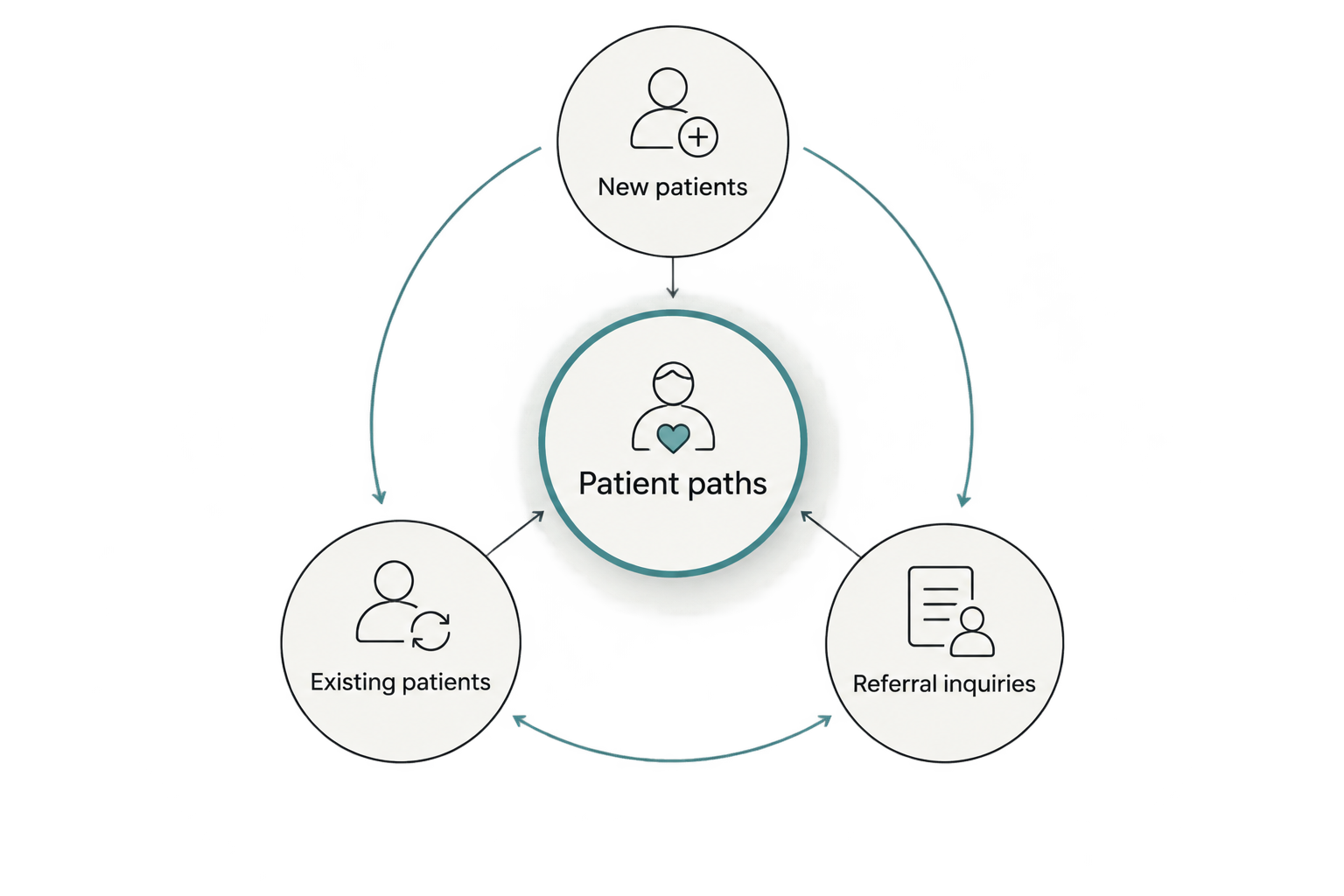
For each path, name the destination, the staff owner, and the confirmation the visitor sees. A submission message must distinguish an appointment request from a confirmed booking when staff approval is still required.
This brief gives providers something concrete to estimate. It also gives your practice a way to judge the finished website beyond whether the homepage looks attractive.
What should an ongoing website agreement include?
Ask for a 12-month operating view alongside the build proposal. This is a comparison period, not a recommended contract length: it helps you identify recurring commitments that an initial project summary leaves separate.
Your 2026 operating worksheet should identify:
- Hosting responsibility and account ownership.
- Technical maintenance and software update responsibility.
- Backup arrangements and the restoration process.
- Support channels and contractual response commitments.
- Included content changes and the approval process for additional work.
- Scheduling, forms, and other third-party subscriptions.
- Marketing deliverables, if you are purchasing marketing.
- Cancellation terms, export access, and handover responsibilities.
Hosting, maintenance, and marketing are different services. Hosting makes the website accessible; maintenance addresses its technical upkeep; marketing concerns attracting and engaging prospective patients. Require the agreement to describe each service rather than treating them as interchangeable.
Ask who handles a failed appointment form after launch. A clear answer names an accountable team and explains the escalation process, including any outside software provider.
Is custom design worth it for a small primary care practice?
Custom design is worth considering when it solves a documented patient or staff problem that the current structure cannot address cleanly. Examples include unclear appointment instructions, mixed inquiry destinations, and service information that is difficult to find.
Do not justify a redesign with an unsupported promise of more appointments. Instead, document the current problem, specify the change, and decide how you will evaluate the patient path after launch.
For a small practice, restraint matters. Keep features tied to real needs and make staff ownership explicit; a feature that nobody maintains adds responsibility without a clear purpose.
Can practical AI functionality justify additional scope?
AI functionality belongs in the scope only when it has a defined task, approved information, and a clear boundary. A proposed administrative assistant might answer office-hours questions or direct visitors to appointment instructions. That is a requirement to evaluate, not a claim that every website needs a chatbot.
Ask the provider to demonstrate how the tool handles an unanswered question, a clinical question, and a request to contact staff. Keep clinical advice outside an administrative assistant’s assigned role, and review what information it collects before launch.
Compare the proposed feature with clearer navigation and a well-written FAQ. If ordinary website improvements solve the same problem, implement those first.
How should you choose a custom medical website provider?
Ask providers to demonstrate a complete patient action using a relevant portfolio example. Start on a service page, follow the appointment route, and inspect the confirmation or handoff. Portfolio work can demonstrate structure and execution without proving an increase in patient inquiries.
Website Symphony fits medical practices seeking custom website design, marketing, and hosting from one team. Its stated offering combines those services, giving you a single team to discuss the website and its ongoing operation.
The benefit is a shared point of responsibility. The trade-off is that you still need explicit boundaries: a combined offering does not establish which integrations, support tasks, or marketing activities your agreement includes.
Review Website Symphony against the same requirements you give other providers. Ask for relevant medical website examples, an explanation of practical AI functionality, and a written account of who owns each patient-facing workflow.
Before approving a 2026 proposal, require a deliverables list, content responsibilities, acceptance criteria, and handover terms. Accountability becomes useful when it is written into the scope.
Define your medical website scope
Discuss patient inquiry paths, custom design, marketing, and hosting with one team.
What should you test before approving launch?
Test the patient journey, not just the page layout. Use a phone and a desktop computer to follow the approved appointment, portal, and inquiry routes.
For every inquiry form, make 2 test submissions using non-patient sample information: one complete submission and one missing a required field. Confirm validation, delivery, confirmation wording, and staff access without entering real health information.
Also check telephone links, office details, keyboard access, and redirects from important existing pages. Record who resolves each issue and repeat the affected test after correction.
Define success precisely. A working request form proves that a request reaches its destination; it does not prove that the practice has gained an appointment.
FAQ
What's the best way to compare primary care practice website cost?
Compare primary care practice website cost using the same written scope for every provider. Separate design, content, scheduling work, hosting, maintenance, and marketing so differences are visible.
Is a custom website better than a template for a primary care practice?
A custom website is the better fit when your patient paths require a structure the proposed template cannot support cleanly. A template remains a reasonable option when its layout and functionality match your requirements.
Does a medical website proposal automatically include hosting?
Hosting is included only when the proposal or agreement explicitly includes it. Confirm account ownership, technical support responsibilities, and what happens when the agreement ends.
Do I need a new booking system when I redesign my practice website?
You do not automatically need a new booking system for a website redesign. Start by assessing whether your existing scheduler supports the patient experience and connection you require.
Can an AI assistant handle patient questions on my website?
An AI assistant can be scoped for approved administrative questions and directions to scheduling information. Define its limits, staff handoff, and information handling before implementation; do not assign it clinical advice.
Can Website Symphony handle design, marketing, and hosting together?
Website Symphony offers custom website design, marketing, and hosting for medical businesses among its stated client categories. Confirm the deliverables and responsibilities included in your specific agreement.
How can I tell whether a redesign produces more patient inquiries?
Evaluate completed inquiries rather than relying on visits or button clicks alone. Define the inquiry event before launch and use privacy-reviewed measurement that does not expose patient information.
One last thing
Ask every prospective provider: “What does the patient see after requesting an appointment, and what does my staff receive?” Then require a demonstration.
That small handoff connects design, scheduling, information handling, and daily operations. If a proposal cannot explain it clearly, clarify the scope before signing—not after launch.


