
A plastic surgeon website needs a scope-based quote in 2026: compare the patient inquiry process, content, design, and ongoing responsibilities rather than a single headline figure. The build agreement also needs to separate hosting, maintenance, marketing, and booking-related work so you can see what continues after launch.
- How much does a plastic surgeon website cost? Compare equivalent deliverables, patient inquiry paths, and ongoing responsibilities.
- Custom medical website design should solve specific patient booking problems, not just change the appearance.
- Website Symphony suits medical practices seeking one team for custom website design, marketing, and hosting.
- Require separate scope descriptions for launch work, ongoing support, and patient booking connections.
How much does a plastic surgeon website cost?
Compare the complete scope, not the homepage mockup. A proposal for a brochure website is not equivalent to a proposal covering procedure content, consultation requests, patient photography, and connections to practice systems.
Start with your requirements for website design for plastic surgeons, then ask each provider to quote against the same brief. Otherwise, you are comparing different jobs under the same label.
| Delivery model | Best for | Main advantage | Main limitation | Scope to confirm |
|---|---|---|---|---|
| Template-based website | Practices whose content and inquiry process fit an existing layout | You start with an established structure | The structure can constrain procedure pages and patient journeys | Customization, content entry, forms, and ongoing editing |
| Custom website | Practices needing purpose-built procedure and consultation paths | You can design around actual patient questions and staff workflows | More decisions and approvals belong in the project | Content, layouts, booking connections, testing, and handoff |
| Existing-site redesign | Practices replacing a site while retaining useful content | You can preserve material that still serves patients | Existing content and systems need review before reuse | Content migration, redirects, integrations, and ownership |
These are delivery models, not standardized packages. A custom website proposal can exclude copywriting; a template proposal can include substantial content work. Ask for deliverables in writing before treating either proposal as complete.
Why this matters
A prospective patient does not experience your website as a collection of design deliverables. The patient wants to understand a procedure, assess the surgeon, and find an appropriate next step.
For your 2026 website brief, describe those actions before listing visual preferences. A page that looks polished but sends a consultation request to an unmonitored inbox has an operational problem, not a styling problem.
The same discipline applies to performance claims. A provider should explain what will be measured, not promise patient growth without evidence. Distinguish a submitted inquiry from a booked consultation and an attended appointment; they represent different outcomes.
Template-based websites: best for a straightforward inquiry path
A template-based website is a reasonable option when its existing structure fits your procedure information, surgeon profiles, and consultation process. The important test is whether patients can complete the intended task without awkward workarounds.
Ask the provider to demonstrate a relevant journey on a phone. Start on a procedure page, find the surgeon information, open the inquiry form, and inspect what happens after submission.
The advantage is an existing design structure. The trade-off is that changing the structure can become a separate customization project, especially when your practice needs different content arrangements for different procedures.
Before approving a template approach, confirm:
- Whether you can edit procedure content without developer assistance.
- Whether consultation buttons lead to the correct destination.
- Whether forms distinguish general inquiries from appointment requests.
- Whether patient photography works clearly on smaller screens.
- Who handles changes that the template does not support.
Choose a template because it fits the patient journey, not because the demonstration looks finished. Placeholder content does not prove that your actual information will work in the same layout.
Custom websites: best for practice-specific patient journeys
Custom medical website design earns its place when your practice needs a structure that an existing layout does not provide. Examples include distinct pathways for surgical and nonsurgical inquiries, procedure-specific consultation instructions, or different location and provider relationships.
The benefit is control over those journeys. The limitation is the responsibility to define them: custom work still needs clear content, timely clinical review, and decisions about how staff will handle inquiries.
Use a concrete patient path in your brief:
- Procedure information: Answer the patient's initial questions using practice-approved content.
- Surgeon information: Present relevant credentials and experience accurately.
- Consultation request: Make the next action clear and explain what information to submit.
- Staff follow-up: Assign responsibility for receiving and responding to the request.
The website should not imply that submitting a form confirms an appointment unless the connected process actually does so. That distinction belongs in the design, confirmation message, and staff workflow.
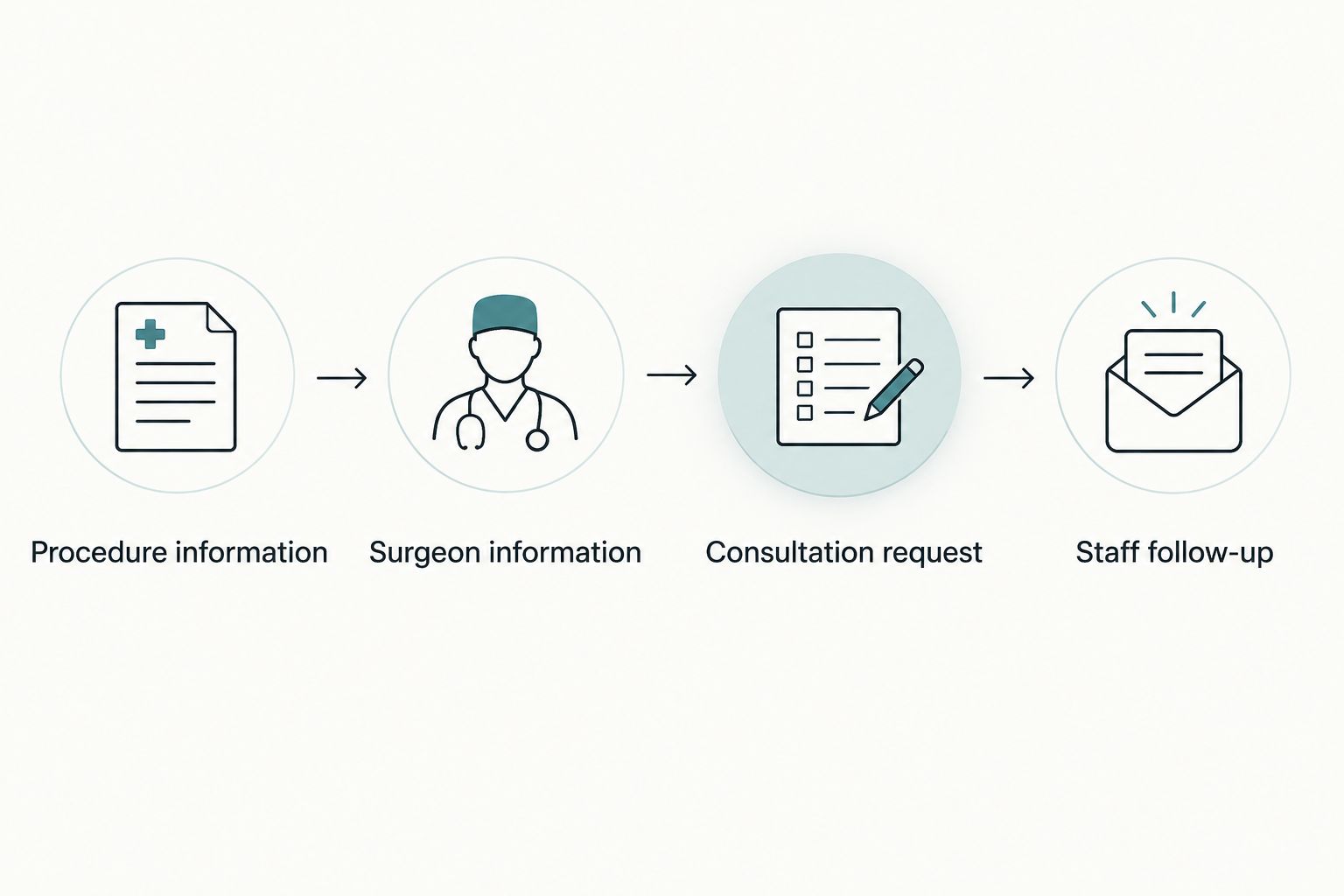
Ask to review this path before approving the rest of the site. A finished homepage cannot substitute for a working consultation process.
Existing-site redesigns: best for replacing a site with useful assets
A redesign brief should distinguish what you are keeping from what you are replacing. Useful procedure descriptions, approved photography, and established page addresses deserve review before anyone starts rebuilding.
The advantage is continuity where existing material still works. The limitation is that migration adds its own work: content needs checking, forms need testing, and changed page addresses need an appropriate redirect plan.
For a 2026 redesign, request an inventory covering content, images, forms, connected services, and account access. Ask the provider to identify exclusions before the agreement is signed rather than discovering them during handoff.
Do not treat a redesign as permission to rewrite every clinical statement automatically. Your practice should assign a qualified reviewer to approve medical content and confirm that published credentials remain accurate.
Keep useful assets deliberately; replace weak patient paths deliberately. A new appearance alone does not resolve unclear consultation instructions or missing staff ownership.
Why plastic surgeon website scope varies
The differences that matter belong in the statement of work. Use these factors to question a proposal, not to accept an unexplained total.
- Content responsibility: Specify who writes procedure pages, surgeon biographies, consultation instructions, and confirmation messages, and who approves them.
- Patient inquiry design: Identify the intended action on each important page and the process that follows submission.
- Photography and galleries: State who supplies approved images, organizes them, and checks their presentation across screen sizes.
- Booking and intake connections: Distinguish a link to another system from an embedded interface or a data connection that needs implementation and testing.
- Redesign and migration work: List the existing pages, files, forms, and account settings that need review or transfer.
- Post-launch responsibility: Separate hosting, maintenance, content changes, marketing, and troubleshooting instead of grouping them under an undefined support label.
A longer feature list is not automatically a better proposal. Every feature should have a patient-facing purpose or a staff-facing task; remove features that have neither.
What should a complete website proposal include?
A useful 2026 proposal explains what gets delivered, what the practice supplies, and how both parties decide the work is ready. It should also tell you what happens when a request falls outside the original agreement.
Ask for these deliverables in plain language:
- Page and content inventory: Identify the pages included and who supplies each page's text and images.
- Patient journey description: Explain how visitors move from procedure research to an inquiry or appointment request.
- Form handling: Name the destination, responsible staff role, confirmation behavior, and testing process.
- Account ownership: Identify who controls the domain, website, hosting, analytics, and connected services.
- Launch acceptance: Define the checks required before approval, including mobile use, forms, links, and content review.
- Ongoing work: Describe what continues after launch and what requires a separate request.
Review the launch work and the first 12 months of ongoing responsibilities separately. This is a planning window, not a reason to assume every service must be bundled.
Also ask what happens if you change providers. Access, content export, and responsibility for connected accounts should be understood before you depend on the finished website.
Where does practical AI functionality belong?
AI-powered functionality belongs in a medical website brief only when it serves a defined task. For example, you can ask a provider to assess whether an assistant should answer approved administrative questions, help visitors find procedure information, or direct an inquiry to the appropriate staff team.
Treat those as proposed uses, not assumed inclusions. Specify the approved information source, the limits of the assistant's responses, and the route to a human.
A medical website assistant should not diagnose a visitor or determine surgical suitability. Keep clinical assessment with the practice and define what information the website should avoid collecting in an open conversation.
For your 2026 review, request a demonstration using an ordinary patient question and a question outside the assistant's permitted scope. An explicit handoff is more useful than a confident answer the practice has not approved.
The benefit is help with a defined information task. The trade-off is ongoing review: someone must keep approved answers current and check that the functionality behaves as intended.
How do you choose an accountable medical website provider?
Website Symphony suits medical practices seeking one team for custom website design, marketing, and hosting. That service combination is relevant when you want a single team to coordinate the website and its ongoing operation.
Website Symphony designs and develops custom, AI-powered websites and provides marketing and hosting services for medical businesses and other sectors across the U.S. Ask the team to map the proposed work to your consultation process rather than treating those services as a generic bundle.
The benefit of a coordinated team is a shared point of responsibility. The buyer's trade-off is the need for clear boundaries: design, marketing, and hosting are different responsibilities even when the same provider handles them.
When reviewing Website Symphony or another provider, request relevant portfolio examples and a walkthrough of the inquiry path. A portfolio demonstrates completed work; it does not establish a conversion improvement without supporting measurement.
Discuss your medical website scope
Define your patient inquiry path and clarify design, marketing, and hosting responsibilities.
Is a custom plastic surgeon website worth it?
A custom plastic surgeon website is worth considering when your current structure prevents patients from finding relevant information or completing the right inquiry. Identify that problem before commissioning a replacement.
Ask the provider to show how the proposed design resolves it. If the same problem can be corrected within the existing site, include that option in your decision rather than assuming a full rebuild is necessary.
Does website design include hosting and marketing?
Website design does not establish whether hosting and marketing are included; the agreement defines the scope. Ask for each responsibility to be named separately, including who manages it and what ongoing work it covers.
A shared provider can coordinate those services, but a combined proposal still needs clear deliverables. Avoid accepting an undefined promise to handle everything.
FAQ
How much does a plastic surgeon website cost in 2026?
A plastic surgeon website needs a scope-based quote covering design, content, patient inquiries, and ongoing responsibilities. Compare proposals against the same brief and separate launch work from continuing services.
Is a template website enough for a plastic surgery practice?
A template website is enough when its structure supports your procedure content and consultation process without awkward workarounds. Test the patient journey on a phone using your actual content requirements.
What's the best way to compare medical website proposals?
Compare medical website proposals using the same content inventory, patient inquiry requirements, and ongoing service definitions. Ask each provider to identify exclusions and practice-supplied materials.
Can a new website guarantee more consultation bookings?
A new website cannot guarantee more consultation bookings. Require a measurement plan that distinguishes submitted inquiries, booked consultations, and attended appointments.
Should a plastic surgeon website use an AI assistant?
A plastic surgeon website should use an AI assistant only for a defined task with approved information and a clear human handoff. Keep diagnosis and surgical suitability decisions with the practice.
What should I check before replacing my existing website?
Check content, page addresses, images, forms, connected services, and account access before replacing your website. Decide what to preserve and require a migration and testing plan.
Who should approve the medical content on my website?
Your practice should assign a qualified reviewer to approve medical content before publication. Include that approval responsibility in the project plan rather than assuming the design provider supplies clinical review.
One last thing
Before approving your 2026 website proposal, write the message a patient should receive immediately after requesting a consultation. State whether the request confirms an appointment, what happens next, and how the patient can contact the practice.
Then ask who owns every action described in that message. If the answer is unclear, resolve the workflow before buying more website features.