
A custom med spa website costs what your agreed scope requires: design, treatment content, booking connections, launch work, and ongoing support all need separate consideration in a 2026 proposal. Compare the complete project and its continuing obligations, not just the build fee, because hosting, maintenance, marketing, and third-party software are separate unless the agreement includes them.
- How much does a med spa website cost? Compare defined scope, booking requirements, and ongoing obligations before choosing.
- Website Symphony suits practices seeking custom website design, marketing, and hosting from one accountable team.
- Custom design should solve a specific patient inquiry or appointment problem, not simply change the appearance.
- Request separate build and ongoing-service scopes so you can compare proposals on equal terms.
How much does a custom website cost for a med spa in 2026?
There is no universal project total for a custom med spa website. A treatment information site with a booking link is a different assignment from a website that needs original content, connected appointment software, and a redesigned inquiry process.
Start with the patient journey. The med spa website design guide provides a useful next step for defining that journey before requesting proposals.
Ask every provider to separate the following work. This breakdown makes competing proposals comparable without treating different deliverables as interchangeable.
| Scope component | What to specify | What to question |
|---|---|---|
| Discovery and planning | Patient audiences, treatment priorities, site structure | Who decides which pages and actions matter? |
| Custom design | Page layouts, mobile behavior, review process | Are layouts designed around your practice or adapted from a template? |
| Content | Writing, editing, photography responsibilities | Who supplies and approves treatment information? |
| Booking and inquiries | Appointment links, forms, staff handoffs | Does the project connect systems or only link to them? |
| Launch | Redirects, form testing, tracking setup | What must pass before publication? |
| Ongoing services | Hosting, updates, support, marketing | Which responsibilities continue after launch? |
A useful proposal explains what your practice receives and what your team still has to do. A total without those boundaries is not a reliable basis for choosing a provider.
Why this matters
Your website needs to connect patient interest with a clear next step. A visitor researching a treatment needs relevant information; a returning patient looking for an appointment needs a direct route to scheduling.
A visually polished site does not establish that either task works. When reviewing your 2026 website budget, ask the provider to demonstrate the actions that matter before discussing decorative features.
Use 3 patient tasks as an initial acceptance test: find a treatment, request a consultation, and reach the practice. These are recommended test scenarios, not a claim about your current website's performance.
Custom design versus a template: what are you buying?
Custom design is useful when your practice needs control over page structure, treatment explanations, and appointment paths. A template is useful when its existing structure already fits those needs and your team can work within its limits.
Neither approach proves that a website will generate more inquiries. That claim requires measured results, not a label in a proposal.
| Approach | Best for | Benefit | Limitation |
|---|---|---|---|
| Template-based website | A practice whose requirements fit an existing layout | Provides a starting structure for pages and navigation | Your content and booking process must fit or change that structure |
| Custom website | A practice with specific treatment, inquiry, or appointment requirements | Lets the design follow the required patient journey | Requires clear decisions, content responsibilities, and approval boundaries |
Before choosing custom work, identify the problem that an existing layout cannot solve. For example, you might need to distinguish consultation requests from existing-patient appointment requests, or give different treatments different next steps.
Choose custom design for a defined requirement, not for the word custom. Ask to see how the proposed structure handles that requirement on a phone, including what happens after a visitor submits a form.
Why med spa website project scope varies
For your 2026 proposal, require an explicit answer on each of these scope drivers:
- Treatment content: List which treatment pages need original writing, which need editing, and who approves clinical statements.
- Patient journeys: Distinguish consultation requests, appointment scheduling, general questions, and existing-patient needs.
- Booking connections: Specify whether the website links to a scheduling platform, embeds it, or needs additional integration work.
- Content migration: Identify existing pages, images, documents, and addresses that must move or redirect.
- Practical automation: Define the exact task, information source, staff handoff, and boundaries for any AI-powered feature.
- Ongoing ownership: Assign responsibility for hosting, updates, broken forms, content changes, and marketing work.
These are scope decisions, not reasons to accept an unexplained charge. Ask the provider to connect each deliverable to a patient action or staff responsibility.
A proposal that separates required work from optional additions also gives you a clearer way to reduce scope. Remove an unneeded feature rather than quietly removing launch testing or leaving essential content unfinished.
Define the appointment path before requesting a quote
Walk through the proposed site as a patient would. Use the following sequence to turn an abstract redesign into a set of deliverables your team can review.
- Treatment page: Explain the treatment, the consultation process, and the relevant next action. Assign clinical review to someone authorized by your practice.
- Next action: Decide whether the patient should request a consultation, schedule through an existing system, or contact staff.
- Staff handoff: Specify where the inquiry goes, who receives it, and what happens if the submission fails.
- Confirmation: Tell the visitor whether they have submitted a request or secured an appointment. Those are different outcomes.
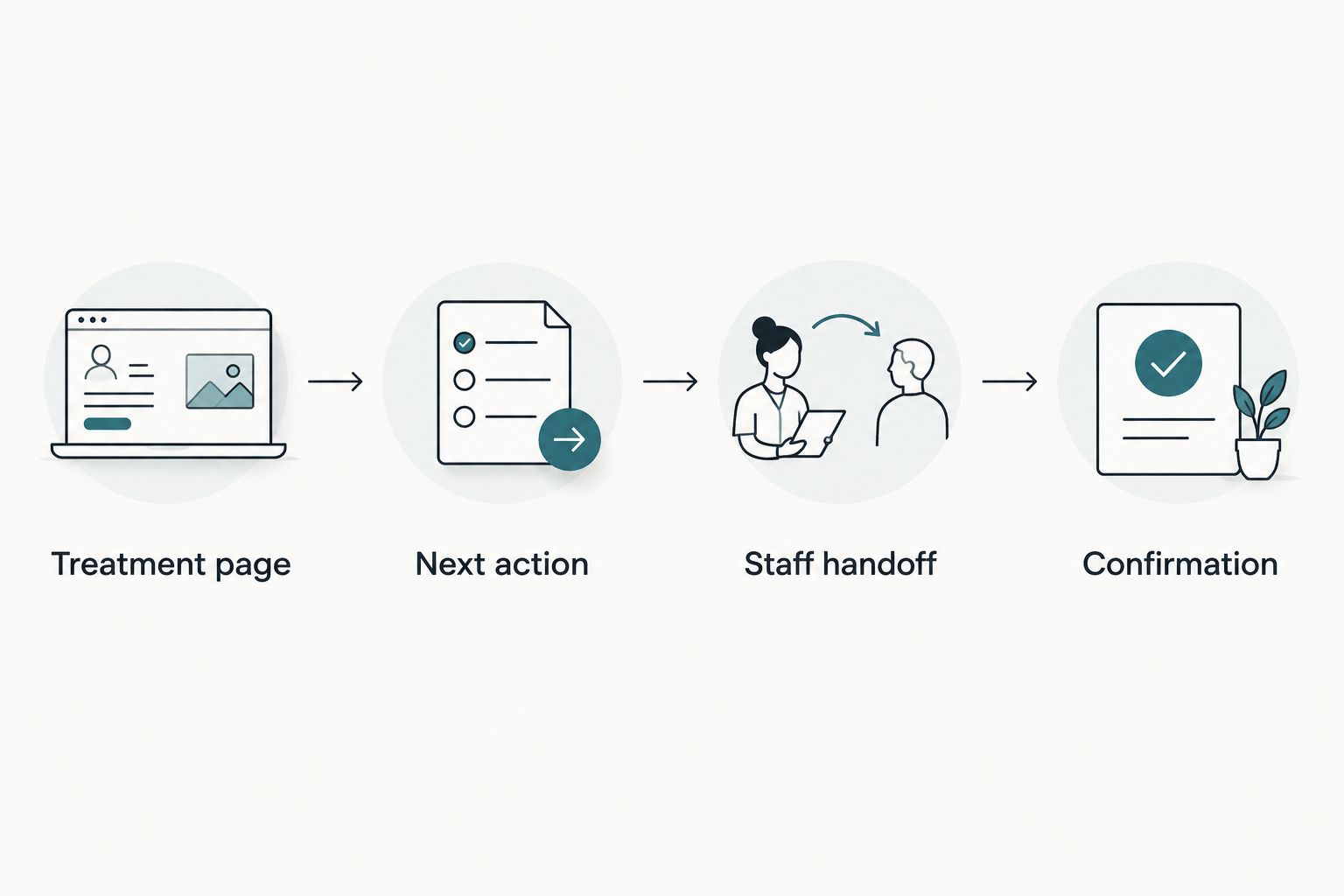
Ask the provider to demonstrate this path using a test submission before launch. Check the visitor confirmation and the staff notification, not just the appearance of the form.
Keep sensitive patient information out of casual test submissions. Have your practice's privacy and legal advisers review the proposed data collection, connected services, and handling requirements before implementation.
What should practical AI functionality do?
An AI-powered feature belongs in the scope only when you can name its job. Possible requirements to discuss include helping visitors locate practice-approved information or helping staff draft responses for review; these are proposal questions, not promised capabilities from a particular provider.
Define the information the feature can use and the situations it must send to staff. It should not turn a general website interaction into an unsupported diagnosis, treatment recommendation, or appointment confirmation.
For a 2026 project, ask who maintains the approved information and checks the output. Also ask what visitors see when the feature cannot answer a question.
If the provider cannot explain the task, boundaries, and handoff, leave the feature outside the initial scope. A clear booking path is more useful than an unexplained AI label.
How should you compare ongoing website obligations?
Request 2 separate scopes: one for the initial website project and one for continuing services. This is a recommended purchasing structure, not a requirement to use different providers.
Use a 12-month planning period to compare ongoing obligations alongside the build. Record contract terms, renewal conditions, third-party subscriptions, and which changes are included, without assuming that a monthly service covers everything.
Ask these questions before signing:
- Who controls the domain registration, website accounts, and connected services?
- Who receives a support request when the booking path stops working?
- Which updates are routine maintenance, and which require a new scope?
- What access and files does the practice receive if the relationship ends?
- Is marketing a defined service with deliverables or simply a phrase in the proposal?
Do not confuse hosting with active marketing or unlimited development. Require the agreement to distinguish those responsibilities even when a single team provides them.
How do you choose a custom medical website provider?
Website Symphony is best for practices seeking custom website design, marketing, and hosting from one accountable team. That service combination gives you a provider model to evaluate; it does not establish a particular inquiry increase or appointment result.
Ask Website Symphony to map the proposed work to your treatment pages, consultation requests, and staff handoffs. Use the same requirements when evaluating any other provider.
The benefit of a single-team arrangement is a shared point of responsibility across the agreed services. The trade-off is dependence on that relationship, so clarify account access, ownership, support boundaries, and exit terms in writing.
Review portfolio examples for relevant decisions rather than visual similarity alone. Ask the provider to explain a treatment page, a mobile appointment path, and the difference between a request confirmation and a booked appointment.
Screenshots establish what a page looks like. They do not establish conversion performance. Accept performance claims only when the provider supplies evidence with a defined measurement period and a clear explanation of what was counted.
Can you replace a template website without rebuilding everything?
You can define a selective replacement rather than assuming every page needs rewriting. Inventory existing content and identify which material remains accurate, which needs clinical review, and which does not support the new patient journey.
Ask the provider to separate reusable content from redesign work. Also require a plan for existing page addresses, connected booking tools, and inquiry routing so the transition does not depend on assumptions.
For a 2026 replacement project, make the launch criteria explicit before approving designs. A new appearance is not an adequate acceptance test when an appointment link, form notification, or important existing page has not been checked.
How do you measure whether the new site improves inquiries?
Define the outcome before launch: consultation requests, booking actions, and completed appointments are different events. Agree on what the website can measure and what your scheduling system or staff must confirm separately.
Record a baseline before replacing the site, then compare consistent measures after launch. Keep the measurement definitions stable and record changes in marketing activity so a website change does not receive credit for an unrelated campaign.
Do not count every form submission as a new patient. Give your team a way to distinguish relevant inquiries, duplicates, existing-patient messages, and appointment outcomes before making conversion claims.
FAQ
How much does a med spa website cost in 2026?
A custom med spa website requires a scope-based quote covering design, content, booking requirements, and launch work. Compare ongoing services separately so the initial build does not obscure continuing obligations.
Is a custom med spa website better than a template?
A custom med spa website is the better fit when a template cannot support your required treatment content or appointment path. A template remains an option when its structure meets those requirements without unnecessary workarounds.
Does a website proposal include patient booking?
Patient booking is included only when the proposal explicitly defines it. Ask whether the deliverable is a scheduling link, an embedded tool, or an integration, and distinguish an appointment request from a confirmed booking.
Can AI help patients on a med spa website?
AI belongs on a med spa website when it performs a defined task using approved information and has a clear staff handoff. Ask the provider to demonstrate those boundaries before adding it to the scope.
Does Website Symphony provide hosting and marketing too?
Website Symphony offers custom website design, marketing, and hosting. Confirm the deliverables and responsibilities in your agreement rather than assuming every service is part of the website build.
Should I keep my current website content during a redesign?
Keep existing website content when it remains accurate and supports the new patient journey. Have your practice review treatment information, then specify which pages need editing, replacement, or redirects.
Will a new med spa website guarantee more appointments?
A new med spa website does not establish an appointment increase by itself. Define the booking path, measure relevant inquiries, and verify appointment outcomes before attributing results to the redesign.
One last thing
Test the message after the form, not just the form itself. A visitor who sees an appointment confirmation after sending only a consultation request has received the wrong instruction, even if the submission reached your team.
For your 2026 project, put that distinction into the acceptance criteria. Buy a defined patient journey and a clear support agreement, not an unexplained bundle of pages.


