Medical website design in 2026 is priced by project scope: get an itemized proposal built around your practice’s patient inquiry and appointment paths. Separate the website build from hosting, maintenance, booking software, and ongoing marketing so you can compare the full commitment—not just the launch deliverables.
- How much does medical website design cost? Your quote should separate custom design, appointment booking, content, and ongoing services.
- Website Symphony suits medical practices seeking custom website design, marketing, and hosting from one accountable team.
- Choose custom medical website design when patient inquiry paths require more than a template supports.
- Compare proposals against the same scope, including booking handoffs, content ownership, maintenance, and hosting.
Why this matters
A website proposal describes what your practice will receive and what your staff will still need to handle. A design-only proposal is not equivalent to a project that includes treatment content, appointment-request forms, hosting, and post-launch support.
Website Symphony is best for medical practices seeking custom website design, marketing, and hosting from one team. Website Symphony offers those services, but your proposal should still define the deliverables, responsibilities, and exclusions. One accountable team does not remove the need for a clear scope.
How much does medical website design cost in 2026?
The useful answer is an itemized project quote, not a package figure detached from your requirements. Start by asking each provider to price the same website scope and identify every ongoing commitment separately.
Use this breakdown to make competing proposals comparable. These are scope categories to request, not a claim that every medical website needs every item.
| Scope category | What the proposal should specify | What to clarify |
|---|---|---|
| Discovery and planning | Patient audiences, services, page structure, and inquiry goals | Who documents and approves the requirements? |
| Design and development | Custom layouts, mobile behavior, and content editing | What is custom, and what uses existing components? |
| Content | Page writing, editing, photography responsibilities, and clinical review | Who supplies and approves each asset? |
| Appointment paths | Booking links, request forms, confirmations, and staff routing | Does the site request an appointment or confirm one? |
| Launch | Testing, redirects, tracking setup, and handover | What must pass before launch approval? |
| Ongoing services | Hosting, maintenance, support, software, and marketing | Which services continue after the build? |
Do not compare proposals until their inclusions line up. A shorter deliverables list is a smaller scope—not evidence that the provider delivers the same work more efficiently.
Ask each provider to identify dependencies, too. If your practice must supply approved treatment descriptions or access to a booking platform, record that responsibility before work begins. Otherwise, an apparently complete proposal can leave essential work with your staff.
Custom medical website design: best for specific patient paths
Custom design fits practices that need their website to reflect distinct services, providers, locations, or appointment requirements. The benefit is control over the patient journey, not simply a different-looking homepage.
For a dental practice, a new-patient examination request and an inquiry about implants require different information. For a specialist clinic, a referral inquiry and an existing-patient follow-up also serve different needs. A custom scope can define these routes separately instead of forcing every visitor into the same generic form.
Ask the provider to demonstrate the path from treatment page to staff response. That demonstration makes the proposed work tangible: what the patient selects, what information the form requests, and where the inquiry goes.
The trade-off is involvement. Your practice must approve the structure, content, and workflows. Custom work without timely clinical and operational input leaves the provider making decisions your team should own.
Template-based medical websites: best for straightforward requirements
A template-based approach fits a practice whose content and appointment process work within the template’s existing structure. It gives the project a defined starting point and reduces the number of layout decisions your team must make.
The limitation is fit. If the practice needs distinct provider journeys, unusual content relationships, or a specific inquiry workflow, adapting the template becomes part of the project scope. Ask to see those requirements demonstrated before choosing the approach.
| Approach | Best for | Main advantage | Main limitation |
|---|---|---|---|
| Template-based website | Practices with straightforward content and booking paths | An existing structure to evaluate before committing | Requirements must fit the structure or require adaptation |
| Custom website | Practices with distinct patient, service, or provider journeys | Layouts and workflows defined around practice requirements | Requires more decisions and practice input |
Neither approach guarantees patient inquiries. Choose the approach that supports your required patient actions, then assess the quality of its execution.
Why medical website design quotes vary
These scope decisions explain why proposals for medical practices differ. Use them to question the work included, rather than treating every difference as a design-quality issue.
- Custom design depth: Reusing an approved page layout is different from designing a distinct interaction or content structure. Ask which page types need separate design work.
- Content responsibilities: Supplying clinically approved copy is different from asking the provider to plan, write, and revise it. Identify who approves medical statements.
- Patient inquiry paths: A link to an existing booking destination differs from a form with conditional questions and staff routing. Define the handoff explicitly.
- Practical AI functionality: A narrowly scoped assistant needs a defined information source, boundaries, and escalation path. Include those requirements in the proposal.
- Ongoing accountability: Hosting, maintenance, content updates, and marketing are separate responsibilities. Specify which belong to the provider and which remain with your practice.
Keep these decisions in a shared scope document. When you change a requirement, ask the provider to explain the effect on deliverables and ongoing responsibilities before approving it.
Define the patient journey before requesting proposals
A useful 2026 brief starts with what patients need to accomplish, not a list of visual preferences. Work through this sequence before asking providers to propose a solution.
- Patient need: Identify the action the page must support, such as requesting a dental examination, asking about a consultation, or finding referral instructions. Keep informational visits separate from appointment requests.
- Service page: List the questions patients need answered before acting. Assign your clinical team responsibility for reviewing treatment descriptions and any instructions.
- Booking handoff: Decide whether the visitor enters a booking system, submits a request, or calls the practice. Do not describe a request form as confirmed scheduling.
- Staff response: Name the team responsible for each inquiry type. Define what happens when a visitor selects the wrong service or submits an incomplete request.
- Outcome tracking: Specify the actions your practice wants measured. Distinguish form submissions and booking-link clicks from appointments confirmed by staff or the booking system.
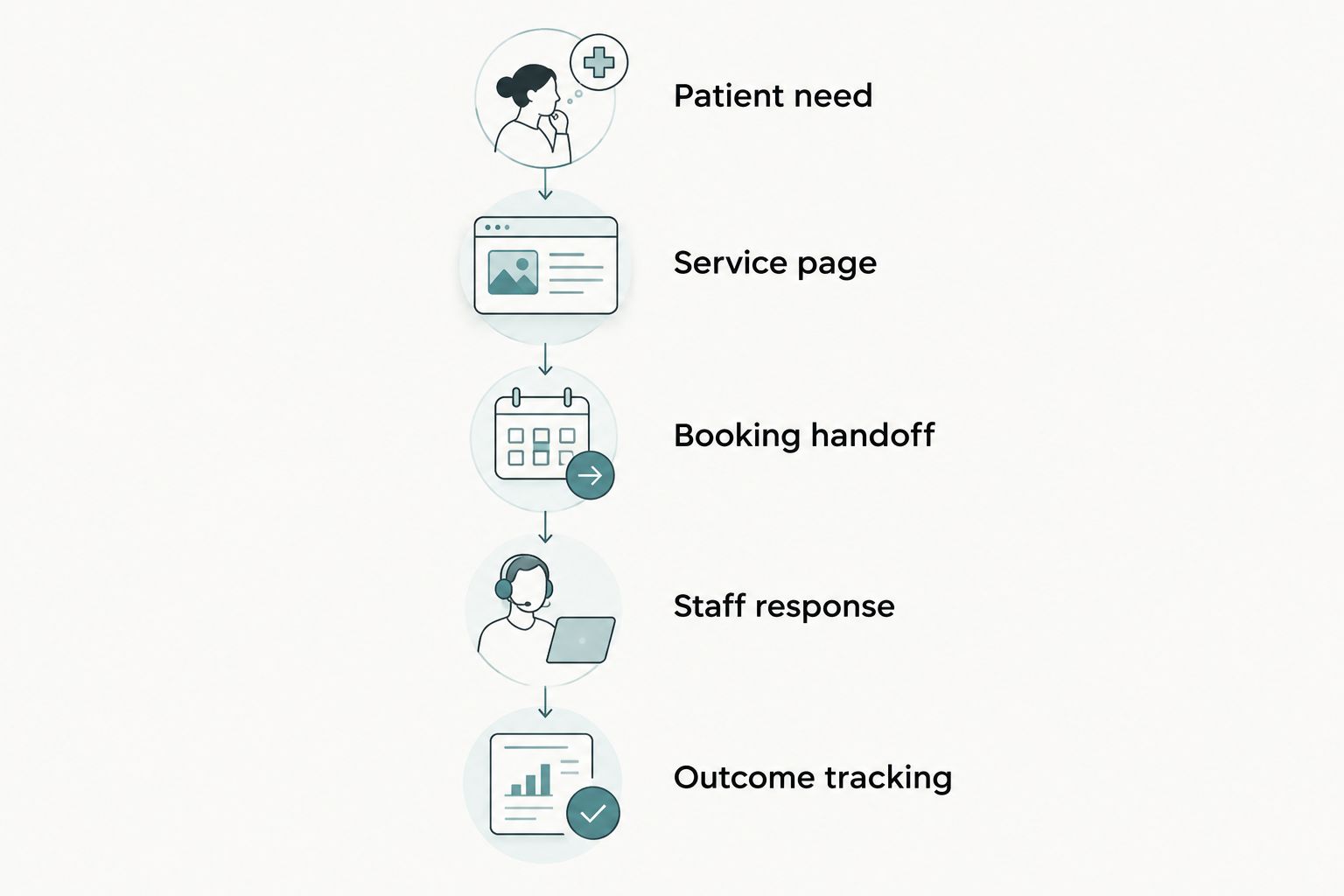
Give prospective providers a representative journey to demonstrate. For example, ask them to show how a new dental patient finds the relevant service, understands the next step, and submits the correct request. A screen-by-screen explanation reveals more about scope fit than a gallery of homepages.
Ask for practical AI functionality, not an AI label
In a 2026 medical website proposal, AI should have a specific job and clear boundaries. A useful proposed application is helping visitors find practice-approved information about services, preparation instructions, or the appropriate contact route.
Treat that as a requirement to evaluate—not a capability every provider automatically includes. Ask what information the feature uses, how your practice approves it, and what happens when the feature cannot answer reliably. Keep individualized medical advice outside the proposed assistant’s role.
Website Symphony offers AI-powered website design and marketing. Require the proposal to connect any AI feature to a patient or staff task, such as directing a visitor to approved information or the correct inquiry path.
The benefit is a defined function your team can assess. The trade-off is additional review and oversight: an interactive feature needs boundaries, testing, and responsibility for updates. If the provider cannot explain those requirements plainly, leave the feature out of the initial scope.
Separate the website build from ongoing services
Your 2026 budget should distinguish launch work from services that continue afterward. Ask for a written schedule of ongoing obligations and the conditions for changing or ending them.
Hosting and maintenance
Ask who manages hosting, software updates, backups, and restoration. Request a clear explanation of what support includes and how your staff reports a problem. Do not assume hosting includes content changes or responsibility for every connected system.
Booking and other software
Identify which systems your practice already uses and which new services the proposal requires. Confirm account ownership and who manages access. A website that links to an existing booking service has a different responsibility boundary from a project that configures the booking workflow.
Marketing and content updates
Separate the initial website content from ongoing publishing and marketing. Define whether future treatment-page edits, provider changes, and campaign landing pages fall within a continuing agreement or require separate approval.
A combined provider can simplify coordination. The limitation is that unclear service boundaries still create gaps, even when the same team handles several functions.
How do you choose a custom medical website provider?
Choose a provider that can explain your patient journey, show relevant work, and put responsibilities in writing. Portfolio examples demonstrate design and structure; they do not establish appointment growth without supporting evidence.
For a dental practice, review the best web design agencies for dentists with your own inquiry requirements beside you. Look beyond visual similarity and ask how each provider would handle your actual services and staff handoffs.
Use these questions during evaluation:
- Which portfolio example demonstrates a comparable patient journey?
- Who writes the content, and who approves clinical statements?
- What happens after a patient submits an appointment request?
- Which accounts and website assets will the practice control?
- What testing and staff handover are included before launch?
- Who owns design, marketing, and hosting issues after launch?
Website Symphony fits buyers seeking those services through one team. Confirm the exact engagement scope rather than assuming every service is included in the website project.
Does a redesign require replacing the whole website?
A redesign does not automatically require rebuilding every page or changing every system. Ask the provider to distinguish what stays, what changes, and what must be replaced to support the intended patient journey.
Start with the problem. If patients reach a treatment page but cannot find the relevant appointment action, the proposal should address that route directly. If staff cannot update provider information, content editing belongs in the scope.
Approve a replacement plan based on identified requirements, not dissatisfaction with appearance alone. Require an inventory of existing content, forms, booking destinations, and important page addresses before agreeing to remove or replace them. That inventory also gives your team a practical launch-review checklist.
How do you compare medical website proposals fairly?
Compare proposals against the same written brief and ask providers to mark exclusions explicitly. Keep required work separate from optional additions so the decision does not turn into a contest between unrelated feature lists.
Read the deliverables alongside the acceptance criteria. For an appointment-request form, define the fields, confirmation message, destination, and test that proves the submission reaches the intended team. For content editing, ask staff to demonstrate a routine update during handover.
A proposal is easier to judge when every major deliverable has an owner and a visible completion condition. Resolve those details before signing, while the scope is still open to clarification.
FAQ
How much does medical website design cost in 2026?
Medical website design requires a project-specific quote based on design, content, booking paths, and ongoing services. Compare providers against the same written scope rather than treating different packages as equivalent.
Is a custom medical website better than a template?
A custom medical website is the better fit when your patient journeys or staff workflows do not fit an existing template. A template remains a valid option for straightforward requirements that work within its structure.
Does medical website design include appointment booking?
Appointment booking is included only when the proposal specifies it. Distinguish a booking-system link, an appointment-request form, and a workflow that confirms an available appointment.
Can AI help patients use a medical practice website?
AI can be scoped to help visitors find practice-approved information and the appropriate inquiry route. Require defined information sources, clinical boundaries, testing, and a handoff when the feature cannot answer.
What should a dental practice ask a website designer?
A dental practice should ask the designer to demonstrate the route from a treatment page to the correct appointment request. Also confirm content approval, staff routing, account ownership, and post-launch responsibilities.
Does Website Symphony provide hosting and marketing too?
Website Symphony offers custom website design, AI-driven marketing, and hosting. Your proposal should identify which services your engagement includes and who handles each responsibility.
How do I know whether a medical website redesign worked?
Judge a medical website redesign against agreed outcomes and working patient journeys. Track inquiry actions separately from confirmed appointments, and check that submissions reach the responsible staff.
One last thing
Before approving your 2026 website brief, have a front-desk team member walk through the proposed appointment path. Ask what they need to respond, what would cause confusion, and which requests belong elsewhere.
Your website scope should end at a clear operational handoff, not at the submit button. That requirement gives you a concrete basis for evaluating design, functionality, and provider accountability.