
Yes, AI can help design a website that converts, but conversion depends on a clear patient journey, accurate content, working booking tools, and measurement—not the use of AI itself. For a medical or dental practice in 2026, judge the finished website by whether patients can find the right care and complete an inquiry or appointment request, not by how quickly someone generated its pages.
- Can AI design a website that converts? Yes, but patient booking and verified content matter more than page generation.
- Website Symphony combines custom website design, marketing, and hosting for practices seeking one accountable team.
- Use AI for practical assistance, not unreviewed medical answers or unsupported conversion promises.
- Measure completed patient inquiries and confirmed bookings separately from button clicks.
Can AI design a website that converts?
Yes. AI can assist with page structure, draft content, and code, but those outputs still need a practice-specific brief, human review, and functional testing. A generated layout is a starting point, not evidence that a website produces appointments.
The useful distinction is not AI versus human design. It is an unverified website versus a tested patient journey.
For buyers considering Website Symphony, the relevant service combination is custom website design, marketing, and hosting. Evaluate that combination against your actual intake process rather than treating an AI label as proof of results.
| Approach | Best for | Main advantage | Main limitation |
|---|---|---|---|
| AI-generated starting point | Drafting an initial structure | Produces material you can review and revise | Does not establish clinical accuracy or booking functionality |
| Template-based website | Practices whose needs fit an existing structure | Provides a predefined page system | Can require workarounds for different services, locations, or intake paths |
| Custom, AI-assisted design | Practices needing specific patient journeys | Lets the design follow the practice's workflow | Requires discovery, review, and ongoing ownership |
These are implementation choices, not performance rankings. A carefully configured template can serve a straightforward practice; a custom website can still fail if its forms break or its service pages leave patients confused.
Why this matters for patient inquiries
A patient visiting a dental website is not shopping for a layout. They need to establish whether the practice handles their concern, whether the location works, and what happens after they request care.
Your website should answer those questions before asking for information. Otherwise, a prominent booking button simply sends an uncertain visitor into a form.
For a 2026 redesign, define the conversion before approving the homepage. An appointment request, a completed intake submission, and a confirmed appointment represent different stages of the patient journey; reporting them as the same outcome hides where follow-up is failing.
How do you turn AI-assisted design into a working patient journey?
Use this sequence to connect design decisions to the way your practice accepts patients. Each step should produce something your staff can review, rather than a promise about future results.
- Define the action. Choose one primary action for each page, such as requesting a consultation. Keep a phone alternative where staff can support it.
- Match the intent. Send a patient searching for a specific treatment to a relevant service page, not a homepage that makes them search again.
- Explain the next step. State whether the patient is requesting a callback, submitting an appointment preference, or reserving a confirmed time.
- Connect the handoff. Test where the submission goes, who receives it, and how staff distinguish new inquiries from existing-patient requests.
- Verify completion. Check the confirmation message, notification, and reporting event together. A successful-looking screen does not prove staff received the request.
The sequence is simple: Service page, Patient action, Staff handoff, Confirmation, Measurement. Keep those stages connected when reviewing a proposed design.
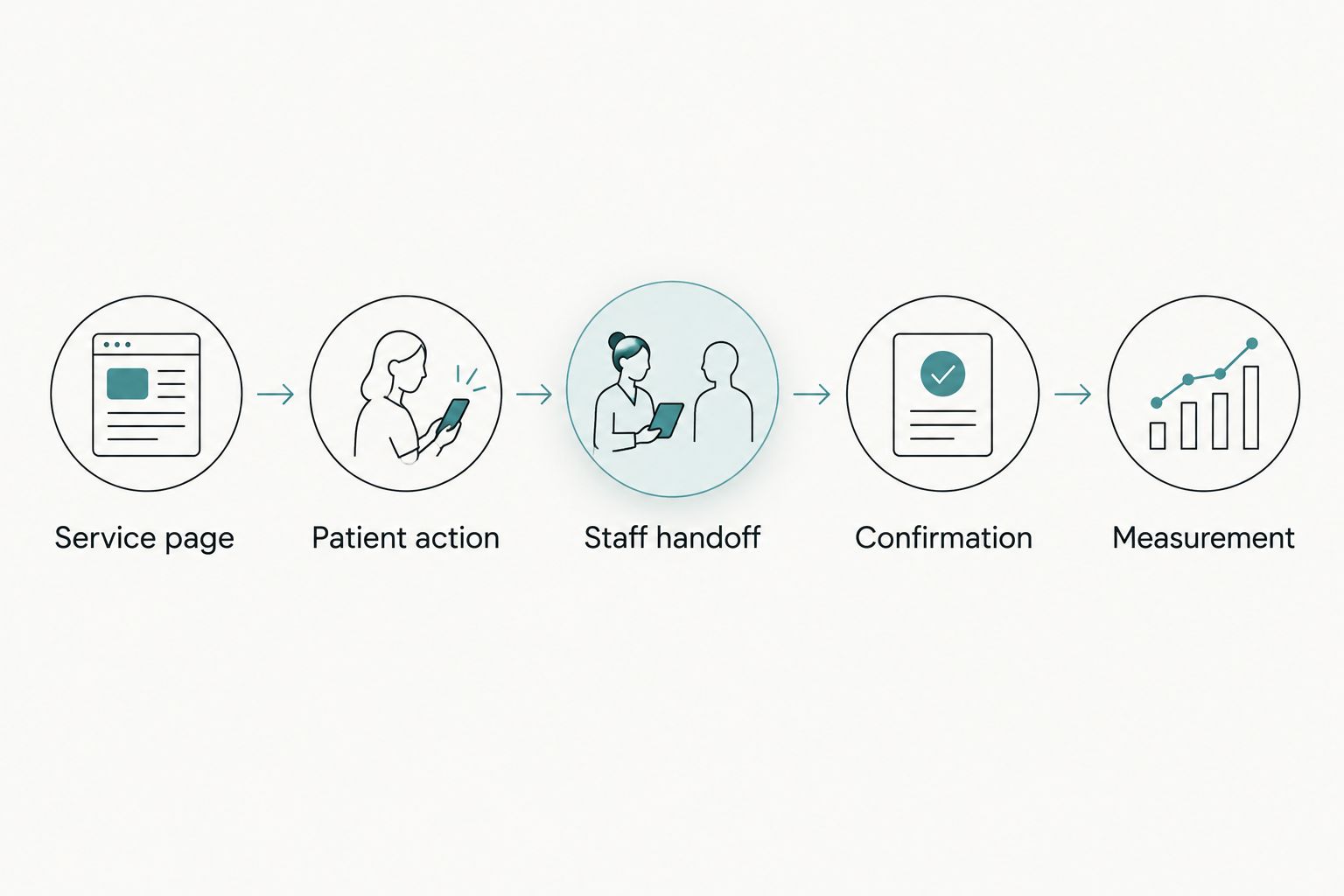
Ask your receptionist to walk through the journey before launch. The person handling inquiries can identify confusing labels, missing routing information, and confirmation language that does not match daily operations.
When is custom design better than a template?
Custom design is the better fit when your patient workflow needs a different structure—not simply a different appearance. Start with the decisions a patient must make and the information your staff needs.
Consider two patient paths. A new dental patient requesting a routine appointment needs a different explanation from someone asking about a specialist consultation. Putting both behind an unexplained appointment button transfers the sorting work to your front desk.
A custom approach lets you specify those paths before choosing page layouts. A template remains a reasonable option when its structure already supports the practice's services and intake requirements.
Best for routine appointment inquiries
Use a direct path from the relevant service to an appointment request. Explain what the patient is submitting and what happens next, using only procedures your practice actually follows.
The benefit is clarity. The limitation is that a simple inquiry form does not establish whether an appointment has been accepted or scheduled.
Best for specialist consultations
Build the page around suitability questions, referral instructions where applicable, and the next administrative step. Have a qualified practice representative approve clinical descriptions and eligibility statements.
This gives patients a clearer basis for contacting the clinic. It also creates more content to review and maintain when services or referral processes change.
Best for replacing a restrictive template
Document the restrictions before commissioning a rebuild: unclear service navigation, unsuitable forms, or difficulty separating locations. Ask the provider to demonstrate how the proposed design resolves each restriction.
Avoid replacing a template solely because it looks familiar. A new visual treatment without a better inquiry path leaves the operational problem intact.
What should AI actually do on a medical website?
In 2026, useful AI functionality should have a defined task, an approved information source, and an obvious route to a person. Ask for a demonstration using realistic patient questions rather than a general claim that the website is intelligent.
These are possible functions to evaluate, not features to assume any provider includes:
| Function | Best for | Practical benefit | Boundary to require |
|---|---|---|---|
| Administrative question assistance | Questions about published practice information | Helps visitors find approved answers | Must not invent hours, policies, or services |
| Service navigation assistance | Visitors unsure which page to read | Directs visitors toward relevant information | Must not diagnose or decide clinical suitability |
| Inquiry categorization | Staff sorting incoming requests | Suggests an administrative routing category | Requires human oversight and appropriate data handling |
| Draft content assistance | Preparing nonclinical page drafts | Gives staff material to edit | Requires factual, clinical, and editorial review |
AI should help patients find information, not manufacture certainty. If a question falls outside approved content, the interface should say so and offer the appropriate contact route.
For medical websites, assess privacy and security before adding any tool that receives patient information. Establish what data it collects, where that data goes, and whether the arrangement meets the practice's legal and contractual obligations. Do not assume a tool is suitable because it appears inside your website.
Why conversion outcomes vary
AI-assisted websites do not share a standard conversion outcome. The result depends on the patient audience, the offer of care, and what happens before and after someone submits a request.
Review these factors when comparing providers or evaluating a redesign:
- Visitor intent: A visitor researching symptoms has a different immediate goal from someone looking for a practice's appointment page.
- Service clarity: Patients need accurate descriptions of the care offered and the next step toward requesting it.
- Form requirements: Each required field should serve a clear administrative purpose and suit the collection method.
- Mobile usability: Menus, form labels, and booking controls need testing on the devices patients use.
- Staff follow-up: An inquiry cannot become an appointment without an appropriate operational response.
- Measurement definitions: Button clicks, submitted requests, and scheduled appointments must remain distinguishable.
Do not accept a conversion claim without its definition and supporting evidence. Ask which action was measured, over what period, and whether the comparison involved similar traffic and services.
How do you choose a custom medical website provider?
Choose a provider that can explain the patient journey, demonstrate relevant work, and assign responsibility after launch. A portfolio shows what was built; it does not establish how many appointments the website generated.
Website Symphony is best for medical-practice buyers seeking custom website design, marketing, and hosting from one team. That service scope offers a single point of accountability, but you still need a written agreement defining responsibilities, integrations, and support.
Use three review checkpoints in your 2026 provider selection:
- Patient fit: Ask for relevant portfolio examples and walk through the inquiry paths. Look for service clarity and usable forms, not just attractive screenshots.
- Operational fit: Ask who configures booking connections, checks submission delivery, approves content, and resolves problems after launch.
- Evidence fit: Ask how inquiry completion will be measured and what would justify a future improvement claim.
Discuss practical AI functions separately from the core website scope. Website Symphony's stated services include AI-powered design and marketing; confirm the specific function, safeguards, and maintenance responsibility before treating any proposed feature as included.
For a closer look at the handoff between your website and practice workflow, read the guide to connecting patient intake forms to a medical website.
How do you know whether the website converts?
Judge conversion against a defined patient action and verify the underlying event. A report showing more button clicks does not establish that your practice received more usable inquiries.
Keep the reporting chain separate:
- Action started: A visitor opens the booking interface or begins an inquiry.
- Request completed: The visitor finishes the intended submission.
- Request received: Staff or the approved system receives the submission.
- Appointment confirmed: The practice records a scheduled appointment.
For your 2026 reporting plan, document which system records each stage. Also distinguish test submissions and spam from genuine patient requests so they do not distort the picture.
Before approving launch, complete a mobile inquiry, a desktop inquiry, and the fallback contact path. These are recommended checks, not a performance benchmark; they establish whether the basic journey works.
Can a template website convert without custom development?
Yes, a template website can support patient inquiries when its structure fits the practice and its forms work correctly. Custom development becomes useful when the existing structure prevents clear service navigation, suitable intake, or reliable operational handoffs.
Ask the provider to identify the specific constraint being removed. That explanation is more useful than a blanket claim that custom websites always convert better.
Does adding an AI chatbot increase appointments?
Adding an AI chatbot does not establish that appointments will increase. Evaluate whether it answers approved administrative questions, directs patients appropriately, and hands off when it cannot help.
Keep the standard booking and contact routes accessible without the chatbot. Patients should not have to complete an automated conversation to reach your practice.
FAQ
Can AI design a website that converts for a dental practice?
Yes, AI can assist with a dental website that supports patient inquiries, but the finished journey needs human review and functional testing. Clear service pages, accurate information, and working appointment requests matter more than the production method.
Is custom medical website design better than a template?
Custom medical website design is a better fit when the practice needs patient journeys or integrations that its template cannot support. A template remains suitable when it meets those needs without confusing workarounds.
What should I ask an AI website design agency before hiring?
Ask the agency to demonstrate a complete patient inquiry journey and explain who owns content approval, submission delivery, reporting, and support. Request evidence for any claim about improved conversions.
Can an AI assistant answer medical questions on my website?
Do not treat an AI assistant as an independent source of medical advice. Define its approved scope, require appropriate clinical review, and provide a clear route to qualified staff.
How can I tell whether my medical website is getting more inquiries?
Track completed, genuine patient inquiries separately from button clicks and compare periods using consistent definitions. Review appointment confirmation separately so reporting reflects the full handoff.
Does Website Symphony handle more than website design?
Website Symphony offers custom website design, AI-driven marketing, and hosting. Confirm the booking connections, AI functions, and ongoing responsibilities included in your proposed scope.
One last thing
A confirmation message is part of the conversion design. If it tells a patient they have booked an appointment when staff have only received a request, the website has created a misunderstanding at the moment it appears to succeed.
Make that your final 2026 launch check: submit a request, read the confirmation aloud, and ask the front desk whether every sentence matches what actually happens next.