
A medical practice website needs hosting that supports HIPAA compliance when its hosting environment creates, receives, maintains, or transmits electronic protected health information (ePHI) for a HIPAA-covered practice. A public site containing only practice information does not automatically need that environment. In 2026, the deciding factor is where patient information travels—including forms, logs, backups, and connected services—not whether the homepage advertises medical care.
- HIPAA compliant medical website hosting depends on patient data flows, not the medical subject of your website.
- A hosting agreement alone does not make appointment forms, patient intake, or tracking tools compliant.
- Public pages can stay separate from systems handling protected patient information.
- Website Symphony combines medical website design, marketing, and hosting; confirm HIPAA responsibilities before contracting.
Does a medical practice website need HIPAA-compliant hosting?
Yes, when the hosting service handles ePHI on behalf of a covered practice. Not automatically when the site only publishes public information. A dental practice can publish treatment descriptions and direct patients to a separate patient portal without storing appointment submissions on its public web server.
The distinction matters when choosing a provider such as Website Symphony: website design, hosting, and patient-data handling are connected decisions, but they are not interchangeable services.
| Website arrangement | Best for | Benefit | Limitation or responsibility |
|---|---|---|---|
| Public informational site | Practices publishing services, clinician information, and directions | Keeps clinical submissions outside the public site's intended function | Logs, tracking, and integrations still need review |
| Public site linking to a separate patient system | Practices directing booking and intake to another environment | Separates public content from patient-data collection | The destination, handoff, and connected vendors need assessment |
| Website handling ePHI directly | Practices collecting patient information within their web environment | Allows a tailored inquiry or intake workflow | Requires appropriate safeguards, agreements, and ongoing oversight |
These are architecture choices, not compliance tiers. A separate portal does not excuse unsafe tracking, and a specialized hosting contract does not fix an exposed form.
Why this matters
A patient inquiry crosses more systems than the page shows. A submission can reach a website database, notification email, staff inbox, backup, and marketing integration. Each destination changes the review.
Start with the appointment path, not the hosting label. For your 2026 website project, ask who receives the information, where it persists, and which organization is responsible for protecting it. A signed business associate agreement, or BAA, matters when required, but compliance also depends on the actual configuration and staff workflow.
When does a website form involve protected health information?
An appointment request containing a patient's name, contact details, and reason for seeking care can contain PHI when handled by a covered practice. A specialist referral upload containing medical records is a clearer example. Neither becomes harmless because the patient submitted it voluntarily.
A general contact form also deserves scrutiny. Even if you ask only for a name and email address, an unrestricted message box invites patients to describe symptoms, diagnoses, or treatment history.
Review these collection points:
- Appointment requests: Names and contact details connected with seeking care.
- Patient intake: Medical history, medications, insurance details, and uploaded documents.
- Chat: Conversations that identify a patient and discuss care.
- Referral forms: Patient records sent by another provider.
- Technical records: Request logs, error reports, or saved URLs containing submitted information.
Do not treat every anonymous visit to a medical page as PHI automatically. Identifiability, context, and the information disclosed matter. Public-page tracking requires a specific assessment rather than a blanket assumption in either direction.
Public pages: keep patient submissions elsewhere
An informational website does not automatically require a HIPAA-regulated hosting arrangement merely because a physician or dentist owns it. Service descriptions, office directions, and clinician biographies are not patient records.
For a public-only design, make the boundary explicit. Direct appointment requests to the reviewed patient system, avoid clinical free-text fields on the public site, and inspect integrations for unintended disclosures.
Best for: Practices that want public information and a clear route to booking without collecting patient submissions on the public server. The trade-off is the handoff: patients must understand that they are entering a separate system, and staff must know where requests arrive.
Separate patient systems: review the handoff
Linking to a patient portal or booking system can separate patient-data processing from public website hosting. The separation works only when the public site does not also capture, copy, or disclose the same information through another route.
Check embedded tools as carefully as external links. An embedded scheduler can involve scripts, cookies, network requests, and data sharing that are not obvious from its appearance.
Best for: Practices using a dedicated patient workflow outside their public website. The limitation is divided responsibility: your website provider, booking vendor, and practice team need a clear understanding of the handoff. The guide to connecting patient intake forms to a medical website covers the integration decisions to address.
Direct collection: assess the whole environment
If your website receives or stores ePHI, assess the application and its supporting services—not just the server. Form software, databases, backups, administrative access, and notification routes all belong in scope.
A provider maintaining encrypted ePHI can still be a business associate even when it cannot decrypt that information. Encryption does not automatically remove contractual obligations.
Best for: Practices with a defined need for a tailored on-site patient workflow. The benefit is control over the experience; the limitation is a broader set of technical and operational responsibilities. Do not choose direct collection merely to avoid sending patients to another page.
How do you determine the right hosting arrangement?
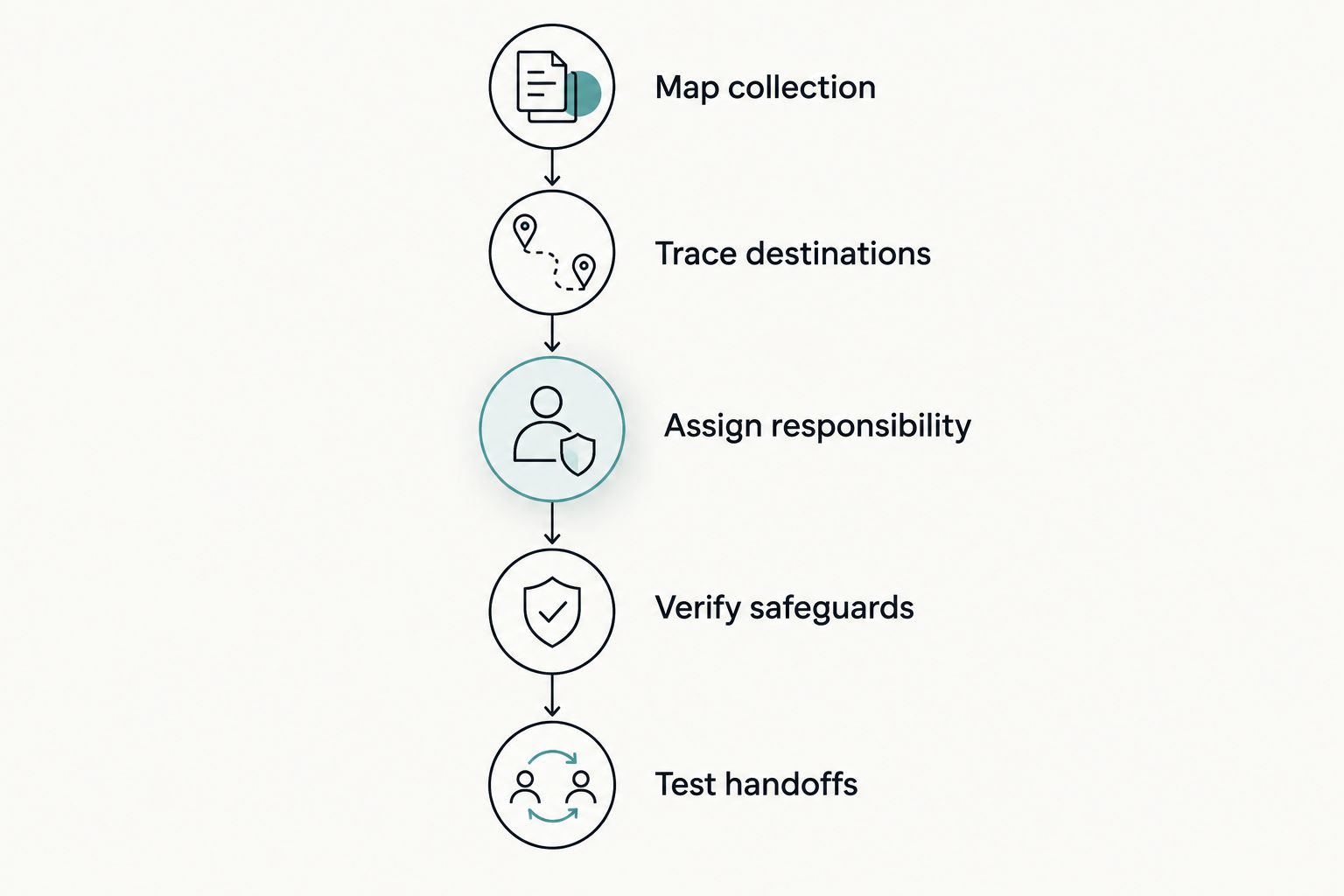
Use this sequence before approving a 2026 redesign. Document the actual route rather than relying on a vendor's description of what usually happens.
- Map collection. List forms, chat tools, uploads, booking widgets, and portal connections. Include mobile versions and landing pages.
- Trace destinations. Follow submissions into databases, email systems, integrations, logs, and backups. Identify temporary copies as well as permanent records.
- Assign responsibility. Determine which organizations handle ePHI and what agreements and safeguards apply to each relationship.
- Verify safeguards. Review access controls, audit records, transmission protection, recovery procedures, and incident responsibilities.
- Test handoffs. Submit fictional patient details and verify where they appear. Do not use real patient information for routine website testing.
The result should be a data-flow record your practice manager can understand. If nobody can explain where a submission goes, the architecture is not ready for approval.
Why HIPAA hosting requirements vary
The relevant differences come from the workflow, not the specialty printed on the homepage. A dental website with referral uploads presents a different scope from a primary care website that publishes office information only.
- Information collected: Clinical uploads require a different assessment from public service descriptions.
- Storage locations: Copies in backups, logs, and databases expand the environment you must review.
- Connected vendors: Scheduling, chat, email, and marketing services introduce separate relationships and disclosures.
- Staff access: Administrative accounts and permissions determine who can reach patient information.
- Tracking configuration: Advertising tags, analytics, and session recording need review wherever sensitive information appears.
- Operational ownership: Maintenance, incident handling, and access removal need named owners.
Replacing a template does not remove these obligations. Custom development does not remove them either. Architecture and operations determine the risk—not the design method.
What should a hosting provider put in writing?
For a 2026 provider review, request an explanation of service scope, applicable agreements, and the division of responsibility. A generic compliance badge is not a substitute for contract language and technical evidence.
Use the federal requirements to structure your questions:
- 45 CFR §164.308: Ask about administrative safeguards, including risk analysis and contingency planning.
- 45 CFR §164.312: Ask about technical safeguards, including access controls, audit controls, and transmission security.
- 45 CFR §164.504(e): Review applicable business associate contract requirements with your compliance adviser.
These references identify obligations; they do not certify a particular vendor. HHS guidance on cloud computing also explains why a cloud provider maintaining ePHI can be a business associate without possessing the encryption key.
Ask which services the proposed BAA covers. Then ask what remains your responsibility: application updates, user access, integrations, backup restoration, and incident escalation. Do not assume the provider manages a task because its proposal mentions security.
Can custom design improve booking without collecting more data?
Yes. A custom medical website can organize the patient journey around the practice's actual scheduling process rather than adding fields to a generic contact form. A dental patient seeking a new-patient appointment needs a clear next step, not an unrestricted invitation to upload records.
Templates offer a starting structure, but their default forms and integrations still require review. Custom design lets you specify the booking handoff and information requested; it also requires a clear brief and ongoing maintenance. Neither approach proves compliance or better conversion by itself.
Website Symphony is best for medical practices seeking one team for website design, marketing, and hosting. That service fit does not establish HIPAA suitability. Before selecting Website Symphony for a patient-data workflow, confirm the proposed architecture, applicable BAA, and responsibilities in writing.
Judge the design by observable tasks: Can patients find the correct appointment route? Can staff locate submissions in the intended system? Can the practice explain what happens after submission? Those checks support a useful patient experience without inventing performance claims.
Where does AI belong in a medical website?
Use AI for a defined task, not as an open-ended patient-information collection point. A bounded assistant answering approved questions about office hours or appointment procedures serves a different purpose from a chatbot soliciting symptoms and retaining identifiable conversations.
Before adding AI functionality in 2026, review transcript storage, vendor access, retention, model-training use, and staff escalation. Public-facing instructions should clearly limit the tool's role, but instructions alone do not prevent patients from entering sensitive details.
Keep clinical intake in the reviewed patient workflow. If an assistant will handle ePHI, assess that service and its agreements as part of the same environment. Do not assume the website host's contract covers an unrelated AI vendor.
Does HTTPS make a medical website HIPAA compliant?
No. HTTPS protects information in transit between the browser and the website, but it does not establish appropriate access controls, safe storage, vendor agreements, or staff procedures. A secure connection can still deliver patient information to an inappropriate destination.
Does a BAA make the entire website compliant?
No. A BAA addresses the relevant business associate relationship; it does not validate every plugin, tracking tag, form, or staff action. Confirm the services covered and verify their actual configuration.
Can patient information go into marketing tools?
Do not send identifiable patient submissions into marketing tools by default. Evaluate the intended disclosure, applicable HIPAA requirements, vendor relationship, and tool configuration before enabling the connection. Removing a diagnosis field does not automatically make an appointment request non-sensitive.
FAQ
Does every medical practice website need HIPAA compliant medical website hosting?
No. A public informational website does not automatically need a HIPAA-regulated hosting arrangement. Hosting that handles ePHI for a covered practice requires appropriate safeguards and applicable business associate arrangements.
Can my dental website link to a separate booking portal?
Yes. A separate booking portal can keep patient submissions outside the public website's hosting environment. Review the destination, the handoff, and whether scripts or integrations also capture patient information.
Is a basic appointment request protected health information?
An identifiable appointment request connected with seeking healthcare can contain PHI when handled by a covered practice. Assess the submitted details and context rather than assuming a short form is harmless.
Does encrypted patient data still require a business associate agreement?
Encryption does not automatically remove the need for a BAA. A service provider maintaining ePHI can be a business associate even without access to the decryption key.
Can I add an AI chatbot to a medical website?
Yes, but define its task and assess its data handling before launch. Review identifiable conversations, transcript retention, vendor access, and applicable agreements rather than assuming the hosting contract covers the chatbot.
Is custom medical website design automatically HIPAA compliant?
No. Custom design does not establish HIPAA compliance. The patient-data workflow, safeguards, vendor agreements, and practice procedures determine whether applicable requirements are met.
One last thing
A form that does not save submissions can still leave patient information elsewhere. Notification emails, error reports, request logs, and backups deserve inspection alongside the visible form settings. Make that end-to-end check a launch requirement for your 2026 website—not a task postponed until after patients begin using it.
This article provides general information, not legal advice. Have your privacy or compliance adviser assess your practice's specific workflow and applicable obligations.