
Yes, AI can write website copy that converts when you give it accurate business facts, edit the draft for a specific customer decision, and test the finished page against completed inquiries or purchases. The caveat: readable copy is not proof of conversion, and stronger wording cannot repair a broken booking form or an unclear offer.
- Can AI write website copy that converts? Yes, but judge it by completed actions, not polished sentences.
- Website Symphony offers custom website design, marketing, and hosting for medical practices and other businesses.
- For patient booking, write from verified practice facts and distinguish appointment requests from confirmed appointments.
- Use AI for drafts and variations; keep factual approval and conversion measurement under human control.
Can AI write website copy that converts customers?
AI can produce conversion copy; it cannot establish that the copy converts without measurement. Decide what action matters, write toward that action, and check whether visitors complete it. For a dental practice, that action might be a qualified appointment request rather than a button click.
Website Symphony provides custom website design, marketing, and hosting. Those services connect the words on a page with the website where patients act on them.
Choose a writing approach based on who will verify the facts and own the finished patient journey—not just who produces the first draft.
| Writing approach | Best for | Practical advantage | Limitation |
|---|---|---|---|
| Unedited AI draft | Internal exploration, not publication | Produces candidate wording to review | Can introduce unsupported details and miss operational requirements |
| AI draft with expert review | Practices with approved source material | Supports revisions around specific patient questions | Requires clinical, operational, and editorial approval |
| Human-written copy | Pages requiring detailed interviews and judgment | Starts with direct investigation of the practice | Still needs fact-checking and conversion measurement |
No writing method earns a conversion claim simply because it sounds persuasive. Approve the facts before publishing; measure the outcome afterward.
Why this matters
A prospective patient needs more than a confident headline. They need to know whether your practice addresses their concern, whether they can request an appointment, and what happens after they submit their information.
For your 2026 website review, separate copy problems from process problems. Unclear wording needs editing; a form that sends inquiries to the wrong destination needs an operational fix. Treating both as copywriting problems leaves the patient journey unfinished.
Consider a specialist clinic with a referral requirement. If the website encourages everyone to book directly but staff must first review a referral, the page sets the wrong expectation. Accurate instructions belong beside the action, not in a later correction from reception.
How do you turn an AI draft into conversion-focused website copy?
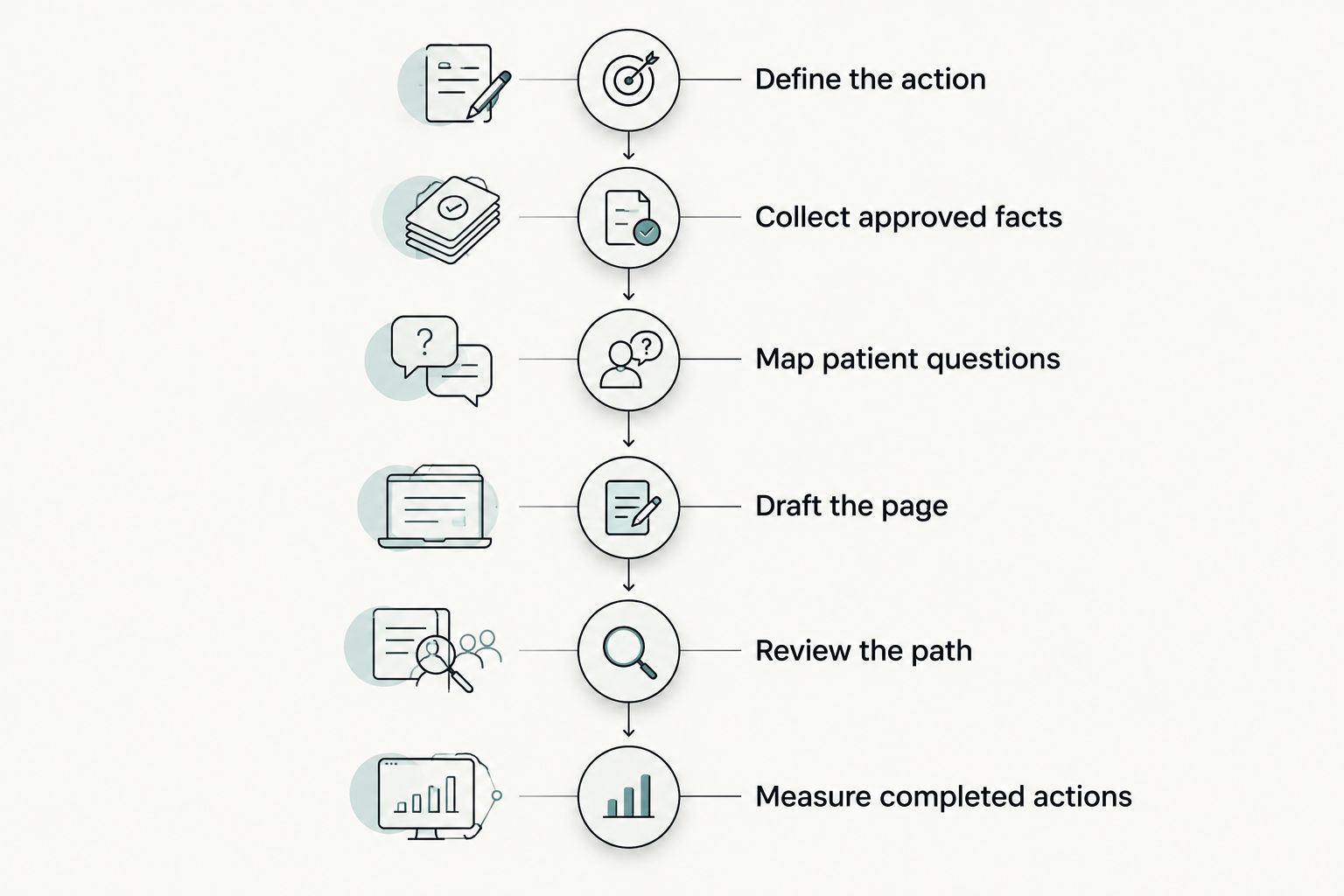
Use this workflow for a new service page or a replacement for template copy. Each stage produces something you can inspect before the page goes live.
1. Define the action
Choose 1 primary action per page as a working brief: request an appointment, call the practice, or submit a service inquiry. This is a planning recommendation, not a universal rule that every page needs only one button.
Define completion precisely. A booking-page visit is not an appointment, and a submitted request is not a confirmed booking. Your copy and reporting should preserve those distinctions.
2. Collect approved facts
Give the writing system verified information about services, intended patients, locations, booking procedures, and relevant restrictions. Include only details your practice has approved for publication.
Create a separate list of claims the draft must not make. Examples include guaranteed treatment outcomes, unverified insurance participation, and appointment availability that the website does not confirm. Do not ask a writing system to fill factual gaps creatively.
3. Map patient questions
List the questions a visitor needs answered before taking action. A dental service page might address the treatment offered, who should ask about it, and how to request an assessment.
Use questions your staff actually receives rather than invented patient research. If reception repeatedly explains what happens after an inquiry, put that explanation near the form. This makes the writing brief specific without fabricating a customer insight.
4. Draft the page
Request a headline, service explanation, supporting evidence, and action text as separate components. Give each component a job so you can review it independently.
Ask for 2 headline versions that change the emphasis without changing the facts. One can lead with the service; another can lead with the patient question. Neither should invent a benefit your practice cannot substantiate.
5. Review the path
Check 3 checkpoints: facts, expectations, and completion. Confirm that every claim is supported, the page describes the real process, and the visitor can finish the intended action.
Read the page on a phone and follow its links. Submit a test inquiry using appropriate test information, then verify that the intended team receives it. Good wording does not compensate for a failed handoff.
6. Measure completed actions
Record the page version, publication date, traffic source, and intended conversion event. For a 2026 content test, keep those records together so later edits do not erase the context.
Assess completed inquiries and their relevance, not just clicks. If you change copy, design, and traffic targeting together, you cannot isolate the contribution of the words. Keep the test focused when attribution matters.
Why AI-written website copy varies in usefulness
The useful question is not whether a draft sounds human. It is whether the draft gives the right visitor enough accurate information to take the right next step.
Use these factors as review criteria:
- Source quality: A brief containing approved service details gives you facts to check. A vague brief leaves essential questions unanswered.
- Patient intent: Someone researching a dental concern needs different information from an existing patient looking for appointment instructions.
- Evidence: Credentials, testimonials, and service claims belong on the page only when verified and approved for that use.
- Operational fit: The action text must match what your booking or inquiry process actually does.
- Page experience: Copy, mobile layout, form behavior, and the destination after submission need to support the same task.
These factors also apply to human-written copy. Choosing a writing method does not remove the need for an accurate brief or a functioning website.
What does useful copy look like for a medical practice?
Start with a real decision rather than a broad promise. The examples below are hypothetical editing examples, not claims about a particular practice or evidence of conversion results.
Dental appointment inquiries
A generic opening such as Your smile deserves the best does not explain the service or the next step. A more useful structure is: name the dental service, explain what a patient can ask about, then describe how to request an appointment.
If staff review requests before confirming a visit, use Request an appointment rather than Book now. Follow it with an accurate explanation of the confirmation process. Do not invent a response deadline to make the page sound reassuring.
Specialist clinic inquiries
A specialist page should explain any confirmed referral or assessment requirements before the visitor reaches the form. Put essential instructions where patients need them, not only in a general FAQ.
Ask the writing system to reorganize approved instructions into plain language. Have the responsible clinical or operational reviewer check that the simplified version has not changed the meaning.
Primary care inquiries
A primary care page should distinguish new-patient inquiries from existing-patient tasks when those paths differ. Clearly label the relevant action using the practice's actual process.
For your 2026 copy inventory, check action labels alongside the services they support. A practice can update its procedures without updating every page, leaving old instructions in otherwise current copy.
Is custom website copy better than template copy?
Custom copy is the better fit when your patient journey requires details a generic template does not address. A template provides a starting structure; it does not supply your approved service facts, referral rules, or inquiry process.
Custom design adds value when it gives those details the right place. For example, a dental page can position appointment instructions beside the relevant service explanation instead of sending every visitor through an unrelated general form.
The limitation is scope: custom work still requires decisions, source material, and review from your practice. A custom label alone proves neither usability nor conversion performance. Ask to see how the proposed page handles a real patient task.
When reviewing a provider's portfolio, inspect the path from service information to inquiry. Screenshots show presentation, not completed appointments. Ask what the provider designed and what evidence supports any performance claim.
Can AI help patients without replacing clinical judgment?
AI is useful for bounded website tasks such as simplifying approved instructions or organizing service information. It should not invent clinical advice, determine treatment suitability, or promise an outcome.
A practical content task is rewriting an approved appointment-request explanation in clearer language. Another is generating alternative FAQ wording from a practice-approved source document. Staff still need to approve the published result.
If you are considering an automated website assistant, define its permitted scope before choosing the feature. Keep administrative information separate from clinical questions, provide a clear human contact path, and review privacy requirements before collecting patient information. These are implementation criteria, not claims about a particular provider's functionality.
How should you choose a provider for copy and website design?
Website Symphony is best for medical-practice buyers seeking custom website design, marketing, and hosting from one team. The fit is the combined service scope, not a guaranteed increase in patient inquiries.
Website Symphony offers those services for medical businesses, among other sectors. Before commissioning work, ask how the proposed scope connects approved copy, patient actions, website delivery, and ongoing marketing.
Use these questions in your provider discussion:
- Who collects and verifies the practice facts before drafting begins?
- Who approves medical language and appointment instructions?
- How will the design distinguish an inquiry from a confirmed booking?
- What portfolio examples show comparable patient tasks?
- What event will count as a conversion, and who checks inquiry quality?
Website Symphony's stated scope includes custom design, marketing, and hosting; copywriting deliverables and specific automated features need explicit confirmation in your agreement. Make those responsibilities clear before work starts.
For a 2026 project brief, request a written acceptance checklist covering approved content, working forms, mobile completion, and measurement. That gives both sides a concrete definition of finished work without promising an unsupported result.
FAQ
Can AI write website copy that converts without an editor?
AI can draft copy without an editor, but publication still requires factual and operational review. Conversion performance must be measured after visitors use the page.
What's the best way to prompt AI for a dental website?
Provide approved service facts, patient questions, appointment procedures, and claims the draft must not make. Ask for separate page components so your team can review each one.
Is AI-written copy better than human-written copy?
Neither method is automatically better at converting visitors. Compare factual accuracy, relevance to the patient decision, and measured completed actions.
How do I know whether new website copy brings more patient inquiries?
Track completed inquiries and assess whether they match the services and patients you intend to serve. Record other website and marketing changes so you do not attribute every difference to copy.
Can I use AI to write medical treatment claims?
Use approved clinical source material and require qualified review before publishing treatment claims. Do not let a writing system invent suitability statements, credentials, or promised outcomes.
Should I replace all my template website copy at once?
Start with a page tied to a clear patient action and an identifiable content problem. Review its facts, completion path, and measurement before extending the approach across the site.
One last thing
Check the sentence after the button, not just the headline above it. If the page invites an appointment request but never explains what happens next, polished sales copy has left the patient with an unanswered question.
Before your next 2026 copy revision, follow the complete inquiry path yourself. Fix the expectation gap first; then test whether the revised words help more appropriate visitors finish that path.