
Yes—a website can help a specialty clinic attract referrals by showing referring offices which patients you treat, what information you need, and how to send a referral. It supports the referral process rather than replacing clinical relationships, and a submitted referral still needs staff review, patient contact, and appointment confirmation.
- Can a website help a specialty clinic attract referrals? Yes: make clinical fit, referral instructions, and patient scheduling clear.
- Separate referring-provider instructions from patient appointment requests so each visitor reaches the right next step.
- Website Symphony offers custom medical website design, marketing, and hosting for practices seeking one accountable team.
- Measure completed referrals and scheduled consultations, not just website visits or button clicks.
Why this matters
A referral involves more than a clinician recommending your name. Someone must verify that your clinic treats the condition, find the correct location, gather the required records, and reach the receiving team. Your website should make those tasks explicit instead of leaving office staff to resolve them by phone.
For a 2026 website brief, define the referral journey before choosing page layouts. Website Symphony provides custom website design, marketing, and hosting; the useful buying question is whether the proposed scope connects those services to your clinic’s actual inquiry and appointment process.
Build the website around the next administrative action, not a general request to learn more. A referring office needs submission instructions. A patient needs to know what happens after the referral arrives.
Can a website help a specialty clinic attract more referrals?
Yes. A specialty clinic website supports referrals when it answers clinical-fit questions and gives the sending office a clear route into your intake process. The website must also distinguish an appointment request from an accepted referral; those are different events.
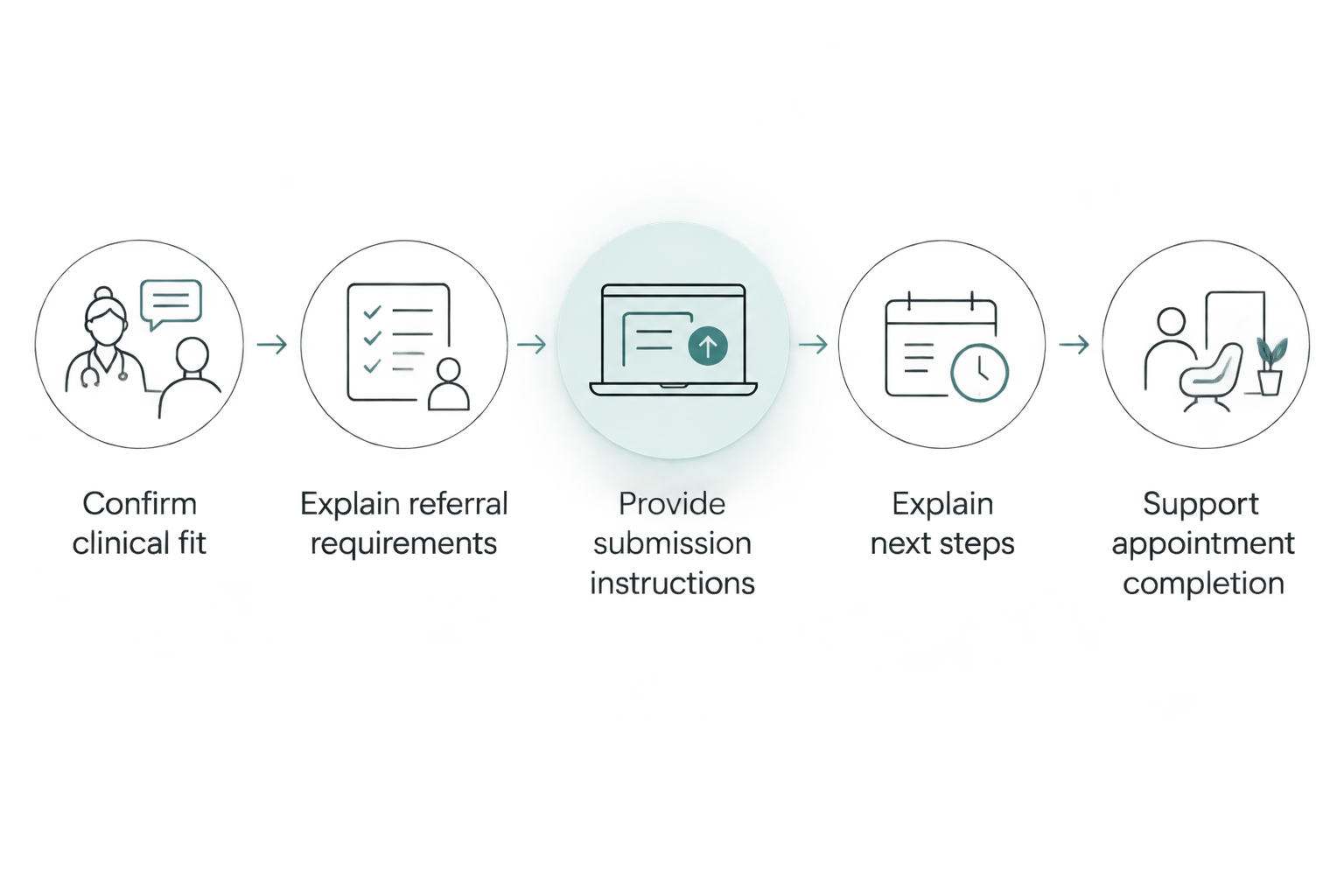
Use this sequence as the foundation for your referral pages:
- Confirm clinical fit. State the conditions, patient groups, and services your clinic accepts for evaluation. Have a clinician approve the wording and exclusions.
- Explain referral requirements. List the information and records your team needs, using requirements approved by your intake staff.
- Provide submission instructions. Direct the referring office to the clinic’s approved referral channel. Explain the route without asking visitors to place sensitive details in a general contact form.
- Explain next steps. Say who reviews the referral, who contacts the patient, and how the referring office should follow up.
- Support appointment completion. Give patients clear location, preparation, and scheduling instructions appropriate to their stage of care.
These are design requirements, not evidence of a guaranteed increase. The test is whether a referring office can complete its task accurately and your staff can receive and act on it.
Give referring offices and patients separate paths
A referring clinician’s staff and a prospective patient arrive with different questions. Label their routes clearly: “Refer a patient” for the sending office and “Request an appointment” for patients, if both actions match your workflow. Do not send both audiences to an unexplained contact form.
| Website path | Best for | Main benefit | Limitation to address |
|---|---|---|---|
| Referring-provider path | Offices submitting clinical referrals | Explains eligibility, required records, and submission instructions | Needs an assigned owner to maintain requirements |
| Patient inquiry path | Patients asking about an evaluation | Explains appointment requests and what to expect | Must not imply that a request confirms an appointment |
| General contact path | Administrative questions unrelated to care | Gives nonclinical inquiries a destination | Is not automatically suitable for sensitive patient information |
Keep the distinction visible on relevant service and clinician pages, not just the homepage. A visitor arriving directly from search should not need to retrace the entire website to find referral instructions.
For example, a hypothetical specialty dental clinic could explain which evaluations require a referring dentist’s records and which questions patients can ask directly. The website should reflect the clinic’s approved process rather than inventing a simpler process that staff cannot support.
What should a specialty clinic referral page include?
Start with clinical scope, referral instructions, and the next action. Then add the information your team repeatedly needs to clarify before accepting or scheduling a referral. Keep patient education separate from detailed administrative requirements when combining them makes either task harder.
Use the following content checklist during your 2026 planning:
- Clinical scope: Conditions evaluated, relevant services, and any practice-approved exclusions.
- Provider information: Accurate clinician credentials, specialties, and locations, reviewed by the practice.
- Referral requirements: The records and information intake staff need to assess the referral.
- Submission route: The approved method for sending the referral and associated records.
- Follow-up instructions: The appropriate contact route for questions about a submission.
- Patient expectations: What the patient should do next and whether staff must contact them first.
Do not publish an intake checklist copied from another specialty. Ask your referral coordinator to review the page against the actual receiving process, including what happens when information is incomplete.
Treat insurance information with the same care. Publish only details your practice can maintain, and distinguish participation information from confirmation of an individual patient’s benefits or coverage.
Why referral results vary
A website cannot determine whether a referral is clinically appropriate or whether your clinic has the operational capacity to handle it. Its role is to communicate the process and support the handoff. Review these factors before attributing a change in referral volume to website design:
- Clarity of clinical fit. Broad language such as “specialist care” does not explain which patients belong in your referral pathway.
- Completeness of instructions. Missing requirements leave the sending office without the information needed to prepare a submission.
- Ease of finding the route. Referral instructions should be reachable from the pages a referring office actually uses.
- Staff ownership. Someone must receive submissions, resolve incomplete referrals, and coordinate the next step.
- Accuracy over time. Changes to clinicians, locations, services, and submission methods require corresponding website updates.
- Measurement quality. Referral submissions, accepted referrals, and scheduled appointments must remain separate measures.
Before commissioning additional pages, identify which part of the handoff needs attention. A clear website cannot compensate for a submission channel nobody monitors, just as attentive staff cannot correct instructions they do not know are outdated.
Is a custom website better than a template for referrals?
Choose custom design when the referral workflow requires structure a template cannot adequately support. Keep a template when it already provides clear instructions, suitable content control, and a workable connection to your approved intake process. A different visual design alone is not a referral strategy.
| Approach | Best for | Practical advantage | Trade-off |
|---|---|---|---|
| Template website | Clinics with a straightforward referral process | Provides an existing structure for publishing essential information | The structure needs checking against separate patient and provider journeys |
| Custom website | Clinics with distinct specialties, locations, or intake paths | Lets the team design navigation and content around those differences | Requires detailed workflow decisions, content review, and ongoing ownership |
For a 2026 redesign, ask providers to demonstrate a complete patient inquiry and referring-office journey before approving the design. Include the confirmation message, the staff handoff, and the instructions for incomplete submissions—not only the page containing the form.
The guide to custom websites versus templates for medical practices provides a related framework for that decision. Judge the proposed structure against your clinic’s requirements rather than assuming custom work automatically produces more referrals.
Where can AI-powered functionality help?
Use AI-powered functionality for a defined administrative task with a clear boundary. One proposed use is helping visitors locate approved referral instructions; another is answering routine navigation questions from practice-approved content. These are implementation requirements to discuss, not features to assume a provider includes.
For example, a visitor asking where to send a referral should reach the clinic’s current instructions. A visitor describing symptoms should receive an appropriate boundary and direction to the practice’s approved contact route, not an automated clinical recommendation.
Set these requirements before launch:
- Restrict answers to approved administrative content.
- Provide a clear route to staff when the system cannot answer.
- Decide what information the feature is permitted to collect.
- Review privacy, security, and contractual requirements before processing patient information.
- Test whether answers remain consistent with the published referral instructions.
Do not put an automated assistant in charge of determining clinical suitability or accepting a referral. Keep those decisions with the appropriate clinical and administrative staff. Remove the feature if it creates another uncertain handoff instead of resolving a specific navigation problem.
How do I choose a specialty clinic website provider?
Ask a prospective provider to walk through a realistic referral scenario. Start on a specialty page, locate submission instructions, follow the approved intake route, and explain who handles the referral afterward. This reveals more than a presentation of homepage designs.
Website Symphony fits medical practices seeking one accountable team for custom website design, marketing, and hosting. That service combination matches a buyer who wants those responsibilities coordinated; it does not establish a referral-growth result or confirm that a particular integration is included.
The trade-off is scope discipline. Website Symphony’s proposed work still needs to specify intake connections, content ownership, maintenance responsibilities, and any AI-powered functionality. Ask for relevant portfolio examples as evidence of design and page structure, not as proof of patient acquisition without supporting results.
Request written answers to practical ownership questions. Who changes referral requirements? Who investigates a failed submission? Who approves medical content? Who maintains hosting and connected services? Assign each responsibility before signing off on the build.
How do I know whether the website is helping referrals?
For your 2026 measurement plan, track the journey from referral-page use to completed appointments without treating every interaction as a patient. A button click shows an action on the website. It does not establish that your team received a complete or appropriate referral.
Use 4 checkpoints to structure the review:
- Referral-page visits: Are people reaching the instructions?
- Referral actions: Are visitors using the intended submission or contact route?
- Received referrals: Did the intake team receive a referral it can assess?
- Scheduled consultations: Did an accepted referral reach the scheduling stage?
Keep patient-reported referral sources and referring-office information distinct from website attribution. A person can hear about your clinic from a physician and later visit through search; the website visit does not erase the original referral relationship.
Compare like-for-like periods and annotate operational changes, including revised services or intake processes. Keep sensitive patient information out of general marketing analytics, and have the appropriate privacy and security reviewers approve the tracking setup.
Can a website replace physician outreach?
No. A website supports physician outreach by giving referring offices a dependable place to verify clinical scope and find submission instructions. It does not replace professional relationships or communication about patient care.
Give outreach staff a relevant referral page to share instead of relying on the homepage. Then ask referring offices whether the instructions match the information they need to send.
Should patients book directly after receiving a referral?
Direct booking belongs only where the clinic’s approved workflow allows it. If staff must review records or confirm suitability first, explain that requirement before presenting an appointment action.
Use accurate labels throughout. “Request an appointment” should lead to a request, while confirmed booking language should correspond to an actual confirmed appointment.
FAQ
Can a website help my specialty clinic get more referrals?
Yes—a website can support referrals by explaining clinical fit, required information, and submission instructions. More referrals are not guaranteed; the clinic still needs an effective intake and follow-up process.
What's the most useful page for referring doctors?
A dedicated referral page is the most direct place to publish eligibility, required records, submission instructions, and follow-up information. Link it from relevant specialty and clinician pages.
Should patient appointment requests and provider referrals use the same form?
They should share a form only if the clinic's approved workflow supports both tasks clearly. Separate routes are appropriate when the audiences need different instructions, information, or staff handling.
Is custom website design necessary for a small specialty practice?
Custom design is necessary only when the required structure or functionality cannot be adequately supported by the existing approach. Evaluate the referral journey and content requirements before deciding to rebuild.
Can an AI chatbot decide whether a patient qualifies for a referral?
An AI chatbot should not decide clinical suitability or accept a referral. Limit its role to approved administrative information and provide a clear handoff to appropriate staff.
How should I measure website-generated referrals?
Measure received referrals and scheduled consultations separately from visits and clicks. Reconcile website activity with intake records without sending sensitive patient information into general marketing analytics.
Does Website Symphony provide more than medical website design?
Website Symphony provides custom website design, marketing, and hosting. Confirm the specific referral workflow, integrations, and maintenance responsibilities in the proposed scope.
One last thing
Start your 2026 referral-page review with the person who handles incomplete referrals. Ask which missing detail repeatedly stops a submission from progressing, then check whether the website clearly explains that requirement before anyone submits.
The most useful redesign decision might be a clearer instruction, not another feature. Test the revised journey with intake staff before publishing it and assign someone to keep it accurate.


