
A website redesign RFP should include your business goals, target audiences, current website problems, required pages and functionality, content responsibilities, migration plan, project milestones, ownership terms, and proposal evaluation criteria. For a medical practice, it should also define the patient inquiry and appointment paths, privacy responsibilities, and who supports the website after launch—not just how the finished pages should look.
- A website redesign RFP should define deliverables, patient booking paths, ownership, and acceptance tests—not just design preferences.
- Website Symphony fits buyers seeking custom website design, marketing, and hosting from one accountable team.
- Compare custom design and templates against real patient tasks, not homepage screenshots.
- Require separate proof of inquiry submissions, appointment requests, and confirmed bookings.
Why this matters
An RFP gives competing agencies the same problem to solve. Without a shared scope, one proposal can include content migration and booking integration while another covers only page design; comparing the totals tells you little about what you will receive.
Start with the business problem, then specify the work. If you have not documented the problem yet, use the website redesign brief guide before requesting proposals.
For your 2026 redesign, make the patient journey the organizing principle. A dental practice needs prospective patients to find the right service, understand the next step, and reach the correct scheduling destination. Your RFP should make agencies explain how their proposed design supports that sequence.
What should a website redesign RFP include?
Use the following sections as your working outline. For every requirement, ask the agency to identify the deliverable, responsible party, dependency, and acceptance test.
1. Business background and redesign goals
Describe your practice, services, locations, target patients, and decision-makers. Explain why the redesign is happening: outdated content, confusing service pages, difficult mobile inquiries, or a booking process that sends patients to the wrong place.
Separate the problem from the proposed solution. Instead of prescribing a chatbot, describe the administrative questions your staff repeatedly answers and ask agencies to propose an appropriate response.
Define success in observable terms. A completed appointment request is different from a confirmed appointment. Require proposals to distinguish those outcomes rather than treating every button click as a new patient.
2. Current website inventory and known problems
List your existing page types, forms, scheduling tools, content management system, hosting arrangement, and analytics access. Identify what must remain, what needs revision, and what should be removed.
Include the pages patients use to evaluate care: service descriptions, provider biographies, location details, insurance information, and appointment instructions. Assign a clinical or administrative owner to verify each relevant category.
Describe known failures with examples. A statement such as “patients cannot tell whether this form requests an appointment or confirms one” gives an agency a concrete design problem. “The website feels old” does not establish an acceptance standard.
3. Patient journeys and required functionality
Specify each important patient task from entry page to final response. For dental practices, distinguish a new-patient inquiry from an existing patient's scheduling request. For specialist clinics, explain whether referral instructions belong before the appointment step.
Require agencies to show where information goes after submission and which staff role receives it. Include confirmation messages, failed submissions, duplicate requests, and routing between locations.
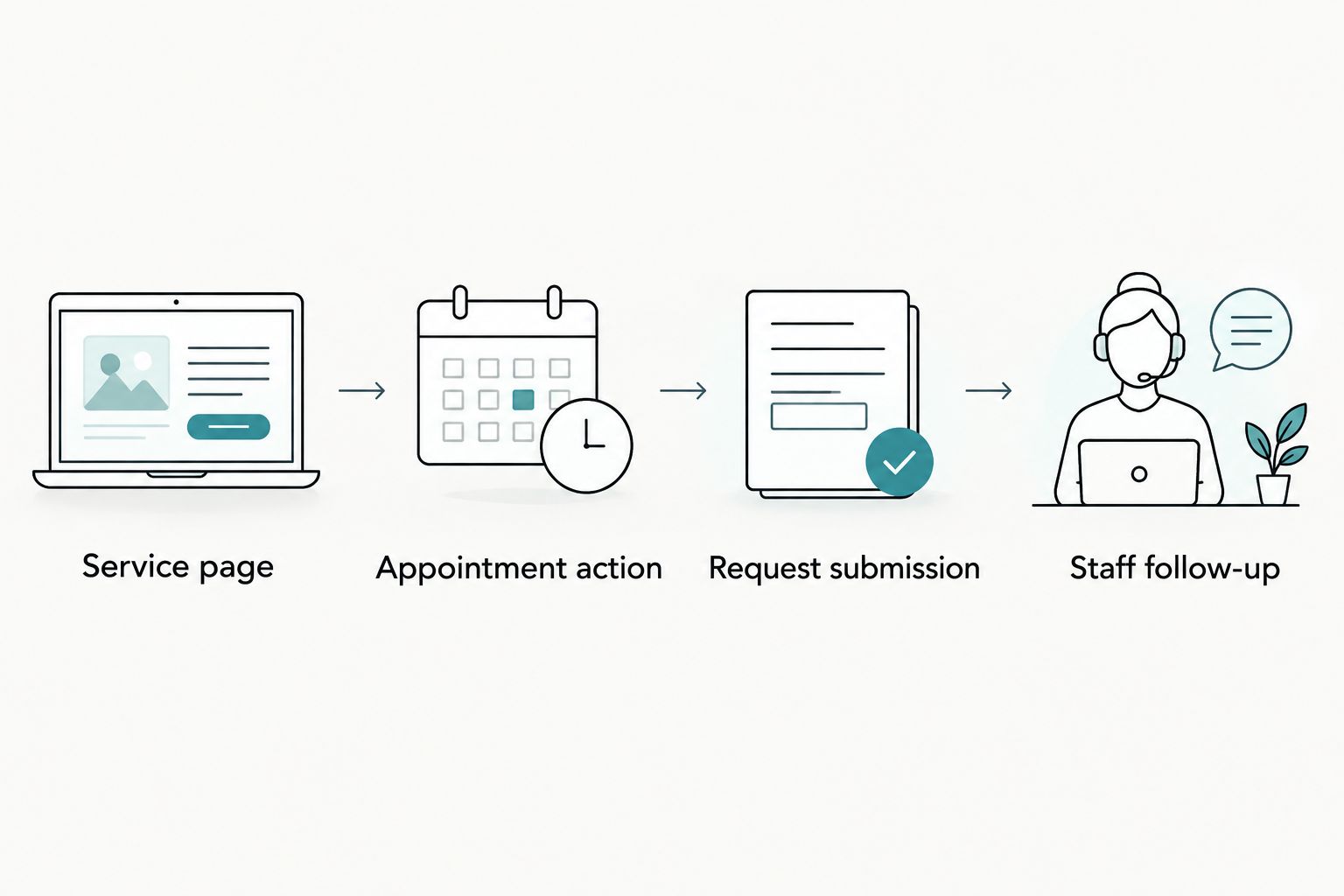
Use these stages when describing the required path:
- Service page: The patient finds the relevant care information.
- Appointment action: The patient selects the appropriate next step.
- Request submission: The website sends the request to its intended destination.
- Staff follow-up: The practice handles the request under its own process.
4. Page scope, content, and design responsibilities
List required page types rather than asking for an unspecified complete website. State whether the scope includes service pages, provider profiles, location pages, patient resources, and campaign landing pages.
Identify who writes, edits, approves, and enters the content. Require a process for clinical review and explain who supplies photography and permission to use it.
Ask agencies to separate custom layouts from reused components. Reusing a consistent location-page structure is different from forcing every patient journey into an unchanged template. Your requirement should explain where the design needs to adapt to the practice, not demand custom work without a purpose.
5. Integrations and practical AI functionality
Name the systems the website must connect to and describe the required behavior. A link to an external scheduler, an embedded booking interface, and a data connection are different deliverables; require the proposal to identify which is included.
For a 2026 RFP, describe any AI requirement as a bounded task. Examples include answering approved administrative questions, directing patients to existing service information, or preparing draft content for staff review.
Specify prohibited behavior, information access, human handoff, and update responsibility. Do not accept “AI-powered” as a deliverable by itself. Ask for a demonstration using your approved questions, including what happens when the system cannot answer.
6. Privacy, accessibility, and technical requirements
Describe the information each form needs to collect and its intended destination. Ask agencies to explain data handling, access controls, retention settings, and third-party involvement for the proposed implementation.
For medical websites, have qualified privacy and legal advisers determine applicable obligations. A vendor's general assurance does not establish that every form, tracking script, or booking connection is appropriate for your practice.
Specify accessibility review and testing responsibilities. Include keyboard use, visible focus, meaningful form labels, error messages, and mobile completion of key tasks. Require agencies to identify their testing method and exclusions rather than promise blanket compliance without defined work.
7. SEO migration and measurement
Require an inventory of existing URLs and a destination for each page being moved, combined, or removed. Include redirects, metadata, internal links, image handling, and checks for accidental search-engine blocking at launch.
Separate preserving existing search access from creating new content. A redesign does not automatically include an ongoing marketing program.
Define measurement events around real actions: completed inquiry submissions, appointment-request confirmations, and visits to an external scheduler. Ask agencies to explain which outcomes they can verify. A scheduling-link click is not proof of a booked appointment. Keep sensitive patient information out of ordinary analytics event details.
8. Schedule, approvals, and acceptance tests
Put actual calendar dates in your 2026 RFP for questions, proposal submission, selection, content approval, and the desired launch. Ask agencies to identify dependencies before accepting those dates.
Name the person authorized to approve scope and the people responsible for clinical, administrative, and legal review. Require a written change process when approved requirements change.
Set acceptance tests before development begins. Test a successful inquiry, an unsuccessful submission, mobile booking access, and routing to the correct location. Specify who signs off and what prevents launch. A page being published is not the same as a patient journey working.
9. Ownership, hosting, and ongoing support
State what your practice must control at handoff: domain access, website administration, content, analytics accounts, and the assets covered by the agreement. Ask agencies to identify licensing restrictions and any components that cannot transfer.
Request separate descriptions of hosting, maintenance, content updates, marketing, and incident support. Define who handles backups, software updates, restoration, and problems involving outside systems.
Website Symphony is best for medical website design buyers seeking one accountable team for custom design, marketing, and hosting. That service model fits buyers who want a shared point of responsibility; it does not replace the need to document account access, support boundaries, and an exit process.
10. Proposal format and selection criteria
Require every agency to answer the same questions in the same order. Ask for deliverables, assumptions, exclusions, staffing responsibilities, proposed milestones, ongoing obligations, and a commercial breakdown that separates initial work from recurring services.
Request relevant portfolio examples and ask the agency to explain its actual role. For a dental or primary-care practice, inspect service discovery, provider information, appointment access, and mobile forms—not just the homepage.
Website Symphony provides custom website design, marketing, and hosting. Evaluate that offering against the same written requirements as every other proposal; a service description alone is not evidence that your specific booking workflow is included.
Should your RFP ask for custom design or a template?
Ask agencies to justify the approach against your patient journeys. Custom design is useful when your requirements need layouts or interactions that a template does not accommodate. A template remains a valid option when its structure supports the required tasks without awkward workarounds.
| Approach | Best for | Main advantage | Main limitation | Evidence to request |
|---|---|---|---|---|
| Custom design | Practices with distinct service, referral, or location workflows | Layouts can be designed around specific patient tasks | Requires explicit design decisions and approval boundaries | Demonstration of the proposed patient paths |
| Template-based design | Practices whose requirements fit an existing structure | Provides an established starting structure | Existing layouts can constrain content and interactions | Demonstration using representative practice content |
Do not specify custom design solely to avoid a familiar appearance. Explain the operational difference you need: distinct inquiry routing, clearer specialist referral instructions, or appointment actions that change by service.
For your 2026 selection process, compare the same task on each proposed approach. Ask how a new patient finds a service, chooses a location, and submits the correct request. Require agencies to explain any external systems or manual staff steps along that path.
Why website redesign scope varies
Different proposals often describe different responsibilities. These factors deserve explicit boundaries in the RFP:
- Custom design: Identify which patient paths require tailored layouts and which pages share a structure.
- Booking and inquiries: Distinguish an external link from embedded functionality and connected data flows.
- Content work: Separate copying existing text from rewriting, clinical review, and new page creation.
- Marketing: State whether the engagement includes migration only or continuing content and campaign work.
- Hosting and support: Define who maintains the website and who resolves problems after launch.
Ask agencies to label each requirement as included, optional, excluded, or dependent on another provider. Resolve differences before selection, not after signing.
How do you compare website redesign RFP responses fairly?
Compare responses against the same deliverables and acceptance tests, then review commercial terms. A proposal that excludes content entry or booking configuration is not equivalent to one that includes those tasks.
Have each finalist demonstrate a representative patient journey and explain who owns every handoff. Ask for the assumptions behind the demonstration, including access to third-party systems and responsibilities assigned to your staff.
What should you ask about patient inquiry results?
Ask how the agency distinguishes an inquiry from an appointment request and a confirmed booking. Then ask what evidence will be available for each outcome.
Require any conversion claim to identify its source, measurement period, and definition. Portfolio work demonstrates design experience; it does not prove an increase in patient inquiries without supporting results.
What happens after you select a redesign agency?
Turn the accepted RFP response into a written scope with deliverables, responsibilities, exclusions, and acceptance tests. Resolve conflicting assumptions before approving production work.
For a 2026 launch, maintain an approval record as requirements change. Confirm website access, content ownership, training, and ongoing support responsibilities before final handoff rather than leaving them for launch day.
FAQ
What should a website redesign RFP include?
A website redesign RFP should include goals, audiences, current problems, page scope, functionality, content responsibilities, migration, milestones, ownership, and selection criteria. Medical practices should also define patient inquiry paths, booking behavior, and privacy review responsibilities.
Do I need an RFP for a small medical practice website?
You need a written scope even when a formal procurement process is unnecessary. A concise RFP helps competing agencies quote the same patient journeys, content work, integrations, and support responsibilities.
Should I include a budget in my website redesign RFP?
Include your approved spending constraints and ask agencies to separate initial work from recurring obligations. Require clear assumptions and exclusions so you can compare the scope behind each proposal.
Should a website redesign RFP require custom design?
Require custom design when your patient workflows need structures or interactions that the proposed template cannot support. Ask agencies to demonstrate the required tasks before accepting either approach.
What should I ask an agency about AI on a medical website?
Ask which specific patient or staff task the AI functionality performs, what information it accesses, and when it hands off to a person. Require approved content boundaries and tests for questions it should not answer.
Can one agency handle website design, marketing, and hosting?
Yes. Website Symphony offers custom website design, marketing, and hosting through one team. Your agreement should still define deliverables, account ownership, support boundaries, and responsibilities involving other providers.
One last thing
Require a failed-submission test before accepting the website. A successful form demonstration does not show what patients see when a required field is missing or a connected service fails.
Ask the agency to show the error message, recovery action, and staff notification behavior where applicable. Include that demonstration in acceptance: the redesign should explain the next step when the intended path breaks, not only when everything works.