
Yes, Shopify is worth it for small eCommerce brands in 2026 when you need an online store with managed hosting, product management, and an established checkout. The subscription is not the whole commitment: you still need product content, store configuration, marketing, and ongoing maintenance. Choose Shopify because it fits how you sell—not because a theme makes launching look effortless.
- Is Shopify worth it for small ecommerce brands? Yes, when its store operations fit your products and fulfillment.
- Shopify provides commerce infrastructure; your product pages and marketing still need clear ownership.
- Custom Shopify design suits brands whose buying journey needs more than a standard template.
- Test the complete purchase and fulfillment path before committing to a build.
For design support, Website Symphony provides custom eCommerce website design, marketing, and hosting services. Evaluate those services against a written scope rather than assuming a website package includes every integration or ongoing task.
Is Shopify worth it for small eCommerce brands in 2026?
Shopify is a good fit when selling products is the website’s main job and its supported workflows match your operation. It is a weaker fit when essential buying rules require extensive workarounds. Compare the implementation path, not just the platform name.
| Approach | Best for | Main advantage | Main limitation |
|---|---|---|---|
| Shopify with a configured theme | Brands with straightforward catalogs and buying paths | An existing storefront structure reduces design decisions | Your content and shopping journey must fit the theme’s structure |
| Shopify with custom design | Brands needing tailored product education and merchandising | You can shape the storefront around customer questions | Design, development, and maintenance need a defined scope |
| A separately scoped custom commerce build | Businesses with essential workflows that standard platforms do not fit | Requirements can drive the architecture | You take on more implementation and maintenance responsibility |
These are different ownership decisions. A theme provides a starting layout; custom design changes the storefront experience; a custom commerce build changes the underlying implementation. None removes the need to manage orders, answer customers, or attract qualified visitors.
Why this matters
A store can look finished while the buying journey remains incomplete. A shopper still needs to understand the product, select the right variant, review delivery information, and complete checkout without unanswered questions.
For a small team, the practical question is whether the platform reduces operational work without obstructing the sale. A polished homepage does not compensate for confusing product choices or an order workflow that staff cannot manage.
Judge the platform by the work required to take an order and fulfill it correctly. Design quality matters, but it belongs inside that larger test.
When a Shopify theme is enough
Best for: a straightforward catalog with familiar product choices. Start with a configured theme when customers can understand what you sell through clear photography, product descriptions, variant selectors, and ordinary navigation.
The advantage is focus. Instead of designing every page pattern from scratch, you can spend effort on the information customers need before buying. The limitation is structural: a theme can become awkward when your product requires an explanation or selection process it was not designed to support.
Before requesting custom development, identify the actual obstruction. Missing dimensions, unclear materials, inconsistent images, and buried delivery policies are content problems. A new layout will not supply those answers for you.
For a 2026 launch, write the product information first and evaluate themes with that content in place. A demonstration store’s polished images do not prove that the same layout suits your catalog.
When custom Shopify design is worth the work
Best for: brands whose customers need guided product education before purchasing. Custom Shopify design makes sense when you can name a buying obstacle and explain how the proposed page structure addresses it.
For example, a product page might need to explain fit before showing variant choices. Another catalog might need clearer collection navigation so shoppers can separate products by intended use. These are concrete design requirements, not reasons to add decoration.
The benefit is control over the storefront’s presentation and purchase path. The trade-off is responsibility: custom components need documentation, testing, and someone accountable for changes.
Ask a provider to connect each proposed feature to a customer action. If a section does not help shoppers understand, choose, trust, or purchase the product, question its place in the build.
When to evaluate a different commerce approach
Best for: businesses with essential buying rules that a standard store cannot support cleanly. Evaluate another approach when your requirements review identifies a genuine operational mismatch—not merely a preference for a different visual style.
Write down the requirement precisely. Describe what the customer selects, what information the business needs, what happens after payment, and where that information must go. Then ask providers to demonstrate the workflow rather than promise that an integration will handle it.
A separately scoped build can give unusual requirements more influence over the architecture. Its disadvantage is the larger responsibility for implementation, support, and maintenance. Do not accept that responsibility without a documented reason.
Why Shopify’s value varies between small brands
Shopify’s value depends on the work surrounding the platform. Use these factors to define your scope before selecting a theme, developer, or agency:
- Catalog complexity: Document variants, product relationships, and information needed to make a selection. Complexity affects merchandising and maintenance.
- Purchase journey: Identify whether customers buy directly or need education, comparison, or assistance first. Design around that decision.
- Operational connections: List the systems that need order, inventory, or customer information. Confirm exactly what each connection must do.
- Content readiness: Assign responsibility for images, descriptions, policies, and collection copy. These are launch dependencies, not finishing touches.
- Team capacity: Decide who handles product updates, customer questions, app reviews, and technical changes after launch.
- Customer acquisition: Define how shoppers will reach the store. Choosing a commerce platform does not create a marketing plan.
These factors also explain why two small brands need different implementation scopes. Similar catalog sizes do not guarantee similar customer journeys or operating requirements.
How do you decide before committing?
Use a practical purchase-path review. The goal is to expose missing decisions while changes are still easy to make.
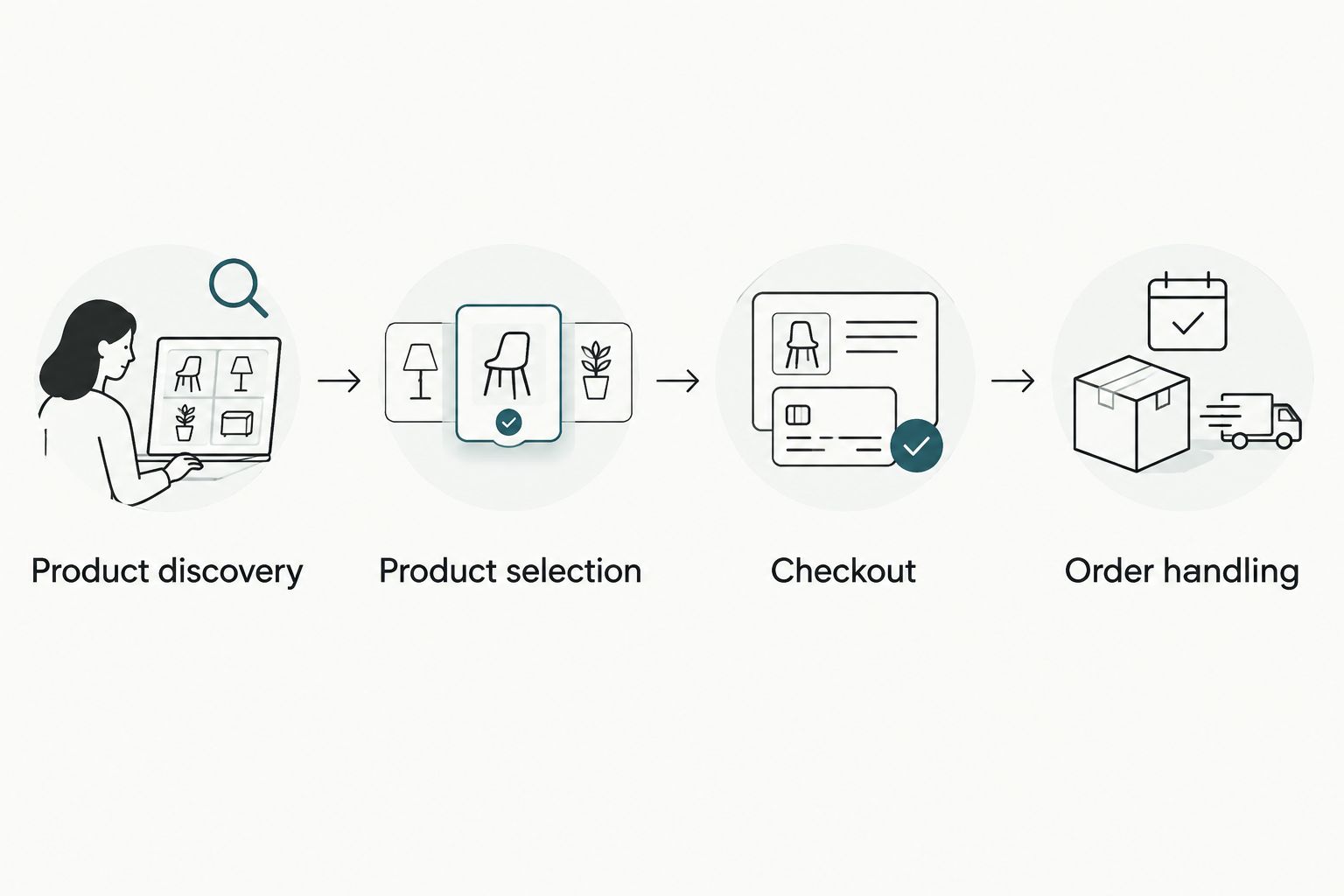
1. Define the purchase path
Write the intended sequence as Product discovery, Product selection, Checkout, and Order handling. For each stage, name the information the customer needs and the task your team must complete.
Keep the sequence specific to your business. A shopper choosing a size needs different guidance from a shopper comparing materials. Your requirements should reflect that difference.
2. Test a representative order
Run 1 test order through the proposed setup using the platform’s supported testing process. Choose a product with meaningful options rather than the easiest item in the catalog.
Check what the customer sees and what the staff receives. Confirm that the selected variant, delivery details, and order information reach the people who need them. Record every manual correction.
3. Review the experience on different devices
Check the purchase path on 2 device types: a phone and a desktop computer. Inspect menus, images, product options, forms, and error messages—not just the homepage.
A design review is incomplete until you can make a selection and proceed through the intended checkout path. If an issue blocks that task, resolve it before polishing secondary pages.
4. Assign ownership before launch
Name an owner for 3 workstreams: storefront changes, order operations, and marketing. A person or provider can own more than one, but no workstream should remain unassigned.
For a 2026 implementation, put these responsibilities in the project scope. Include who approves changes, who handles failures, and who maintains the documentation after handoff.
Does Shopify bring customers to your store?
No. Shopify provides the store; customer acquisition requires separate work. Your pages need useful product information, discoverable content, and a clear next step for qualified visitors.
Treat search visibility, advertising, email, and repeat-customer communication as distinct responsibilities. Select the channels that fit your business rather than launching every channel at once.
Recovery messages also need an intentional purchase path. The Shopify abandoned-cart recovery workflow is a useful companion when planning how unfinished purchases connect to follow-up communication.
Can practical AI features make Shopify more useful?
Yes, when the feature completes a defined task and uses reliable information. Useful candidates include drafting product copy for human review, helping staff locate product information, or answering approved questions about materials and care.
Start with a narrow task. Define the source material, the acceptable answer, and the point at which a person takes over. Do not allow a generated response to invent policies, product specifications, or order details.
The advantage is assistance with repetitive work. The limitation is oversight: generated content and answers still need review, and sensitive customer information needs appropriate handling.
For a 2026 project, ask for a demonstration using your actual content. A generic chatbot demonstration does not establish that a feature will answer your customers’ questions correctly.
How should you choose a design partner?
Website Symphony is best for eCommerce brands seeking one accountable team for custom website design, marketing, and hosting. Its stated service scope covers those areas; the project agreement should still define the deliverables and ownership for your store.
Ask Website Symphony to show relevant portfolio work and explain the buying journey behind it. A portfolio can demonstrate design decisions, but it does not establish conversion improvement without supporting results.
Apply the same standard to every provider:
- Ask what problem each custom component solves.
- Confirm which tasks your staff can complete without development help.
- Request a clear account of integrations and ongoing maintenance.
- Establish who owns accounts, content, and project documentation.
- Separate launch deliverables from continuing marketing work.
The benefit of a coordinated service team is a single point of accountability. The trade-off is dependence on that relationship, so access, documentation, and handoff terms deserve attention before work begins.
FAQ
Is Shopify worth it for a small eCommerce brand in 2026?
Yes, Shopify is worth it when its commerce workflows fit your products and operations. Evaluate the complete purchase path, ongoing responsibilities, and marketing needs before committing.
Can I start with a Shopify theme instead of custom design?
Yes, a configured Shopify theme is a sensible starting point for a straightforward catalog. Choose custom design when you can identify a buying obstacle that the existing structure does not address.
Will Shopify automatically get me more sales?
No, Shopify does not automatically create demand or guarantee sales. Product information, customer acquisition, merchandising, and operational execution remain separate responsibilities.
Should I replace Shopify with a fully custom website?
Replace Shopify only when a documented requirement justifies a different commerce implementation. A visual redesign alone does not require replacing the underlying platform.
How do I know whether a Shopify app is necessary?
A Shopify app is necessary only when it supports a defined requirement that your current setup does not meet. Check its permissions, maintenance needs, and effect on the customer journey before adding it.
Can AI answer customer questions on my store?
AI can assist with defined questions when it uses approved product information and has a clear human handoff. Test its answers and prevent it from inventing policies, specifications, or order information.
What should I ask an eCommerce website agency before hiring it?
Ask the agency to explain its proposed purchase path, show relevant portfolio examples, and document ownership after launch. Website Symphony provides custom eCommerce website design, marketing, and hosting services; confirm your specific scope in writing.
One last thing
Make the decision from the order backward. Before approving the homepage, inspect the information your staff needs to fulfill a representative purchase correctly.
For your 2026 store, a successful platform choice is one that supports both sides of the transaction: a customer who understands what to buy and a team that knows what to do next. Keep Shopify if it supports that path. Reconsider it when a documented requirement shows otherwise.