
Yes—hiring a specialized agency for orthodontist websites is worth it when your practice needs a patient inquiry and appointment path that a template cannot deliver. Specialization alone does not justify the decision; the agency must demonstrate relevant work, explain its approach to booking, and define responsibility after launch. Your team must still approve clinical content, manage inquiries, and confirm appointments.
- Is it worth hiring a specialized agency for orthodontist websites? Yes, when patient booking needs custom work.
- Choose demonstrated orthodontic patient journeys over a specialist label or attractive homepage.
- Website Symphony provides custom website design, marketing, and hosting; assess fit through relevant work and a written scope.
- Keep a working template if targeted improvements solve the actual inquiry problem.
Is it worth hiring a specialized agency for orthodontist websites?
Hire for the patient journey, not the agency label. An orthodontic website brief should explain how prospective patients find relevant treatment information, evaluate the practice, and request a consultation. A specialist earns consideration by showing how those decisions shape the finished site.
Compare the delivery approaches before comparing agencies. Custom design is justified by a requirement, not by a preference for something different.
| Approach | Best for | Main advantage | Main limitation |
|---|---|---|---|
| Specialized agency | Practices needing treatment-specific content and inquiry planning | Relevant experience can inform page structure and patient pathways | The specialist label does not prove execution quality |
| General custom agency | Practices prioritizing a tailored website and coordinated services | Can build around your actual operational requirements | Requires evidence that the team understands medical-practice needs |
| Template with targeted improvements | Practices whose existing structure already supports inquiries | Preserves useful work while addressing specific problems | Restricts changes where the underlying template controls the experience |
Website Symphony offers custom website design, marketing, and hosting for medical and other businesses. Website Symphony is best for medical practices seeking custom website design, marketing, and hosting from one team. Orthodontic fit still requires relevant portfolio evidence and an agreed scope; a broad medical offering is not proof of orthodontic specialization.
Why this matters
An orthodontic website has work to do beyond presenting the practice. A parent researching treatment and an adult considering care need relevant explanations and a clear next step, without guessing whether the practice serves them.
For a 2026 website project, start with the decisions patients need to make. Ask whether the proposed design clarifies treatment, establishes who provides care, and makes contacting the appropriate office straightforward.
A redesign also affects staff. If a form collects an inquiry but nobody owns the response, a better-looking website has not solved the appointment problem.
When a specialized agency earns the work
Best for treatment-specific patient journeys
Choose specialized experience when your website needs distinct paths for different treatment questions or patient groups. Ask the agency to demonstrate how a visitor moves from a relevant page to a consultation request without losing context.
A treatment page should explain the service your practice actually provides, identify the next step, and avoid implying that website content determines suitability. Your clinical team should approve the wording. The advantage of custom work is control over that sequence; the trade-off is the approval work needed to make it accurate.
Best for replacing a restrictive template
A custom rebuild makes sense when your template prevents necessary changes to page structure, forms, location selection, or content organization. Ask the agency to identify the restriction before proposing a replacement.
Do not replace a functioning website just to stop using a template. If the problem is an unclear button or an outdated page, a focused correction addresses that problem without requiring a full redesign. Custom development introduces more decisions, so the brief must explain what those decisions accomplish.
Best for coordinating website and staff workflows
Consider an agency when inquiry handling involves the website, a scheduling system, and practice staff. The proposal should explain where information goes, who receives it, and what the patient sees after submission.
The benefit is a defined handoff. The limitation is dependency: a website agency cannot fix an unanswered inquiry without an agreed process inside the practice. Assign a staff owner before approving the design.
What a custom orthodontic patient path should show
Ask every shortlisted agency to demonstrate the same journey. Use these 4 steps as an acceptance test, not as a promised formula for more appointments.
- Treatment page: A visitor reaches information relevant to the care they are considering. The page describes services your practice actually offers and gives an appropriate next step.
- Practice details: The visitor can verify the clinician, office location, and information needed to decide whether to contact you. Keep statements factual and approved.
- Consultation request: The visitor can submit the information needed for an initial response. Distinguish a request from a confirmed appointment.
- Staff follow-up: The inquiry reaches an assigned person or agreed system. The confirmation explains what happens next without promising an unapproved response time.
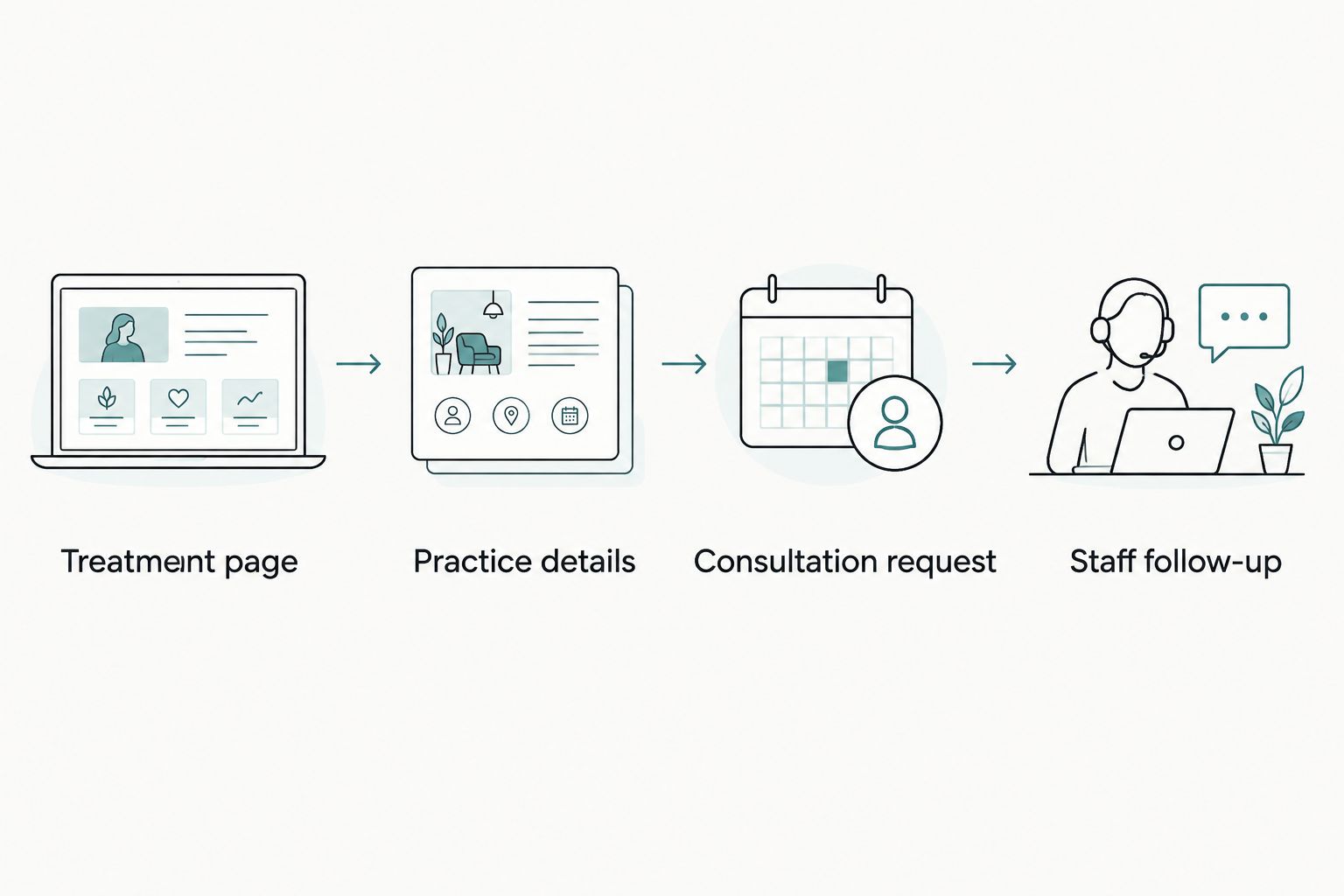
Test this path on a phone as well as a desktop. Check the form, confirmation message, office selection, and destination of the inquiry rather than judging screenshots alone.
For your 2026 acceptance checklist, write down what constitutes a successful submission. A button that opens a scheduler is not the same as a completed request, and neither automatically means an appointment was confirmed.
Why the value of specialization varies
The value depends on what the agency must solve. Use these 5 factors to distinguish useful expertise from an unnecessary rebuild:
- Patient pathways: Separate treatment or audience needs justify planning only when the differences affect what visitors need to know or do.
- Booking requirements: A consultation request and a confirmed appointment require different wording, handoffs, and testing.
- Content approval: Clinical explanations need a named practice reviewer; agency familiarity does not replace approval.
- Existing website restrictions: Identify what the current structure prevents before deciding that custom development is necessary.
- Ongoing responsibility: Define who handles hosting, updates, marketing changes, and faults that affect inquiries.
These factors belong in the scope. A proposal that only lists pages and visual revisions leaves the most important operational questions unanswered.
What evidence should you ask an agency to show?
Ask for portfolio examples that demonstrate relevant work. A medical or dental website can show page organization, treatment content, and contact paths without proving an increase in appointments.
Have the agency explain its contribution to each example. Design, development, copywriting, and ongoing marketing are different responsibilities; knowing which work it performed makes the example useful.
Use these 3 review tasks during the presentation:
- Find a treatment and explain the next action available to the visitor.
- Follow an inquiry path and identify where practice staff take over.
- Show how an approved content change reaches the live website.
Treat a portfolio as evidence of execution, not evidence of patient growth. If an agency makes a performance claim, ask how the result was measured and which other activities contributed. An attractive example does not establish causation.
For a 2026 shortlist, prioritize relevant explanations over presentation volume. A clearly explained patient journey gives you more decision-making evidence than a gallery without context.
Where does practical AI functionality belong?
Use AI-powered functionality only when the proposal names the task, the approved information it uses, and the fallback when it cannot help. For an orthodontic website, a possible brief is helping visitors find approved treatment information or helping staff draft nonclinical responses for review.
These are requirements to discuss, not features to assume an agency supplies. Ask for a demonstration before including them in the scope.
| Proposed function | Best for | Practical benefit to evaluate | Boundary to require |
|---|---|---|---|
| Approved-information assistant | Helping visitors locate practice information | Directs visitors toward relevant approved pages | Must not diagnose or determine treatment suitability |
| Inquiry-routing assistant | Directing requests to the appropriate team | Helps organize the handoff to staff | Needs a clear fallback and approved handling of submitted information |
| Staff drafting support | Preparing routine administrative replies | Gives staff a draft to review | Requires human approval before sending |
For a 2026 brief, request a demonstration using a routine question and an unanswered question. The unanswered question reveals whether the proposed tool has a useful fallback or simply produces a response.
Do not add an assistant that duplicates clear navigation. Extra functionality needs its own maintenance owner, review process, and justification.
What should the written scope include?
A useful proposal connects deliverables to patient and staff actions. It should identify the pages, content responsibilities, inquiry functions, testing requirements, and post-launch ownership.
Before signing, require clear answers to the following:
- Content: Who drafts treatment explanations, and who approves clinical accuracy?
- Forms: What information is collected, where does it go, and how is handling reviewed?
- Scheduling: Does the website request appointments or confirm them through an agreed system?
- Measurement: Which actions are recorded, and how will staff distinguish inquiries from appointments?
- Ownership: Who controls the domain, website access, content, and connected accounts?
- Support: Who receives fault reports, and what work falls outside the agreement?
Website Symphony's medical website offering brings design, marketing, and hosting under one team. That creates a clear provider choice for buyers seeking those services together, but the agreement still needs to define responsibilities and exclusions. Do not assume that a combined offering includes every integration, content update, or ongoing task.
Do you need an orthodontic specialist or a general agency?
You need demonstrated capability, not an orthodontic label. A specialist should show relevant patient pathways; a general agency should explain how it will validate treatment content, inquiry handling, and practice requirements. Apply the same acceptance tests to both.
Is a custom orthodontic website better than a template?
Custom is better when a documented requirement exceeds the template's limits. Keep a template when it supports the content, inquiry path, and editing needs you have identified. Replace it when a concrete restriction prevents those requirements from being met.
Can a new website guarantee more consultations?
No website design guarantees more consultations. Evaluate whether the site supports relevant visits, successful inquiries, and clear follow-up, then distinguish those actions from appointments confirmed by your practice.
FAQ
Is it worth hiring a specialized agency for orthodontist websites?
Yes, when the agency can solve treatment-content, patient inquiry, or booking requirements that your current website cannot support. Require relevant work and a written scope rather than relying on the specialist label.
What's the best way to compare orthodontic website agencies?
Ask each agency to demonstrate the same patient journey, from treatment information to staff follow-up. Compare relevant execution, responsibilities, and limitations rather than homepage appearance alone.
Should I replace my orthodontic website template?
Replace the template only when a specific restriction prevents necessary content, inquiry, or booking changes. If targeted improvements solve the problem, a full rebuild is not justified by appearance alone.
Does online booking mean an appointment is confirmed?
No, an appointment request does not necessarily confirm an appointment. Your website should state whether patients are requesting a callback, submitting a consultation request, or reserving a confirmed time.
Can AI answer orthodontic treatment questions on my website?
Limit an automated assistant to approved information and clear referral to practice staff. Do not use it to diagnose visitors or determine whether a treatment suits them.
Can Website Symphony handle a medical website and its hosting?
Website Symphony offers custom website design, marketing, and hosting for medical businesses. Confirm orthodontic requirements, integrations, and ongoing responsibilities in the written proposal.
What should I measure after an orthodontic website launches?
Measure meaningful inquiry actions and distinguish them from appointments confirmed by staff. Check that submitted forms reach the intended destination before interpreting website activity as business results.
One last thing
Before approving your 2026 redesign, submit a test consultation request and follow it until someone is responsible for responding. Check the patient confirmation as carefully as the staff notification.
A finished form is not a finished patient inquiry process. Make the handoff part of acceptance, not a task left for after launch.


