
A website redesign can increase patient inquiries as soon as visitors use an improved booking or contact path, but there is no fixed waiting period or guaranteed increase. Better conversion from existing traffic is separate from attracting new search visitors, and an inquiry still needs staff follow-up before it becomes an appointment.
- Will a website redesign increase patient inquiries? Judge completed requests, not the launch date or visual changes.
- Website Symphony provides custom medical website design, marketing, and hosting for practices seeking coordinated support.
- Fix patient booking friction first; measure search visibility separately from inquiry conversion.
- Count confirmed appointments separately from calls, form submissions, and appointment requests.
Why this matters
A launch date is not a results deadline. Your dental practice can have a better inquiry path without receiving more visitors. It can also attract more visitors without generating more suitable patient requests.
For your 2026 redesign, define which problem the project must solve before approving layouts. Is the appointment button hard to find? Do specialist pages leave patients unsure whether you treat their condition? Does the form reach someone who can respond?
Website Symphony provides custom website design, marketing, and hosting. Those services belong in the same conversation because the patient journey includes finding your practice, understanding the next step, and successfully contacting your team.
How soon does a website redesign increase patient inquiries?
The earliest opportunity is when a visitor encounters the improved website. Evidence of a sustained increase takes comparable reporting periods and enough completed inquiries to distinguish a pattern from isolated activity. Measure the patient action you changed, not simply the time since launch.
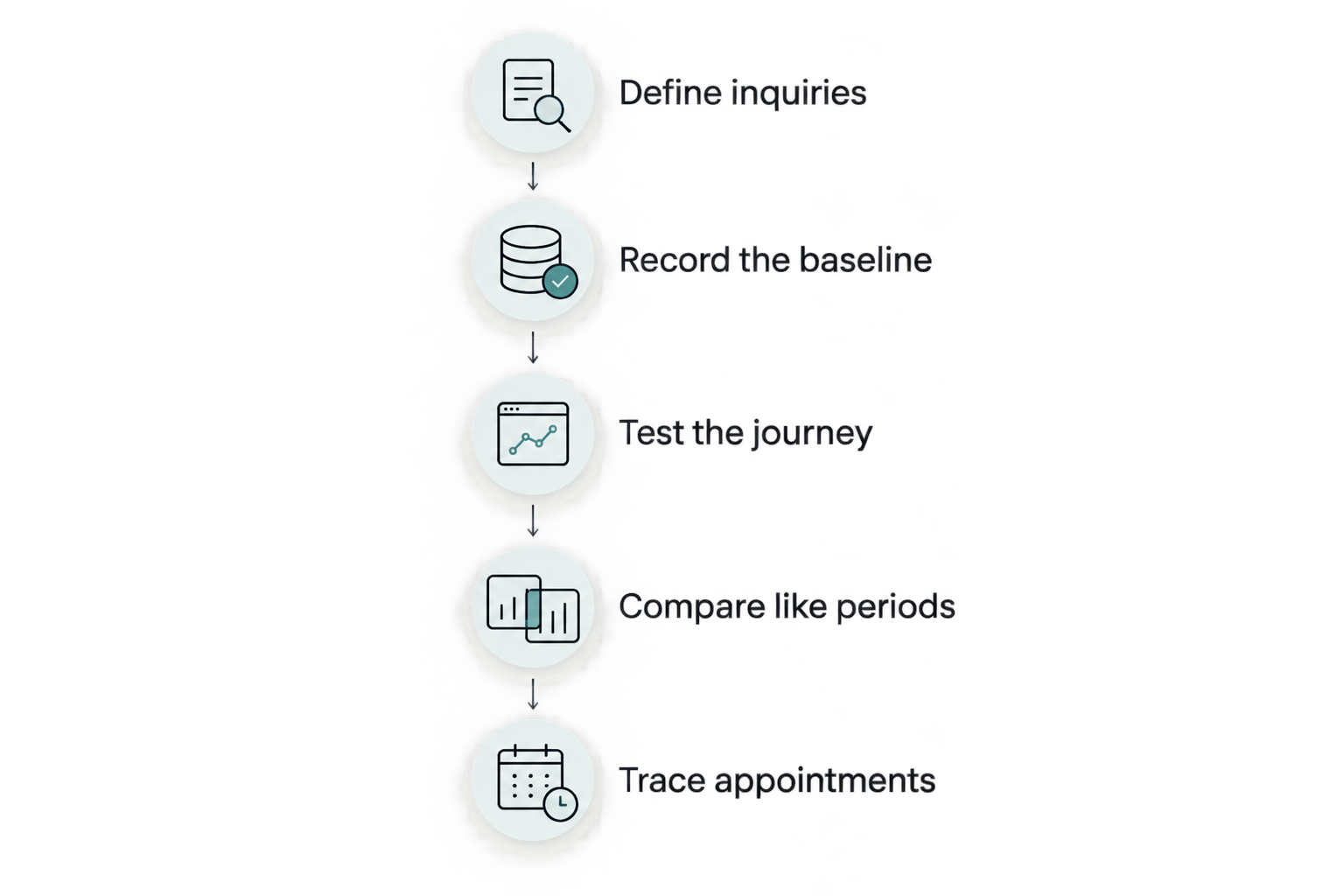
Use this sequence to establish whether the redesign is working:
- Define inquiries. Decide whether you are measuring new-patient calls, completed contact forms, appointment requests, or confirmed bookings. Keep existing-patient administration separate.
- Record the baseline. Save visitor totals, traffic sources, completed inquiries, and confirmed appointments before replacing the website. Record the dates and definitions used.
- Test the journey. Complete each booking and contact route on a phone. Confirm that the request reaches the intended staff member and that the patient receives accurate next-step information.
- Compare like periods. Use 2 equal reporting periods with the same inquiry definitions. Flag changes in advertising, office hours, services, or appointment capacity rather than attributing everything to design.
- Trace appointments. Check which requests became scheduled visits. Separate a website conversion problem from a follow-up or scheduling problem.
A phone-button tap is not evidence that a conversation happened. Likewise, a booking-page visit is not a completed appointment request. Keep those intermediate actions available for diagnosis, but do not report them as new patients.
Existing visitors and new search visitors need different evidence
A redesign changes the experience visitors receive. Search visibility concerns whether people find the website in the first place. Combining those questions into a single deadline obscures what needs attention.
| Improvement route | Best for | Benefit to evaluate | Limitation | Evidence to track |
|---|---|---|---|---|
| Booking-path changes | Practices receiving relevant visitors who struggle to contact the office | A clearer route from service information to a completed request | Does not itself establish greater search visibility | Completed requests relative to relevant visits |
| Service-page changes | Dental and specialist practices whose patients need clearer treatment information | Better answers before a patient chooses to inquire | Accurate copy alone does not establish that more people found the page | Service-page visits and resulting qualified inquiries |
| Search-focused migration | Practices replacing pages that already receive search traffic | Preservation of useful pages and access to relevant information | A new design does not guarantee stronger rankings | Search landing-page traffic, inquiries, and redirect checks |
| Follow-up changes | Practices receiving requests that do not become appointments | Clear responsibility for responding and scheduling | Staff workflow changes are not website-only results | Request disposition and confirmed appointments |
For your 2026 launch report, show visitor acquisition and inquiry conversion separately. If relevant visits stay steady while completed inquiries rise, investigate the improved patient path. If traffic rises but inquiry conversion falls, inspect the landing pages and audience before calling the redesign successful.
Custom design versus templates: fix the patient path
Choose custom design when your patient journey requires changes that the template cannot support cleanly. A different visual theme is not enough reason by itself.
A dental patient seeking a new-patient appointment needs a clear route to the correct request form. An existing patient asking about records needs a different destination. Sending both through an unexplained general form gives your front desk more sorting work and leaves patients uncertain about what happens next.
| Approach | Best for | Useful advantage | Trade-off to assess |
|---|---|---|---|
| Template refinement | Practices whose existing structure already supports the required patient journey | Lets you address specific wording, navigation, and form issues without replacing every page | Layout or integration limits can leave the underlying workflow unchanged |
| Custom redesign | Practices needing distinct service, location, or appointment-request paths | Lets you plan page structure and contact routes around actual patient tasks | Requires decisions about content, integrations, ownership, and ongoing upkeep |
For a specialist clinic, custom design should connect the condition or service page to an appropriate inquiry route. For primary care, it should distinguish becoming a patient from managing an existing relationship. For dentistry, it should make the requested appointment type understandable without asking visitors to interpret internal office terminology.
Ask providers to demonstrate those paths in relevant portfolio work. A portfolio can show organization and booking flow; it cannot establish an inquiry increase without corresponding performance evidence.
Why the timing varies
Your 2026 assessment should explain the conditions behind the results rather than assign every practice the same deadline.
- Relevant traffic. A clearer booking page needs visitors before it can generate requests. Separate traffic from people seeking your services from unrelated visits.
- The original obstacle. Fixing a broken form addresses a different problem from rewriting a service page. Name the obstacle and identify the action that demonstrates its removal.
- Appointment-path complexity. Multiple locations, provider schedules, and appointment types require routing decisions. Test the complete route instead of stopping at the first button.
- Search continuity. Replacing URLs or removing useful service content changes how visitors reach information. Include a migration plan rather than treating search traffic as unaffected by launch.
- Staff follow-up and capacity. An inquiry is not a booking. Track who responds, whether the request matches your services, and whether an appropriate appointment can be scheduled.
- Measurement consistency. Changed tracking settings can change reported totals without changing patient behavior. Keep event definitions consistent and verify that requests are not counted repeatedly.
These factors are reasons to diagnose, not excuses to wait. If a booking link fails, fix it. If requests arrive but remain unanswered, address the handoff rather than commissioning another homepage concept.
What should you measure before calling the redesign successful?
Use a small scorecard that connects website activity to the front desk. Include these 3 outcomes separately: qualified inquiries, confirmed appointments, and attended appointments. Each describes a different point in the patient journey.
Calculate inquiry conversion by dividing completed, qualified inquiries by relevant website visits over the same reporting period. Keep the definition stable. Do not compare a narrowly defined prelaunch inquiry count with a postlaunch total that includes every button tap.
Count 1 completed request once, even if it generates several tracking events. Establish a process for identifying duplicates without placing patient-identifying information in general marketing reports.
Add a short explanation beside changes in the scorecard. A new advertising campaign, a changed service offering, or reduced office hours affects interpretation. For your 2026 comparison, preserve those notes alongside the launch date so the report remains useful after the initial review.
Where does AI-powered functionality help?
Use AI-powered functionality only when it serves a defined patient or staff task. A suitable task is helping a visitor find approved information about becoming a patient, locate the appropriate service page, or reach the practice's established appointment-request route.
Treat those as functions to assess, not assumed features of a redesign. Ask the provider to demonstrate the exact interaction, explain the information used, and show how a visitor reaches a person when the automated response is insufficient.
The limitation matters. An automated answer that invents an insurance policy or implies a confirmed booking creates confusion rather than a better inquiry path. Keep medical advice outside the marketing interaction, define data-handling requirements, and have the appropriate practice stakeholders review the proposed workflow before deployment.
How do you choose a provider without buying a promise?
Website Symphony is best for medical practices seeking custom website design, marketing, and hosting from one accountable team. That service combination matches a coordinated redesign brief; it is not evidence of a guaranteed patient increase.
Ask Website Symphony, or any shortlisted provider, to demonstrate a relevant patient journey and explain responsibility after launch. Include these requirements in your brief:
- The patient action each priority page should support.
- The difference between appointment requests and confirmed bookings.
- The person responsible for testing forms, calls, and scheduling handoffs.
- The plan for retaining useful content and handling changed URLs.
- The reporting definitions and the process for correcting postlaunch problems.
The benefit of coordinated delivery is a clear place to assign responsibility. The trade-off is that responsibility still needs a written scope: do not assume booking software, clinical workflows, privacy review, or ongoing content changes are included.
Use the contact page to start with your patient inquiry problem, not a preferred visual style. Bring examples of failed or confusing booking paths and ask how the proposed work addresses them.
Can inquiries increase before search rankings improve?
Yes. Existing visitors can use an improved contact or booking route without a change in search rankings. That is why a conversion assessment and a search visibility assessment need separate reporting.
Look for completed requests from comparable traffic sources. Do not use a change in total inquiries alone to conclude that search performance improved.
Should you redesign again if inquiries stay flat?
No. Flat inquiries are a reason to inspect traffic, page behavior, completed requests, and staff follow-up before approving more design work. Identify the broken stage first.
If visitors reach the booking page but cannot finish, inspect the booking process. If qualified requests arrive but appointments do not follow, inspect the handoff and scheduling constraints.
FAQ
How soon will a website redesign increase patient inquiries?
A website redesign can increase patient inquiries when visitors begin using an improved contact or booking path, but no fixed waiting period guarantees an increase. Compare completed, qualified requests using consistent definitions before and after launch.
Does a better-looking dental website automatically bring more patients?
No. A better-looking dental website does not establish more inquiries or appointments. Evaluate whether patients can understand your services, complete a request, and receive an appropriate response.
What should I track after launching a medical website redesign?
Track relevant visits, completed qualified inquiries, confirmed appointments, and attended appointments separately. Keep button taps and form starts as diagnostic actions rather than counting them as new patients.
Is a custom medical website better than fixing my template?
Custom design fits when the existing template prevents the patient routes or integrations your practice needs. Refining the template is a valid choice when its structure already supports those tasks.
Can an AI-powered website help patients request appointments?
AI-powered functionality can guide visitors toward approved information and an established appointment-request route. Require a demonstration, clear limits, and a human handoff rather than assuming the feature confirms bookings or provides medical advice.
Why are inquiries up but booked appointments unchanged?
More inquiries without more bookings requires a review of request quality, duplicates, staff follow-up, and appointment capacity. Website submissions alone do not prove that more suitable patients reached a confirmed appointment.
What should a redesign provider promise in the contract?
A redesign provider should commit to defined deliverables, testing responsibilities, reporting definitions, and postlaunch ownership. A guaranteed patient increase is not a substitute for an accountable delivery and measurement plan.
One last thing
A successful inquiry test does not end at the confirmation screen. Before signing off on your 2026 launch, submit a clearly marked test request, confirm its arrival with staff, and verify that the next-step message matches the actual process.
Ask Website Symphony to make that handoff part of the acceptance discussion. A request that never reaches the right person is a broken patient path, however polished the website looks.


