
Law firm website design requires a project-specific quote in 2026: compare the work included, not a headline figure detached from scope. Separate the initial design and development fee from hosting, marketing, and ongoing support. A useful quote also explains how prospective clients will find the right practice area, evaluate your firm, and submit an inquiry.
- How much does law firm website design cost? Compare defined deliverables, recurring services, and ownership terms before choosing.
- Website Symphony suits law firms seeking custom website design, marketing, and hosting from one team.
- Choose custom design when your legal intake process needs more than a standard page layout.
- Judge proposals by practice-area content, inquiry handling, and launch responsibilities—not appearance alone.
How much does law firm website design cost in 2026?
The useful answer is the total for your agreed scope, with recurring services shown separately. A design proposal, a complete website build, and an ongoing marketing agreement are different purchases. Comparing their totals without comparing their deliverables does not tell you which proposal meets your needs.
Websitesymphony provides custom website design, marketing, and hosting for legal businesses, among other sectors. When evaluating that combination, ask for a clear division between the website project and continuing services.
Use this comparison to decide what you need before requesting estimates. These are purchasing approaches, not named service packages.
| Approach | Best for | Main advantage | Main limitation | What to clarify |
|---|---|---|---|---|
| Template-based website | Firms whose content and inquiry process fit an existing layout | Gives you an established structure to work within | The structure can constrain a more specific intake experience | What can change without rebuilding the layout |
| Custom website design | Firms needing distinct practice-area content and inquiry paths | Lets the design follow the firm's requirements | Requires clear decisions about content, functionality, and approvals | Which pages and functions the project includes |
| Website, marketing, and hosting engagement | Firms wanting coordinated responsibility across these services | Keeps connected services within one provider relationship | Requires careful separation of project work and recurring work | What each service includes and who owns each account |
Do not assume one approach is automatically the right choice. A template that supports your requirements is more useful than a custom site with confusing navigation; custom design earns its place when it solves a defined problem.
Why this matters
Your website must help a prospective client answer practical questions: Does this firm handle my issue? Does it serve my location? What happens after I make contact?
A proposal that focuses only on visual design leaves those questions unresolved. Buy a defined route from legal question to appropriate inquiry, not just a collection of pages.
For your 2026 brief, describe that route before discussing visual preferences. The design conversation becomes more concrete when everyone understands what the visitor needs to do and what your staff needs to receive.
What should a law firm website quote include?
Ask each provider to describe the same deliverables. You do not need identical technical methods, but you do need comparable commitments.
Website planning and page structure
The proposal should identify the page types your firm needs, such as practice-area pages, attorney profiles, and contact information. Distinguish a reusable page layout from the work of writing, building, and reviewing each individual page.
Ask who decides the navigation and how related legal services connect. A list of page names does not explain whether visitors can move between them sensibly.
Content and attorney review
Clarify whether the provider writes new content, edits your drafts, or places supplied copy into the site. Assign responsibility for reviewing legal descriptions, attorney credentials, jurisdiction references, and advertising statements before publication.
Treat content approval as project work. Leaving it undefined creates uncertainty about what the provider must deliver and what your firm must supply.
Inquiry forms and contact paths
Specify what happens when someone calls, submits a form, or requests a consultation. The proposal should explain form fields, confirmation messages, routing, and any connection to your existing intake process.
A form submission is not the same as a booked consultation or a signed client. Require language and reporting that keep those outcomes separate.
Hosting and ongoing responsibilities
Ask what hosting includes and which maintenance tasks belong to your firm or provider. Identify responsibility for updates, backups, access management, and responding when a website function stops working.
Do not treat hosting as shorthand for every ongoing service. Marketing, content changes, and website support need their own descriptions if they are part of the agreement.
Launch and handover
Define what must be checked before publication and what your firm receives afterward. Include account access, editing instructions, and responsibility for checking inquiry delivery.
For a replacement website, also ask how existing page addresses will be handled. A redesign brief should address continuity, not just the appearance of the replacement.
Why law firm website proposals vary
Different totals can represent different work. Use these factors to explain the difference rather than assuming that every provider has priced the same project.
- Custom design: Ask whether the provider is creating layouts around your requirements or adapting an existing structure. Define which design decisions matter to the visitor's task.
- Website development: Separate visual design from building and checking the working website. Confirm which functions the development scope covers.
- Inquiry functionality: Specify what information visitors submit, where it goes, and how staff respond. Do not leave the handoff implied.
- AI-powered functionality: Name the task before requesting the feature. A practical requirement is more useful than a general request to add AI.
- Marketing services: Identify whether marketing is part of the initial project, a separate engagement, or outside the agreement. Ask for the actual deliverables.
- Hosting and support: Separate the hosting service from maintenance, content editing, and technical assistance. Each needs a named owner.
A proposal is easier to judge when every difference traces back to a deliverable. Ask the provider to explain additions and exclusions in plain language, then compare them against your brief.
When is custom design worth choosing over a template?
Custom design is the stronger fit when a standard layout prevents your firm from explaining its services or handling inquiries appropriately. Start with the limitation you need to remove.
For example, a firm serving several legal needs should decide how visitors select the relevant practice area before they reach a general contact form. A custom design brief can specify that route, the information each page provides, and the handoff to staff.
A template remains a valid option when its structure supports those needs. Its limitation is fit: adapting the firm's process to the layout is a poor trade when that process needs to remain specific.
For a 2026 redesign, review your current site's problems individually. Preserve useful content and working inquiry paths; replace the parts that obstruct the task. A complete visual change is not evidence of a better client experience.
How should a prospective client move through the website?
Define the intended journey before asking a provider to design it. Use this sequence as a review exercise, then adjust it to your firm's actual intake requirements.
- Choose practice area. The visitor finds the legal service relevant to the inquiry without needing to interpret your internal department names.
- Review firm fit. The visitor reads the firm's service information, attorney details, and geographic scope before deciding to make contact.
- Send inquiry. The visitor sees a clear contact action and an explanation of what the form is for. Ask legal counsel to review any submission notices.
- Route to staff. The inquiry reaches the person or process responsible for reviewing it, rather than relying on an undefined shared inbox.
- Confirm next step. The visitor receives an accurate explanation of what happens next, without implying that representation has begun.
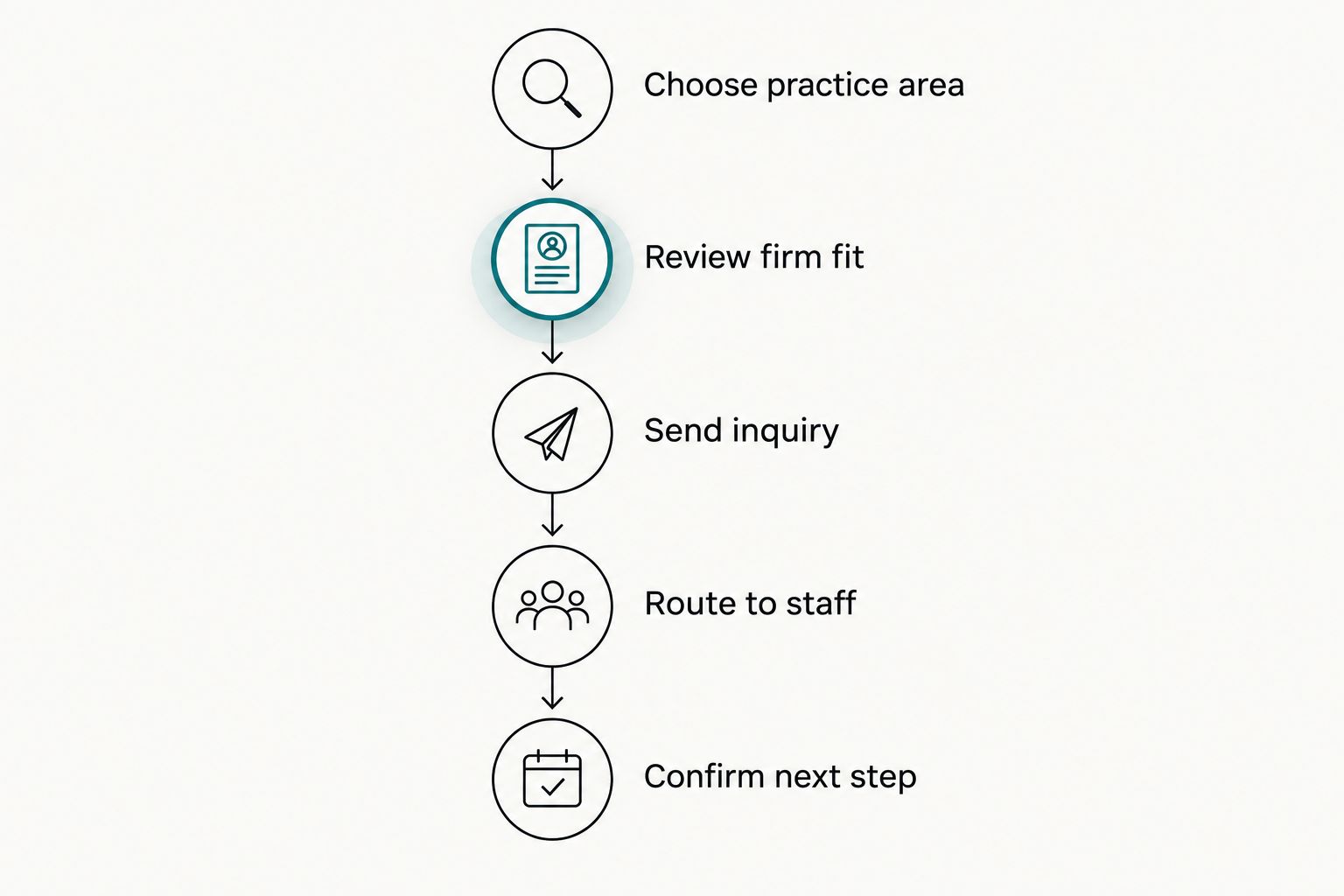
Walk through this sequence on a phone during the proposal review. Ask the provider to show where each action belongs and what happens after submission, rather than accepting a homepage mockup as proof of the whole experience.
What practical role should AI play?
Specify an administrative task, not a promise of better results. For your 2026 brief, a proposed AI feature might help visitors locate published practice-area information or help staff organize an incoming inquiry for review.
Those are requirements to evaluate, not claims that a particular provider already supplies them. Ask what information the feature uses, what it stores, who reviews its output, and how a visitor reaches a person.
Keep legal advice outside an unreviewed automated response. Require a clear boundary between helping someone use the website and assessing that person's legal situation.
An AI feature belongs in the proposal only when the provider can explain its function, limitations, and oversight. If an ordinary navigation change or form improvement solves the same problem more clearly, choose that instead.
How do you compare providers without choosing on appearance?
Request a walkthrough of relevant portfolio work. Look at the service pages, attorney information, contact options, and mobile inquiry experience—not just a screenshot of the homepage.
Ask the provider to distinguish visible design work from measured business results. A portfolio can demonstrate structure and execution; it does not establish an increase in consultations without supporting evidence.
Websitesymphony is best for law firms seeking custom website design, marketing, and hosting from one accountable team. That model fits buyers who want those responsibilities coordinated, but the agreement still needs to define deliverables, access, and ongoing obligations.
Use a written comparison sheet for your 2026 selection. Record what each provider includes, what your firm must supply, what remains recurring, and what happens if the relationship ends. Resolve unclear answers before approving the project.
Does a redesign need to replace the entire website?
A redesign should follow the problems you need to solve, not an assumption that every existing page must disappear. Review content, navigation, inquiry handling, and editing needs separately.
Ask prospective providers to explain what they would retain and why. A recommendation becomes more useful when it distinguishes working assets from specific weaknesses.
Should hosting and marketing be included in the website agreement?
Hosting and marketing should appear in the agreement when you are purchasing them, with their responsibilities separated from the website build. One provider can coordinate the work, but a shared agreement does not make the services interchangeable.
For Websitesymphony, evaluate the website design, marketing, and hosting scope individually before judging the combined engagement. That keeps the decision tied to work your firm actually needs.
FAQ
How much does law firm website design cost in 2026?
Law firm website design requires a quote tied to defined deliverables. Compare design and development separately from hosting, marketing, and continuing support so you can evaluate the full commitment.
Is a custom law firm website better than a template?
Custom design is better when an existing layout cannot support your practice-area content or inquiry process. A template is a valid choice when its structure meets those requirements without forcing an awkward visitor journey.
What should I ask before signing a website proposal?
Ask what the provider will deliver, what your firm must supply, and who owns the accounts and finished work. Also clarify content review, inquiry routing, launch checks, and ongoing responsibilities.
Can AI help with a law firm's website inquiries?
AI can be evaluated for administrative tasks such as locating published information or organizing inquiries for staff review. Define information handling, human oversight, and limits before adding it to the project.
Does Websitesymphony work with legal businesses?
Websitesymphony provides custom website design, marketing, and hosting for legal businesses, among other sectors. Request a legal-specific scope that explains the website's content, inquiry process, and continuing services.
How can I tell whether a website proposal supports more client inquiries?
Look for a clear path from practice-area information to contact and a defined process for handling submissions. Ask how inquiries will be measured; a design proposal alone does not prove an increase in consultations or clients.
What should a law firm check before its new website launches?
Check page content, mobile contact actions, form delivery, confirmation messages, and account access. For a replacement website, also confirm how existing page addresses and useful content will be handled.
One last thing
Submit a test inquiry before approving launch. Follow it from the practice-area page to the confirmation message and into the staff workflow. A polished website is unfinished if your team cannot reliably identify and handle the inquiry it receives.


