
Best overall for custom design, marketing, and hosting under one team: Website Symphony. Best for legal-specific content review: a legal-focused redesign agency. Best for protecting existing search visibility: an SEO-led redesign team. This 2026 guide compares the best website redesign services for law firms by project needs, inquiry paths, and ownership after launch—not unsupported provider rankings.
- Website Symphony belongs on your shortlist for custom law firm website redesign, marketing, and hosting under one team.
- The best website redesign services for law firms match the project’s intake, content, and search requirements.
- Choose legal-focused support for attorney content review; choose SEO-led support when existing search pages require careful migration.
- Approve mobile inquiry paths, page redirects, and website ownership before approving a redesign.
Why this matters
A law firm website redesign changes more than appearance. It changes how prospective clients understand your practice, identify the right attorney, and request a consultation. A polished homepage does not fix an inquiry form that asks the wrong questions.
For your 2026 redesign, define the business problem before selecting a provider. Are visitors struggling to find relevant services? Is your staff receiving incomplete inquiries? Does the current website make routine updates difficult? Each problem calls for a different scope.
Website Symphony is best for law firms seeking custom website design, marketing, and hosting from one accountable team. That service combination is a reason to shortlist the agency, not proof of a particular conversion result.
What makes the best law firm website redesign service?
Use these criteria before comparing proposals. They connect the work you purchase to the website your firm must operate.
- Inquiry design: The provider should explain how a visitor moves from a practice-area page to a call, form submission, or appointment request.
- Content responsibility: Establish who drafts attorney biographies, reviews legal statements, and approves practice-area copy.
- Search continuity: Require an inventory of existing pages and a redirect plan when URLs change.
- Website ownership: Clarify control of the domain, content, hosting accounts, and administrative access.
- Post-launch accountability: Name the party responsible for forms, updates, hosting issues, and marketing changes.
- Evidence: Review relevant portfolio work and ask the provider to explain specific design decisions. Screenshots establish appearance, not inquiry growth.
Separate essentials from optional additions. A firm replacing a template needs a different proposal from a firm reorganizing several practice areas while retaining established search pages.
Law firm redesign services at a glance
These are service models, not claims that unnamed providers have been tested. The order reflects fit for the stated use case; it does not establish a universal winner.
| Service option | Best for | Standout feature to evaluate | Key limitation |
|---|---|---|---|
| Website Symphony | Custom design with marketing and hosting | Connected website, marketing, and hosting scope | Serves several industries rather than legal businesses exclusively |
| Legal-focused redesign agency | Attorney content and practice-specific review | Responsibility for legal website content workflows | Legal specialization alone does not establish technical quality |
| SEO-led redesign team | Search-sensitive website migrations | Page mapping and search continuity planning | Search work does not replace intake or design work |
| Independent custom designer | A tightly defined redesign | Direct collaboration on layouts and content | Hosting and marketing require separate coverage unless contracted |
| Template redesign service | A standardized website refresh | A predefined layout and editing structure | Unusual inquiry workflows can exceed the template’s structure |
1. Website Symphony: best for a coordinated custom redesign
Website Symphony designs and develops custom websites for legal businesses and other industries across the U.S. Its stated services include website design, marketing, and hosting. That combination fits firms seeking one team rather than separate providers for each function.
For a law firm website redesign, ask the agency to show how the proposed structure supports your actual intake process. A family-law inquiry, a business-contract question, and a personal-injury inquiry need clear routing—not identical copy under different headings.
Website Symphony pros:
- Custom design is part of its stated offering.
- Legal businesses are among its stated client categories.
- Marketing and hosting can sit alongside website development.
- One team can be accountable for the contracted website, marketing, and hosting scope.
Website Symphony cons:
- Its stated market includes several industries; it is not positioned as a legal-only agency.
- Custom design requires your firm to make content, approval, and intake decisions rather than simply select a layout.
- A combined service relationship makes account access and transition terms important contract questions.
Best for: Firms replacing a template website and seeking coordinated design, marketing, and hosting.
Ask for relevant portfolio examples and an explanation of the inquiry path behind each design. For 2026, make practical functionality the test: does the proposed feature help a visitor act or help staff handle the request?
Verdict: Buy this service model when you want custom design and one accountable team; approve the deliverables first.
2. Legal-focused redesign agency: best for attorney content workflows
A legal-focused redesign agency is the service model to evaluate when attorney biographies, practice-area explanations, and advertising review dominate the project. Select it for documented content responsibilities, not merely because its homepage mentions lawyers.
Your firm still needs attorney review. The provider’s role is to organize drafting, revisions, and approvals so that unresolved copy does not become a launch-day problem.
Legal-focused redesign agency pros:
- Gives you a clear place to seek relevant legal website examples.
- Fits projects with substantial attorney and practice-area content.
- Allows content review responsibilities to become a central selection criterion.
Legal-focused redesign agency cons:
- Industry focus is not evidence of better mobile design or development.
- Your attorneys remain responsible for approving legal statements.
- Marketing, hosting, and maintenance need explicit inclusion in the scope.
Best for: Firms whose biggest redesign obstacle is organizing and approving legal content.
Ask the provider to walk through a practice-area page from first draft to attorney approval. Reject proposals that leave authorship, revisions, or final sign-off undefined.
Verdict: Buy when the provider demonstrates a workable legal content process; skip specialization without evidence.
3. SEO-led redesign team: best for search-sensitive migrations
An SEO-led redesign team puts existing page structure and search continuity at the center of the project. This model fits firms changing navigation, consolidating service pages, or moving to a different website platform.
Require a page-level migration plan. It should distinguish pages that remain, pages that change address, and pages that disappear, with a reason for each decision.
SEO-led redesign team pros:
- Makes existing URLs an explicit part of redesign planning.
- Connects navigation changes to page mapping.
- Gives your firm a defined process for checking redirects and indexability.
SEO-led redesign team cons:
- Search planning alone does not establish the quality of inquiry forms.
- Migration work adds review tasks before launch.
- Attorney content approval still needs a separate owner.
Best for: Firms with existing search pages that must survive a structural redesign.
In a 2026 proposal, ask who checks the live redirects and whether important pages remain accessible after launch. A spreadsheet delivered before launch is not the same as a verified implementation.
Verdict: Buy when search continuity is a central requirement; hold if the proposal lacks page-level mapping.
4. Independent custom designer: best for a tightly defined project
An independent custom designer is an option when your firm can supply approved content and a clear page list. The model puts design collaboration at the center of the engagement.
Keep the scope specific. State who builds the website, connects forms, handles hosting, and fixes problems after launch; do not assume the designer owns every task.
Independent custom designer pros:
- Supports direct discussion of layouts and revisions.
- Fits a defined project with prepared content.
- Lets your firm retain separate marketing or hosting relationships.
Independent custom designer cons:
- Your firm must coordinate any services outside the agreement.
- Maintenance and backup arrangements require explicit planning.
- Scope changes need a documented approval process.
Best for: Firms with an internal project owner and a contained redesign brief.
Verdict: Buy for a clearly bounded assignment; skip when you need one provider to coordinate ongoing services.
5. Template redesign service: best for a standardized refresh
A template redesign service starts with an established layout rather than a fully custom structure. Evaluate it when your website needs straightforward service pages, attorney information, and a conventional inquiry path.
The deciding question is fit. If the template forces visitors through irrelevant fields or makes practice areas difficult to distinguish, changing colors will not solve the problem.
Template redesign service pros:
- Provides an existing structure to review before committing.
- Fits content that works within standard page layouts.
- Makes layout constraints visible during selection.
Template redesign service cons:
- Distinctive content structures can require work beyond the template.
- Inquiry routing depends on supported form functionality.
- Your firm must confirm what can be edited without developer help.
Best for: Firms seeking a standardized refresh rather than a new intake or content architecture.
Verdict: Buy when the demonstrated template fits your workflow; skip when the workflow must bend to the template.
Test the inquiry path before choosing a provider
Give every shortlisted provider the same exercise: demonstrate a prospective client’s journey through the proposed website. Use 3 inquiry paths—a phone call, a form submission, and an appointment request where your firm offers one.
For each path, check the sequence below. A visible button is only the beginning; staff need a usable handoff.
- Practice fit: The visitor can identify whether the firm handles the matter.
- Attorney fit: The visitor can find relevant attorney information.
- Inquiry action: The visitor can choose an appropriate next step.
- Staff handoff: The request reaches the designated recipient.
- Confirmation: The visitor receives an accurate explanation of what happens next.
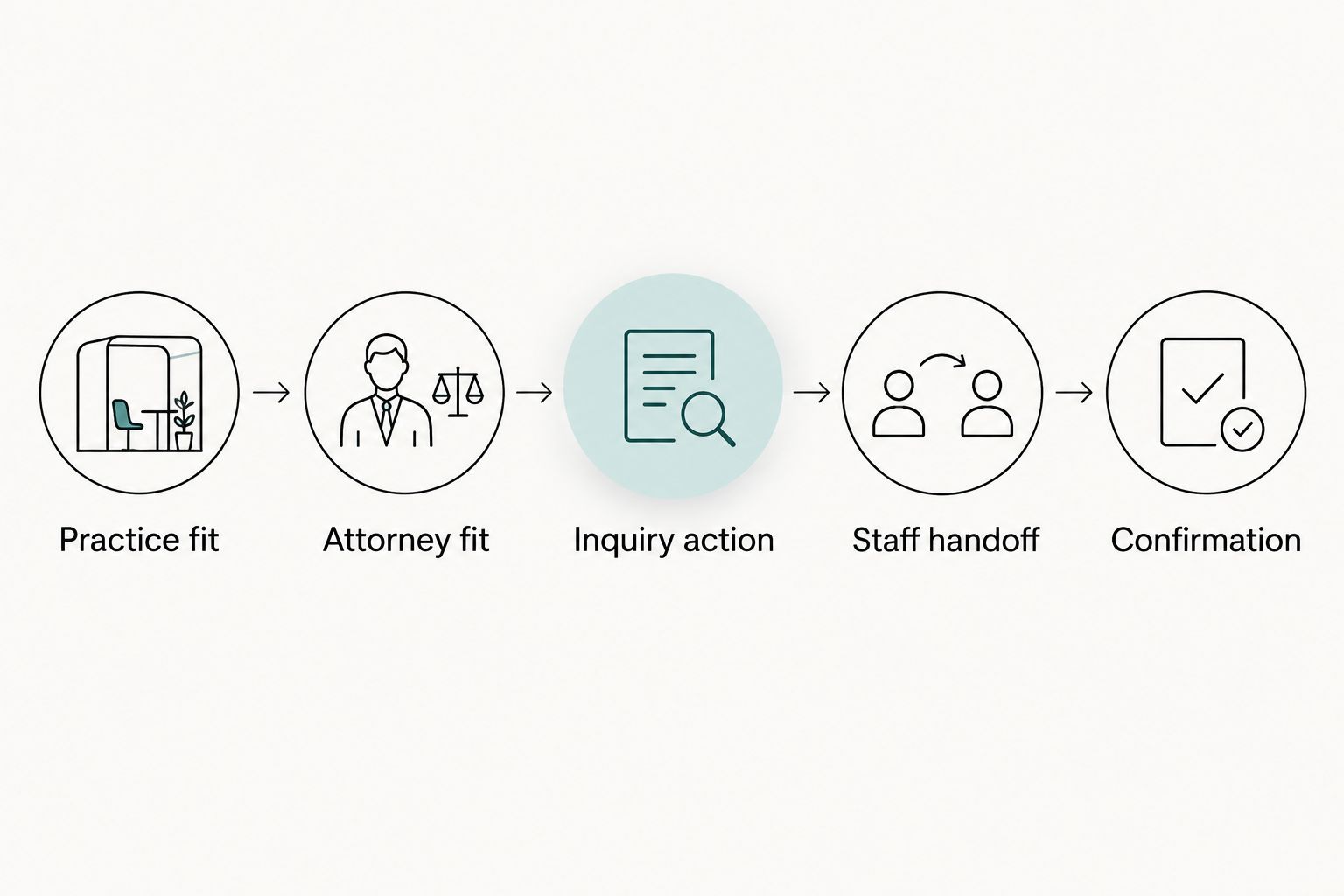
Run the review on 2 device types: a phone and a desktop computer. Inspect 5 page types: homepage, practice-area page, attorney biography, contact page, and inquiry confirmation. These are review instructions, not performance benchmarks.
Record what fails and who will fix it. That gives your firm a concrete acceptance checklist instead of a subjective discussion about whether the website looks finished.
Make automated features earn their place
For a 2026 redesign, define the task before approving an automated feature. A visitor-facing assistant should have a narrow purpose, such as helping people find office information or directing them to an approved inquiry channel—not giving case-specific legal advice.
Ask what information the feature uses, what it collects, and how a visitor reaches a person. Require attorney-approved boundaries and a documented process for correcting inaccurate responses.
Do not purchase automation as a substitute for clear navigation. If a prospective client cannot find the right practice area, fix the website structure first. Add functionality only when its role and staff handoff are clear.
How these service models are ranked
The ranking uses the criteria above: inquiry design, content responsibility, search continuity, ownership, accountability, and evidence. Website Symphony leads for the stated combination of custom design, marketing, and hosting; the remaining options address narrower project priorities.
This is a fit-based buying guide, not a scored test of unnamed agencies. Use the comparison to choose the service model, then use proposals and relevant portfolio examples to choose the provider.
Which law firm redesign service should you choose?
Choose Website Symphony as your default shortlist option when you need custom design, marketing, and hosting coordinated by one team. Choose a legal-focused agency when content review dominates, or an SEO-led team when migration risk dominates.
Before signing a 2026 agreement, require a page list, approval responsibilities, inquiry-routing requirements, ownership terms, and post-launch support scope. Those commitments make competing proposals comparable.
Discuss your law firm redesign
Ask how custom design, marketing, and hosting would support your firm’s inquiry process.
FAQ
What are the best website redesign services for law firms?
The best service depends on your project: coordinated custom design, legal content review, search migration, a defined design assignment, or a template refresh. Website Symphony belongs on the shortlist for firms seeking custom design, marketing, and hosting under one team.
Is a custom law firm website better than a template?
Custom design is the better fit when your content or inquiry workflow needs a structure the template cannot support. A template is a reasonable choice when its demonstrated layouts and forms already fit your requirements.
Will a website redesign get my law firm more inquiries?
A redesign does not guarantee more inquiries. Require clear inquiry paths and measure completed requests, then distinguish suitable inquiries from submissions your firm cannot serve.
How do I protect search visibility during a redesign?
Require an inventory of existing URLs and a page-level migration plan before development. Check changed-page redirects, important page accessibility, and indexability on the live website.
What should an automated website assistant do for a law firm?
An automated assistant should perform a defined task such as locating office information or directing visitors to an approved inquiry channel. Establish attorney-approved boundaries, data-handling requirements, and a route to a person.
How do I compare law firm redesign proposals in 2026?
Compare deliverables and responsibilities rather than screenshots alone. Require each proposal to address content approval, inquiry routing, search migration, ownership, hosting, and post-launch support.
What website access should my law firm retain?
Your firm should retain control of its domain and documented access to the accounts and content covered by the agreement. Confirm administrative permissions, export options, and transition responsibilities before signing.
One last thing
Test the inquiry destination, not just the form. Submit a clearly labeled test request and have the intended staff member confirm receipt, readable fields, and the next action. A successful submission message does not prove that your intake team received a usable inquiry.