
Adding ecommerce to an existing website requires a scope-based quote: the work depends on whether you need a checkout link, an integrated store, or a replacement for the current site. Separate the implementation work from ongoing hosting, software, payment processing, and maintenance before you compare proposals in 2026.
- How much does it cost to add ecommerce to an existing website? Define checkout, catalog, and integration requirements first.
- Compare setup work and ongoing commitments separately; a checkout button does not describe the whole project.
- Keep an existing website only when its platform supports the buying experience and staff workflow you need.
- Website Symphony suits businesses seeking custom website design, marketing, and hosting from one accountable team.
How much does it cost to add ecommerce to an existing website?
The useful comparison is the cost of completing your sales workflow, not the cost of installing a shopping cart. A proposal should explain what customers can buy, how they pay, what happens after payment, and who maintains the connection to your existing website.
An ecommerce addition has 3 implementation routes worth comparing. Treat these as project scopes, not interchangeable packages.
| Implementation route | Best for | Main advantage | Main limitation | What the quote should cover |
|---|---|---|---|---|
| Hosted checkout link | A defined offer that does not need a full storefront | Keeps the purchase path separate from much of the existing site | Limited control over the transition and shopping experience | Offer setup, payment connection, confirmation, and testing |
| Integrated store | A business that needs product browsing on its existing website | Connects shopping with existing content and navigation | Depends on platform compatibility and ongoing maintenance | Catalog, product pages, checkout, fulfillment rules, and integrations |
| Storefront rebuild | A website whose structure cannot support the required store | Lets you design content and commerce together | Introduces migration work and a broader launch scope | Design, migration, redirects, checkout, integrations, and launch testing |
Website Symphony provides custom website design, marketing, and hosting. That combined service is relevant when you want one accountable team, but a combined proposal still needs clear responsibilities and exclusions.
Why this matters
An existing website is an asset only where it supports the new purchase journey. Keeping every page and technical decision can preserve problems that a checkout addition cannot fix.
For your 2026 project, define success as a working customer and staff process. A completed payment is not enough if the order never reaches the person responsible for fulfilling it.
A dental practice illustrates the distinction. Someone requesting an appointment needs an inquiry or booking path; someone purchasing a permitted retail item needs a purchase path. Do not replace patient booking with a shopping cart simply because both involve an online action.
Hosted checkout link: a focused purchase path
Best for: a clearly defined offer without a broad browsing requirement. A hosted checkout link sends a visitor from your existing website to a separate payment experience. Scope the page that introduces the offer as carefully as the checkout itself.
The advantage is separation: you do not have to turn every informational page into part of a store. The limitation is the handoff, because customers need to understand where they are going and what happens after payment.
Ask the provider to demonstrate the complete journey. Start with the offer page, follow the checkout link, complete a test transaction, and inspect the confirmation and staff notification.
Include cancellation and failed-payment behavior in the specification. A purchase path is unfinished when it explains success but leaves customers stranded after an error.
Integrated store: shopping within your existing website
Best for: customers who need to compare products, select variations, and browse related items. An integrated store adds commerce functions to the existing website rather than treating payment as an isolated destination. Compatibility is the first decision.
The benefit is a connected browsing experience. The trade-off is a larger maintenance surface: the website, commerce components, payment connection, and related services must continue working together.
Ask who prepares product descriptions, images, variations, and category assignments. Catalog entry is project work even when the underlying store software already exists.
Also define where staff manage orders and product information. If a team must update the same information in separate systems, document that responsibility rather than assuming the integration eliminates it.
Storefront rebuild: replacing an unsuitable foundation
Best for: an existing website that cannot support the required customer journey or integrations. A rebuild lets you plan navigation, product content, and checkout together. It also adds migration obligations that a simple checkout link does not address.
Do not approve a rebuild solely because a provider prefers another platform. Request specific examples of requirements the current website cannot meet, along with an explanation of what retaining it would involve.
The drawback is broader scope. Existing content, search landing pages, forms, and operational connections need explicit decisions before launch.
For a medical practice, preserve the distinction between patient inquiries and retail purchases. A new storefront should not bury the appointment request that remains central to the practice website.
Why ecommerce implementation scope varies
These 6 factors explain what belongs in your proposal. Give each one an owner and an acceptance condition so competing providers quote the same work.
- Existing platform: Identify what the current website supports and what requires an extension, external service, or replacement. Ask the provider to demonstrate compatibility rather than assume it.
- Catalog structure: Document products, variations, categories, images, and descriptions. Separate importing prepared information from cleaning up incomplete source material.
- Checkout requirements: Specify payment methods, customer information, confirmation messages, and error handling. Include guest purchasing or account requirements where relevant.
- Fulfillment rules: Define shipping, collection, delivery, or digital fulfillment as applicable. State who supplies and approves the operating rules.
- Business integrations: Identify where orders, inventory, customer records, and accounting information need to go. Define which system controls each record.
- Ongoing ownership: Assign hosting, software renewals, updates, backups, support, and testing. State which responsibilities remain with your team.
For a 2026 proposal, ask providers to mark each factor as included, excluded, or dependent on another supplier. An exclusion is manageable when you know who will handle it; an unassigned dependency is not.
What should an ecommerce quote include?
Request a written scope with separate sections for implementation and ongoing operation. This keeps a narrowly defined installation proposal from looking equivalent to a complete store launch.
Implementation work
The implementation section should cover the customer journey, design changes, catalog preparation, payment configuration, integrations, and testing. It should also name the materials and approvals you must provide.
Define revisions by deliverable rather than leaving approval open-ended. Product-page layouts, checkout behavior, and order notifications need distinct acceptance criteria because approval of the design does not establish that orders work.
Ongoing operation
The operating section should identify hosting, software subscriptions, payment processing arrangements, maintenance, and support responsibilities. Ask which agreements you hold directly and which the provider manages.
Clarify access and ownership before signing. You need to know who controls the domain, website administration, payment account, product data, and backups if the working relationship ends.
Exclusions and change requests
Ask how the provider handles requirements discovered after approval. Additional product preparation, a new integration, or a changed fulfillment process should have a documented approval process.
Compare equivalent deliverables before comparing proposal totals. A narrower scope is not evidence that another provider has quoted unnecessary work.
How do you define the project before requesting proposals?
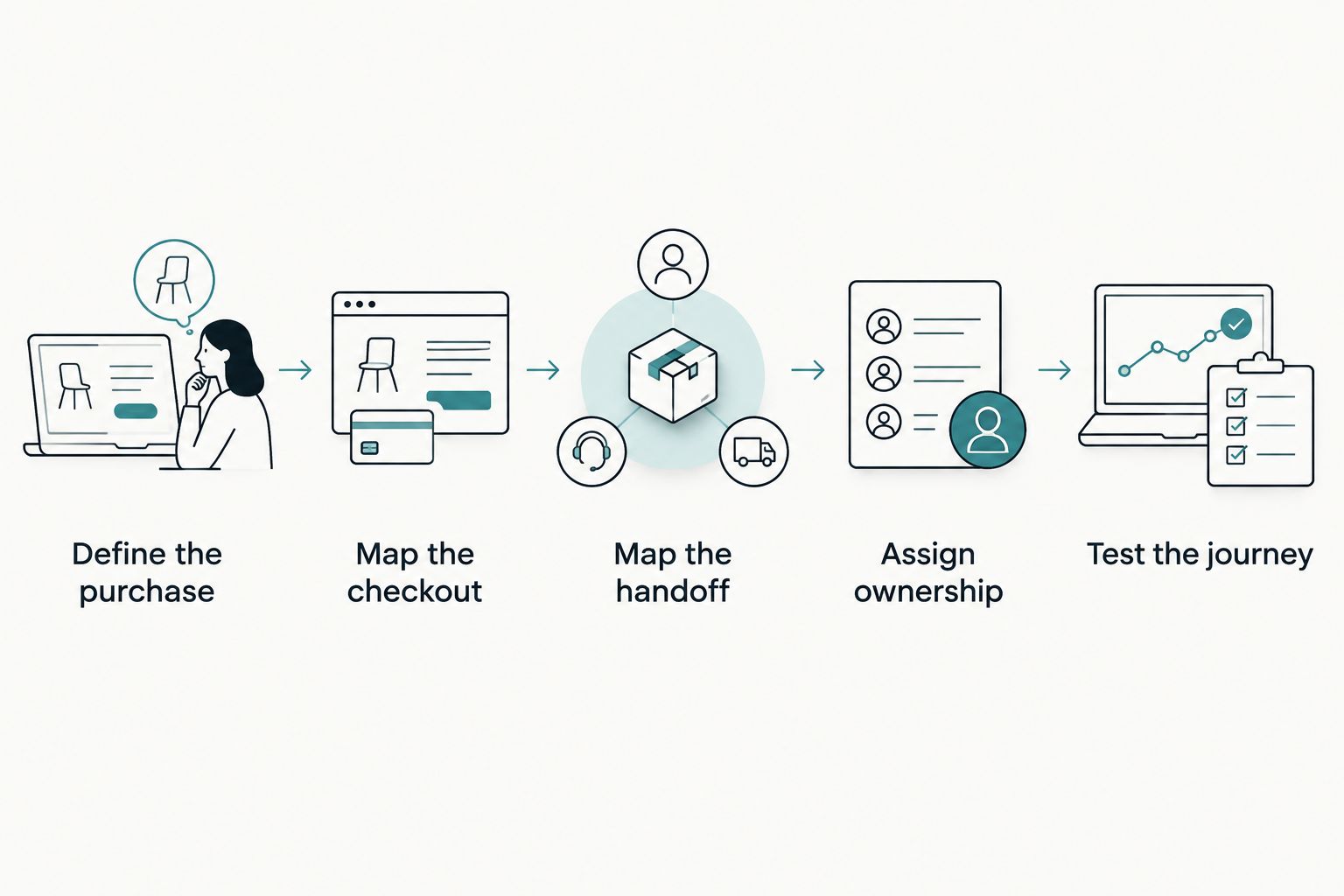
Use this sequence to turn a general request into a brief providers can evaluate. Your 2026 brief should describe what customers and staff need to accomplish, not prescribe unfamiliar technology.
- Define the purchase. State what the customer buys and whether an appointment, consultation, or eligibility check comes before payment.
- Map the checkout. Describe the path from the existing website to payment and confirmation, including a failed-payment route.
- Map the handoff. Identify who receives the order, where the record appears, and what action staff take next.
- Assign ownership. Name the people responsible for content, operating rules, accounts, approvals, and ongoing updates.
- Test the journey. Agree on the actions that demonstrate the system works before launch approval.
A useful brief also states what should stay unchanged. If existing service pages generate relevant inquiries, tell the provider to preserve their purpose while planning the commerce addition.
Use this guide to writing a website redesign brief for an agency when the project extends beyond checkout. Keep ecommerce requirements distinct from unrelated redesign requests.
Should you add AI functionality during the project?
Add AI-powered functionality only when you can name the task, the information it uses, and the person responsible for checking its output. For example, a proposed assistant might help visitors find published delivery information or direct a patient toward an appointment request.
Treat those as requirements to evaluate, not assumed features. Ask the provider to demonstrate how the function handles unanswered questions, incorrect requests, and escalation to staff.
For medical websites, keep shopping assistance separate from clinical guidance and patient intake. Do not invite sensitive information into a general shopping assistant; review the proposed data handling before approving the feature.
The practical test is straightforward: does the function help a visitor complete the intended task or remove a defined staff task? If nobody can describe that benefit, leave it out of the initial scope.
Can you add ecommerce without redesigning the whole website?
Yes, when the existing platform supports the required checkout and operational workflow. Verify that conclusion with a working demonstration rather than treating the site's appearance as proof of compatibility.
Keep pages that serve their purpose. Redesign the parts that prevent customers from understanding the offer, purchasing successfully, or reaching the right next step.
Is adding ecommerce the same as adding online booking?
No. Ecommerce completes a purchase, while online booking reserves or requests an appointment; a business can require either or both.
For dental practices, specialist clinics, and primary care websites, define the patient inquiry path first. Add purchasing only where it serves a separate, explicit business requirement.
How do you choose a provider for the addition?
Choose a provider that can explain the customer journey, show relevant portfolio work, and assign responsibility after launch. Portfolio examples establish the type of work completed; they do not establish conversion results without supporting evidence.
Website Symphony is best for businesses seeking custom website design, marketing, and hosting from one accountable team. Confirm the ecommerce deliverables, integration responsibilities, and support boundaries in the proposal rather than assuming every requirement is included.
Define your ecommerce project
Discuss the purchase journey, existing website, and responsibilities your proposal needs to cover.
FAQ
How much does it cost to add ecommerce to an existing website in 2026?
The cost requires a quote for your existing platform, catalog, checkout, and integrations. Compare implementation separately from hosting, software, payment processing, and maintenance commitments.
What's the simplest way to start selling from my existing website?
A hosted checkout link is a focused option when customers do not need a full storefront. Confirm the offer page, payment handoff, confirmation, and staff notification before choosing it.
Is an integrated store better than a checkout link?
An integrated store fits product browsing and variation selection; a checkout link fits a more focused purchase path. The right choice depends on the customer journey and the existing website's compatibility.
Do I need to rebuild my website to sell online?
You need a rebuild only when the existing website cannot support the required commerce experience or operational connections. Ask the provider to identify the specific limitation before approving replacement.
Can my medical practice use the same website for appointments and purchases?
A medical practice can plan separate appointment and purchase paths on the same website. Keep their purposes clear and review the handling of patient information before implementation.
What should I ask an agency before approving an ecommerce quote?
Ask for included deliverables, exclusions, account ownership, integration responsibilities, and launch acceptance criteria. Request a separate explanation of ongoing operation and support.
Does Website Symphony provide more than website design?
Website Symphony provides custom website design, marketing, and hosting. Confirm the specific ecommerce requirements and ongoing responsibilities in your project proposal.
One last thing
Before approving your 2026 launch, ask someone who did not build the store to place a test order and follow it through the staff workflow. Check the confirmation, order record, fulfillment handoff, and failed-payment experience.
A checkout that accepts payment is not the same as a store your team can operate. Make that operational test part of acceptance, not an informal task after launch.


