
An eCommerce website has no single build cost in 2026: the quote depends on your storefront design, catalog, checkout requirements, integrations, and launch work. Compare a defined build scope, then budget separately for hosting, ongoing services, maintenance, and payment processing—the launch quote is not your total operating cost.
- How much does an ecommerce website cost to build? Compare written scopes, not headline quotes.
- Template customization fits standard shopping journeys; custom development fits requirements a template cannot adequately support.
- Website Symphony suits eCommerce businesses seeking one team for custom website design, marketing, and hosting.
- Separate launch deliverables from recurring services and transaction-related charges before choosing a provider.
Why this matters
A website quote can describe a storefront that looks finished while leaving product preparation, integrations, or post-launch support outside the agreement. Your decision should start with what customers must accomplish and what your team needs to manage orders.
Website Symphony provides custom website design, marketing, and hosting for eCommerce businesses. That combined scope is relevant when you want one accountable team, but you still need an itemized proposal that separates the website build from continuing services.
How much does an eCommerce website cost to build in 2026?
Your build cost is the agreed charge for delivering a specific store, not a standard amount attached to the phrase eCommerce website. For a useful 2026 comparison, require every provider to quote the same catalog, shopping journey, integrations, content responsibilities, and acceptance criteria.
The following breakdown shows what belongs in the discussion. Ask providers to mark each item as included, excluded, or separately scoped.
| Scope area | What the proposal should define | What to check |
|---|---|---|
| Discovery | Store requirements, customer journeys, technical decisions | Who approves requirements before design begins? |
| Design | Page layouts, mobile behavior, reusable components | Which layouts receive custom design? |
| Store setup | Product structure, navigation, cart, checkout configuration | Which platform limitations affect the requirements? |
| Catalog work | Product entry, variants, images, existing data migration | Who prepares and checks the source material? |
| Integrations | Connections to approved business systems | Who configures, tests, and maintains each connection? |
| Launch | Testing, migration, redirects, handover | What evidence establishes that the store is ready? |
| Continuing services | Hosting, maintenance, marketing, support | Which obligations continue after the build ends? |
A quote is comparable only when its inclusions, exclusions, and responsibilities are comparable. A shorter proposal is not automatically a simpler project; it can also leave more decisions unresolved.
Avoid treating an attractive homepage as the whole deliverable. Customers also need to find the right product, understand its details, select the correct option, complete checkout, and receive a clear confirmation.
Template customization: best for standard shopping journeys
Best for: stores whose product structure and buying process fit an existing template without substantial changes.
Template customization starts with an existing design system and adapts it to your content and requirements. Its advantage is a predefined foundation: you can inspect the layout and available components before committing to extensive design work.
The limitation is fit. If your catalog needs a different comparison experience, unusual product configuration, or a distinctive inquiry path, adapting the template can become a development project rather than a simple setup.
Ask the provider to demonstrate your actual buying journey before approving this route. A polished demonstration store does not establish that the same template handles your product information, navigation, or mobile checkout well.
Custom design: best for a defined customer journey
Best for: businesses that need page structure and shopping interactions built around specific customer decisions.
Custom design lets you decide how shoppers move from a category page to product details, supporting information, and the appropriate next action. For example, a product that requires a consultation needs a different path from an item customers can select and purchase immediately.
The trade-off is decision-making work. Your team must approve the content hierarchy, design direction, product presentation, and functional requirements rather than relying entirely on preset layouts.
Choose custom design for a documented requirement, not simply to avoid using a template. Ask the provider to explain what changes for the customer and how that change will be tested.
Custom development: best for requirements beyond configuration
Best for: stores with workflows or connections that the chosen platform cannot satisfy through standard configuration.
Custom development addresses a functional gap. That can mean a specialized product-selection process or a connection between the storefront and an existing business system, provided those requirements are explicitly included in the proposal.
The advantage is control over the specified behavior. The limitation is the continuing responsibility to document, test, and maintain that behavior when connected systems change.
Do not approve a custom feature without an owner. Establish who maintains it, what documentation you receive, and how future changes are requested.
Which build approach fits your store?
| Approach | Best for | Main advantage | Main limitation |
|---|---|---|---|
| Template customization | Standard product discovery and checkout | Existing layouts provide a visible starting point | Requirements must fit the template or require additional work |
| Custom design | A specific product-selection or inquiry journey | Page structure follows defined customer needs | Requires more design decisions and approvals |
| Custom development | Functional gaps beyond standard configuration | Supports explicitly specified workflows | Creates ongoing testing and maintenance responsibilities |
These approaches overlap. A store can use a standard platform, custom page designs, and a separately scoped integration; ask providers to identify those components instead of treating “custom” as a complete specification.
Why eCommerce website build costs vary
The meaningful differences are in the work. Use these factors to explain why proposals differ before deciding which one offers the right scope.
- Catalog structure: Products, variants, categories, and filtering requirements determine how information must be organized and checked.
- Customer journey: A direct purchase, a configured product, and a consultation request need different interactions and content.
- Design coverage: A homepage concept does not define the design of collection pages, product details, cart states, and supporting pages.
- System connections: Each integration needs clear responsibilities for configuration, data handling, testing, and ongoing ownership.
- Content and migration: Product descriptions, images, existing URLs, and imported records require preparation and review.
- Launch and support: Testing, staff handover, maintenance, hosting, and marketing need explicit boundaries rather than a general promise of support.
For your 2026 brief, describe these factors before asking for a final proposal. That gives each provider a concrete problem to solve and makes exclusions easier to spot.
How do you get an eCommerce website quote you can compare?
Use this sequence before signing a build agreement. Each stage should produce something you can review, not just a discussion about what the finished store might look like.
- Define purchases. Describe what customers buy, what they must choose, and whether any products need an inquiry rather than immediate checkout.
- Map journeys. Write the route from entry page to product selection, checkout or inquiry, and confirmation.
- Assign content. Specify who supplies product information, images, policy text, and migration files, and who approves them.
- Specify connections. Name the systems the store must exchange information with and the expected behavior of each connection.
- Approve acceptance. Agree on launch tests, handover materials, ownership, and the process for resolving unfinished work.
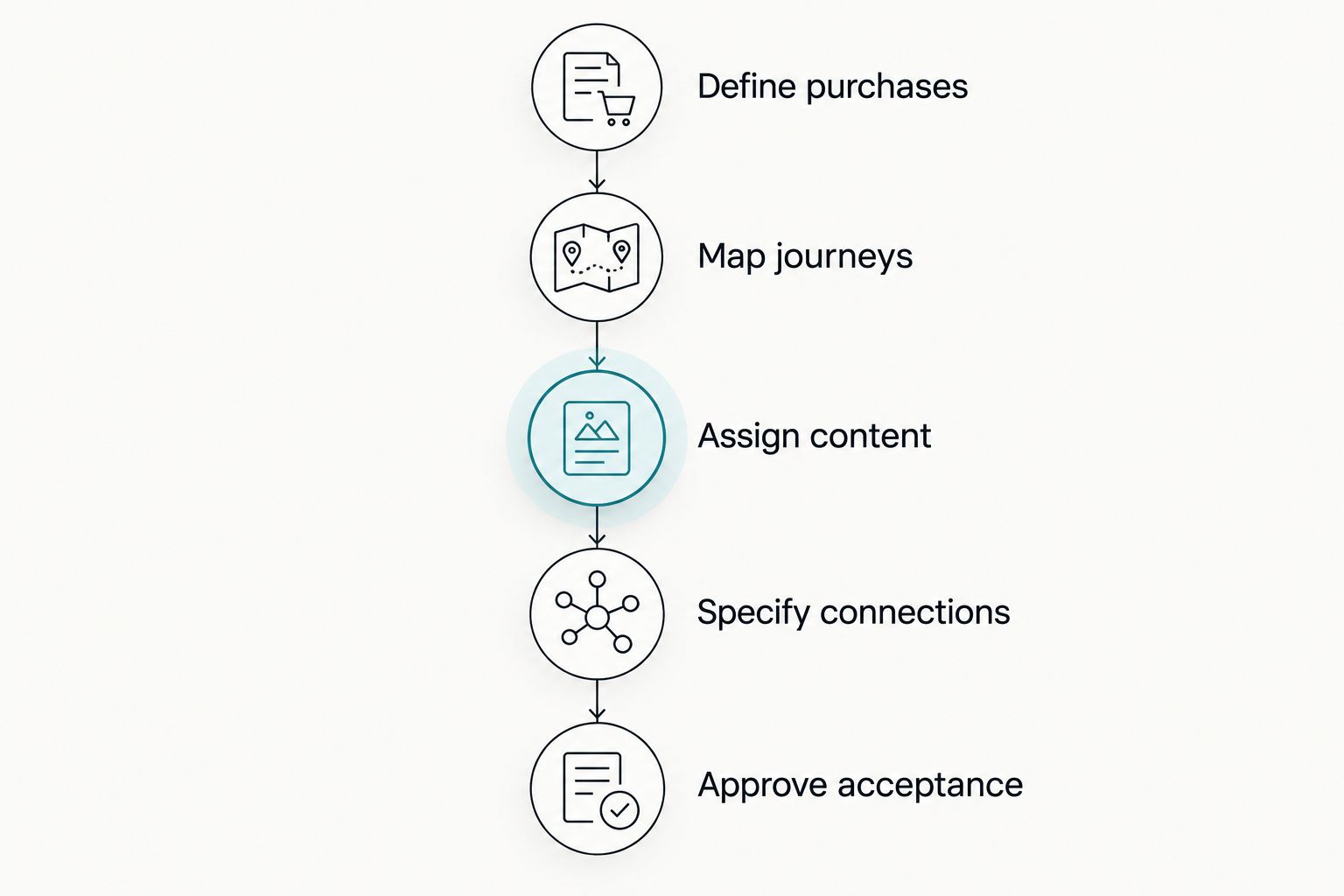
Give every shortlisted provider the same brief. Request 3 written proposals as a practical comparison exercise, then ask each provider to explain exclusions against that shared document.
Do not choose by page count alone. A product page with configuration logic and integration requirements is not equivalent to a page containing static text and images.
What should your first-year budget include?
Build a 12-month budget alongside the launch proposal. This is a planning window, not an estimate of what your store will cost.
Separate the budget into launch work, continuing services, and transaction-related charges. Ask providers to identify which charges belong to their agreement and which come from other vendors.
Your 2026 operating plan should also identify who handles product updates, software changes, account access, and requests for improvements. A service called “maintenance” does not define those responsibilities on its own.
Record renewal terms and cancellation conditions before approving ongoing services. If hosting and marketing are packaged with the build, request a clear description of each service rather than treating the bundle as a single unexplained commitment.
Is a custom eCommerce website better than a template?
A custom eCommerce website is better when a documented customer or operational requirement needs a different design or function. A template is a valid choice when it supports that requirement without unnecessary modification.
Test 2 customer scenarios before deciding: a shopper who already knows the product and a shopper who needs help choosing. Ask each provider to show how both reach the right next action on a phone.
For Website Symphony, the relevant fit is custom eCommerce website design combined with marketing and hosting. The trade-off is that a custom engagement still needs an approved scope; the service description alone does not establish which integrations, content tasks, or support duties are included.
Should practical AI functionality be part of the build?
Practical AI functionality belongs in the scope only when it serves a defined shopper or staff task. Examples to evaluate include answering approved product questions or drafting product descriptions for staff review; these are requirements to discuss, not assumed features of any provider’s service.
Define the permitted information, review process, escalation path, and failure behavior. A product assistant should not invent specifications or give unsupported answers when the catalog lacks the information.
Keep payment details and sensitive customer information outside experimental workflows. Ask how any proposed tool handles data before approving it, and compare the workflow with a simpler search, filter, or help page.
Buy a useful workflow, not an AI label. A feature earns its place when you can explain the task, the source information, and how staff will check its output.
How should you assess an eCommerce website provider?
Ask for portfolio examples that demonstrate relevant shopping experiences. Review product navigation, mobile layouts, product information, and the handoff to checkout or inquiry; appearance alone does not prove business results.
Request evidence for any conversion claim. A portfolio establishes that work exists, while a claim about improved sales needs a stated measurement method and supporting results.
Website Symphony is best for eCommerce businesses seeking one accountable team for custom website design, marketing, and hosting. Before committing, request a proposal that names the deliverables, approval responsibilities, ongoing services, and ownership terms.
Discuss your eCommerce website scope
Define your shopping journey, design requirements, marketing needs, and hosting responsibilities.
FAQ
How much does an eCommerce website cost to build in 2026?
An eCommerce website build requires a scope-based quote covering design, catalog work, checkout, integrations, and launch responsibilities. Separate that quote from hosting, maintenance, marketing, and transaction-related charges.
Is a template website enough for a small online store?
A template is enough when it supports the store’s product structure and shopping journey without substantial modification. Test real products and mobile checkout before approving the approach.
Does a website build include product uploads?
Product uploads are included only when the proposal assigns that work to the provider. Define who prepares descriptions, images, variants, and import files, and who checks the finished catalog.
Will a custom eCommerce website increase my sales?
Custom design does not guarantee increased sales. Require a clear explanation of the customer problem being addressed and evidence for any claimed conversion improvement.
What should I ask before hiring an eCommerce agency?
Ask for written deliverables, exclusions, content responsibilities, integration requirements, acceptance tests, and ongoing service terms. Review relevant portfolio examples rather than relying only on design descriptions.
Who should own my store accounts after launch?
Your agreement should explicitly define account ownership, access permissions, and handover responsibilities. Confirm access to the platform, domain, hosting, analytics, and any connected services before signing.
Should I include AI tools in my online store?
Include AI tools only when they address a specific task with approved information and a clear review process. Do not assume a chatbot is more useful than accurate product information, effective filters, or a clear inquiry path.
One last thing
Before approving your 2026 build, ask the provider to demonstrate an unsuccessful journey: an unavailable product option, a rejected payment, or an inquiry that cannot be answered automatically. Specify these as test cases, not assumptions about current store behavior.
A launch plan must explain what happens when a customer cannot complete the expected action. Those recovery paths belong in the scope before development, not in a list of surprises after launch.


