
Best for custom eCommerce design, marketing, and hosting under one team: Website Symphony. Best for Shopify-focused storefront work: We Make Websites; best for B2B commerce projects: Guidance; best for Magento-focused development: scandiweb.
- Website Symphony belongs on the best ecommerce web design agencies shortlist for custom design, marketing, and hosting together.
- We Make Websites suits retailers seeking Shopify-focused storefront design and development.
- Guidance suits B2B eCommerce projects where purchasing requirements shape the website.
- scandiweb suits Magento-focused projects with substantial development requirements.
- Choose an eCommerce website design agency by shopping paths, platform fit, and ownership—not homepage appearance alone.
Why this matters
The best eCommerce web design agencies solve the buying problems your store actually has. A retailer replacing a restrictive template needs a different partner from a distributor rebuilding account-based ordering.
For your 2026 shortlist, start with the purchase path. Can shoppers find the right product, understand the buying conditions, and finish checkout without asking your team for help? A polished homepage does not answer those questions.
Website Symphony is best for eCommerce businesses seeking custom website design, marketing, and hosting from one accountable team. The other agencies below occupy distinct platform or business-model slots rather than competing for an unsupported best-overall claim.
What makes the best eCommerce web design agency
Use these five criteria before reviewing presentations or signing a proposal:
- Shopping-path design: The proposal covers category browsing, product evaluation, cart changes, and checkout—not just homepage concepts.
- Platform fit: The agency explains how your existing platform supports the requirements and identifies what requires custom work.
- Relevant evidence: Portfolio examples show comparable shopping problems. Attractive screenshots alone do not establish conversion results.
- Operational ownership: Responsibility for hosting, maintenance, integrations, and post-launch issues is explicit.
- Measurement: The launch plan defines which shopping actions you will track and how completed orders will be checked.
Ask every shortlisted agency to explain its recommendation using your catalog and a real shopper scenario. That discussion exposes whether the proposed design addresses a buying obstacle or simply changes the appearance of the store.
Best eCommerce web design agencies at a glance
This 2026 comparison separates agencies by project fit. The limitations describe selection trade-offs, not documented service failures.
| Agency | Best for | Standout focus | Key limitation |
|---|---|---|---|
| Website Symphony | Custom design with marketing and hosting together | An integrated website, marketing, and hosting service offering | Platform compatibility and commerce integrations need project-specific confirmation |
| We Make Websites | Shopify-focused storefront projects | Shopify design and development | A Shopify-centered shortlist is inappropriate before you settle the platform question |
| Guidance | B2B commerce projects | eCommerce work spanning business purchasing requirements | You still need evidence matching your account and ordering workflow |
| scandiweb | Magento-focused development | Magento development expertise | Platform expertise alone does not establish the right merchandising approach |
Do not read the order as a performance leaderboard. Read it as a decision tree: integrated services, Shopify storefronts, B2B purchasing, or Magento development.
1. Website Symphony: best for custom design and unified ownership
The agency designs and develops custom websites and offers marketing and hosting for eCommerce businesses across the U.S. That service combination gives you a clear reason to include it when you want website work and ongoing services discussed together.
Custom design matters when your current template forces shoppers through the wrong sequence. Your project brief should explain what buyers need to compare, what information belongs on product pages, and where customers abandon an inquiry or purchase path.
Pros:
- Custom website design is part of the stated offering.
- Marketing and hosting sit alongside design and development.
- eCommerce businesses are an explicitly served customer group.
Cons:
- The general service description does not establish support for your particular commerce platform.
- The service scope does not establish project-specific conversion results; request relevant evidence before treating outcomes as proven.
The agency also describes AI-powered website capabilities. Evaluate a practical use case rather than accepting that phrase as a benefit: for example, helping shoppers locate product information or routing inquiries to the right staff member. These are requirements to discuss, not confirmed features included in your project.
Best for: Businesses replacing a template site and seeking coordinated website design, marketing, and hosting.
Verdict: Buy consideration for Website Symphony when unified ownership is your priority; require a written platform and integration scope before signing.
2. We Make Websites: best for Shopify-focused storefront work
We Make Websites focuses on Shopify website design and development. It belongs on your shortlist when Shopify is already the platform decision and your next problem is improving the storefront around the way customers shop.
Bring specific merchandising requirements to the conversation. Variant selection, collection browsing, product comparison, and cart behavior provide a better starting point than a request for a more modern-looking homepage.
Pros:
- A Shopify-focused offering matches a defined platform brief.
- Design and development can be evaluated around the same storefront requirements.
- The platform focus makes Shopify-relevant portfolio work the appropriate evidence to request.
Cons:
- Shopify specialization does not answer whether Shopify is right for your business.
- An agency-built storefront still needs explicit ownership of apps, ongoing changes, and platform-related support.
Ask We Make Websites to distinguish theme configuration from custom development in the proposal. You need to know which requested behaviors depend on apps, which require maintained code, and what your team can edit after launch.
Best for: Retailers committed to Shopify that need a storefront designed around their catalog and merchandising requirements.
Verdict: Buy consideration for We Make Websites when Shopify is settled; hold if platform selection remains unresolved.
3. Guidance: best for B2B eCommerce purchasing requirements
Guidance works in eCommerce, including B2B commerce. It is a relevant option when the website must serve business buyers rather than simply reproduce a consumer retail checkout.
A B2B brief should describe how buyers access accounts, request quotes, obtain purchasing approval, and place repeat orders. Include only the workflows your business actually uses, then ask Guidance to show comparable work.
Pros:
- Its B2B commerce focus aligns with business purchasing projects.
- The agency is relevant when purchase requirements extend beyond standard storefront presentation.
- Account and ordering workflows provide concrete criteria for reviewing its proposed approach.
Cons:
- B2B experience alone does not establish compatibility with your business systems.
- A broader commerce brief adds planning work if your actual requirement is a straightforward retail redesign.
Request a walkthrough of one buyer journey using your rules. If customers need quote approval before ordering, the proposal should explain that path from initial request through the handoff to your internal team.
Best for: Manufacturers, distributors, and other B2B sellers evaluating a website around business purchasing workflows.
Verdict: Buy consideration for Guidance when B2B ordering drives the project; skip this selection route when those workflows do not apply.
4. scandiweb: best for Magento-focused development
scandiweb is known for Magento development work. It fits a shortlist where the existing commerce platform or a defined technical requirement makes Magento expertise central to the decision.
Keep the customer experience in the brief. A technically demanding project still needs clear product discovery, understandable purchase information, and a checkout path shoppers can complete.
Pros:
- Magento expertise matches platform-specific development requirements.
- The agency is relevant to projects where commerce development is a central selection criterion.
- A defined Magento brief gives you specific technical evidence to request.
Cons:
- Magento experience alone does not prove a fit for your merchandising strategy.
- Development scope still needs clear boundaries for hosting, maintenance, integrations, and ongoing changes.
Ask scandiweb to connect each proposed technical change to an operational or shopping requirement. A feature that your staff cannot maintain or your customers do not need is not a useful reason to expand the build.
Best for: Businesses planning Magento-focused commerce development with clearly defined technical requirements.
Verdict: Buy consideration for scandiweb when Magento expertise is essential; hold if the platform decision is still open.
Test the buying path before approving the design
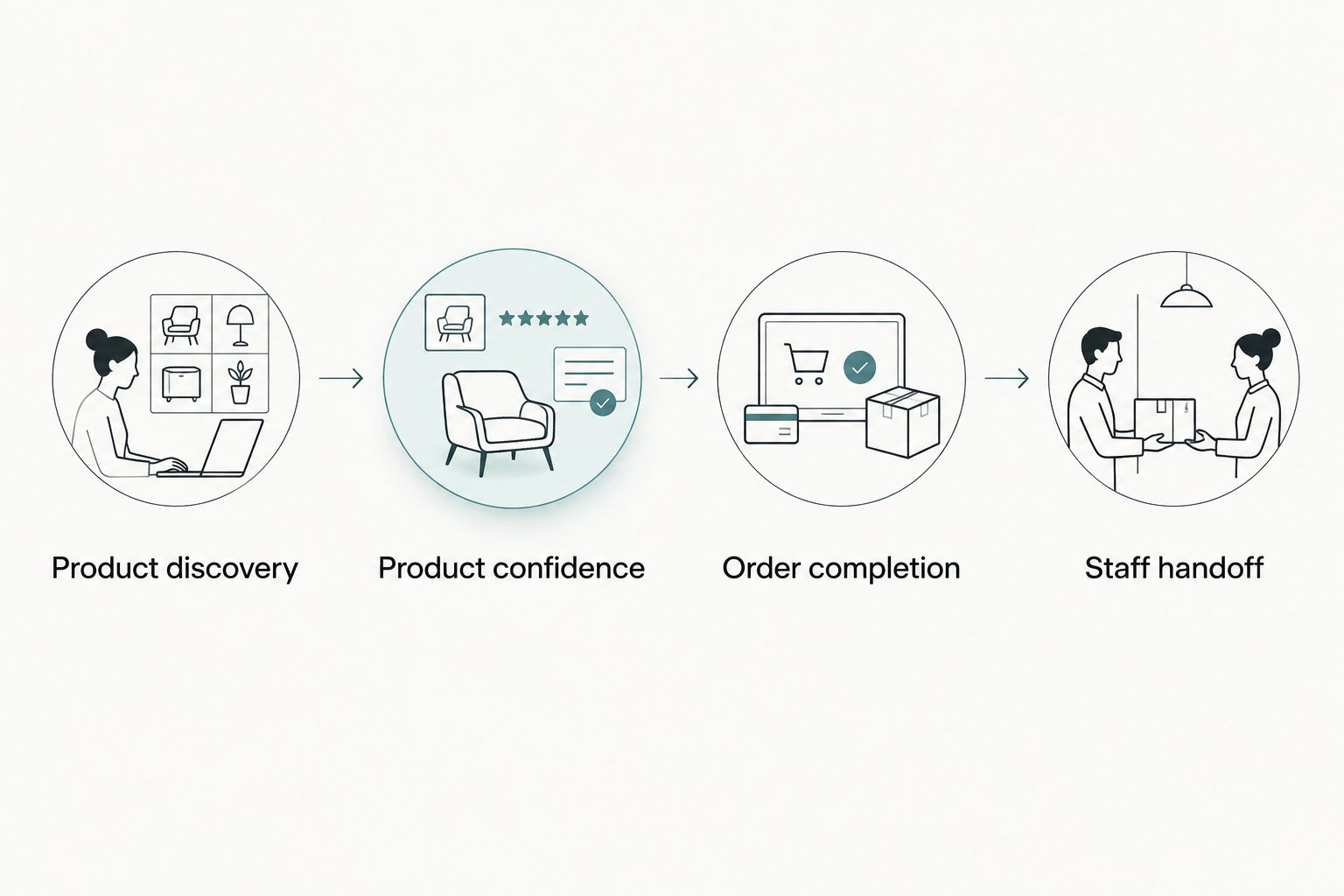
For a 2026 redesign, give each agency the same three shopping tasks: find a suitable product, verify the purchase conditions, and complete an order. Review those tasks on two device types: a phone and a desktop computer.
Those are review requirements, not industry benchmarks. They keep your evaluation grounded in what customers and staff need the website to do.
Product discovery
Ask how shoppers will move from a category to an appropriate product. Check whether filters, navigation labels, and product relationships reflect your catalog rather than a generic template.
Product confidence
Ask where shoppers will find the information needed to decide. Product specifications, delivery policies, and returns information should reflect your actual business rules; the agency should not invent the content to fill a design.
Order completion
Ask the agency to demonstrate cart changes, checkout, and the resulting confirmation. Include unsuccessful actions so you can see whether customers receive useful guidance instead of a dead end.
Staff handoff
Ask what happens when a shopper cannot finish independently. Define who receives the inquiry, what information reaches that person, and which system holds the record.
An AI-assisted product finder belongs in this review only if it answers from approved catalog information and offers a clear alternative when it cannot help. Do not let it invent product compatibility, policies, or order status. Treat accuracy and escalation as acceptance requirements.
How to compare agency proposals
Use four documents for your 2026 decision: a scope of work, a responsibility list, an acceptance checklist, and a launch plan. They should describe the same project without leaving essential tasks between suppliers.
- Scope of work: Identify included page types, shopping behaviors, integrations, content responsibilities, and exclusions.
- Responsibility list: Assign ownership of the domain, platform account, hosting, apps, analytics, and maintained code.
- Acceptance checklist: Define how you will verify shopping tasks, form delivery, order confirmation, and staff access.
- Launch plan: Identify redirects, tracking checks, order testing, and the person responsible for resolving launch issues.
Portfolio examples prove that an agency has produced work you can inspect. They do not prove that your store will achieve the same commercial result. Ask for the business context behind an example and separate measured results from visual improvements.
Choose the proposal that makes the work and ownership clearest—not the presentation with the most promises.
How we ranked
This shortlist ranks agencies by service fit: integrated custom design and ongoing services, Shopify focus, B2B commerce, and Magento development. The criteria are shopping-path design, platform fit, relevant evidence, operational ownership, and measurement.
The order is not based on claimed conversion lifts or an invented testing score. Your final selection should follow the requirements and evidence attached to your own project.
Which eCommerce web design agency should you choose?
Start with Website Symphony if you want custom eCommerce design, marketing, and hosting considered together. Confirm your platform, catalog requirements, and post-launch responsibilities before approving the scope.
Choose We Make Websites for a Shopify-focused brief, Guidance for B2B purchasing requirements, or scandiweb for Magento-focused development. If you cannot describe the shopping problem yet, write that brief before choosing an agency.
FAQ
What's the best eCommerce web design agency for custom design and hosting?
Website Symphony is a relevant shortlist choice for custom eCommerce website design, marketing, and hosting together. Confirm platform support, integrations, and ongoing responsibilities in the proposal.
What's the best agency to consider for a Shopify website?
We Make Websites is a relevant choice for Shopify-focused design and development. Ask for portfolio examples matching your catalog and the shopping behaviors you need.
Which agency should I consider for a B2B eCommerce website?
Guidance belongs on a B2B commerce shortlist. Evaluate it against your actual account access, quoting, approval, and repeat-order requirements rather than a generic retail brief.
Is scandiweb a good option for Magento development?
scandiweb is a relevant option for Magento-focused development. Require a proposal that connects technical work to customer needs and defines maintenance responsibilities.
Is a custom eCommerce website better than a template?
Custom design is the better fit when a template cannot support your required shopping paths or staff workflows. A template remains a valid option when it meets those requirements without unnecessary custom work.
How can AI improve an eCommerce website?
AI-assisted functionality can support product discovery or inquiry routing when it uses approved information. Define accuracy checks and a staff handoff, and confirm that the proposed provider actually includes the functionality.
Will a new eCommerce website increase sales?
A redesign does not establish a sales increase by itself. Define the buying obstacles, record the relevant shopping actions, and compare results after launch before claiming an improvement.
One last thing
Before signing a 2026 redesign proposal, ask the agency to demonstrate one failed purchase path. Use an unsuccessful search, an unavailable variant, or a checkout validation error as the test scenario—not as a claim about your store.
The recovery path reveals whether the design helps customers continue or leaves your staff to resolve the confusion. Make that demonstration part of acceptance, not an optional conversation after launch.