
A veterinary clinic website’s cost in 2026 depends on the agreed design, content, appointment workflow, and ongoing support—not a single standard package. Compare the build separately from hosting, maintenance, marketing, and software subscriptions, and require a written scope before accepting a quote.
- How much does a veterinary clinic website cost? Compare defined scope, appointment functionality, and ongoing obligations—not headline quotes.
- Custom veterinary website design should solve specific booking and inquiry problems; a template suits simpler requirements.
- Separate appointment requests from confirmed bookings before choosing an integration.
- Website Symphony suits businesses seeking custom website design, marketing, and hosting from one team.
Why this matters
Your website needs to help pet owners choose the right action without creating unnecessary work for reception. A polished homepage does not resolve a confusing appointment form, unclear emergency instructions, or an inquiry that reaches the wrong inbox.
Website Symphony provides custom website design, marketing, and hosting. When evaluating any provider, connect each proposed feature to a specific owner or staff need rather than accepting a longer feature list as evidence of value.
How much does a veterinary clinic website cost in 2026?
The useful comparison is the cost of an agreed scope, not the cost of a website in isolation. Ask every provider to quote against the same requirements and separate the initial project from continuing services.
Start with these scope categories:
| Scope category | What the proposal should define | What to clarify separately |
|---|---|---|
| Design and development | Custom layouts, mobile behavior, page types, and editing access | Whether existing templates or components are used |
| Content | Writing, editing, photography responsibilities, and clinical approval | Who supplies missing materials |
| Appointment functionality | Booking links, request forms, confirmations, and staff routing | Whether appointments are requested or actually reserved |
| Existing-site migration | Content transfer, redirects, and analytics continuity | Which existing pages and assets are retained |
| Hosting and maintenance | Hosting responsibility, updates, backups, and support boundaries | What happens when a connected service fails |
| Marketing | Search content, local visibility work, and campaign responsibilities | Which activities continue after launch |
A proposal that includes writing, migration, and booking configuration is not equivalent to one that supplies layouts alone. Match deliverables before comparing totals.
For your 2026 proposal, require a clear division between project work, recurring services, and optional additions. Also identify who pays third-party providers directly and what remains usable if you change agencies.
Which website approach fits your veterinary clinic?
Choose the approach around the work your website must do. A template, custom build, and redesign solve different problems; none deserves an automatic recommendation.
| Approach | Best for | Main advantage | Main limitation |
|---|---|---|---|
| Template-based website | A clinic with straightforward content and simple contact paths | Starts with an established structure | The structure can restrict clinic-specific workflows |
| Custom website | A clinic needing distinct service, location, or appointment paths | Lets the design follow the clinic’s requirements | Requires clearer decisions, content, and approvals |
| Existing-site redesign | A clinic with useful content or working systems worth retaining | Preserves selected assets while addressing problems | Existing technical constraints still need assessment |
Template-based website: best for straightforward requirements
A template is a reasonable choice when pet owners need clear service information, directions, telephone access, and a simple appointment link. Check that staff can edit essential information without breaking the layout.
The limitation appears when the template dictates how your clinic must handle inquiries. If separate locations, species, or service types need different routes, test those paths before committing.
Custom website: best for clinic-specific appointment paths
Custom design earns its place when you can name a problem it must solve. Examples include distinguishing new-client inquiries from existing-client requests or directing owners to the appropriate location before they submit a form.
The trade-off is decision-making. Your team must approve content, workflow rules, and responsibilities; custom design cannot compensate for an appointment process the clinic has not defined.
Existing-site redesign: best for retaining useful assets
A redesign makes sense when your current site contains accurate service content, established pages, or integrations you want to preserve. Identify what works before replacing it.
The limitation is inherited complexity. Review redirects, editing access, connected software, and content ownership rather than assuming a new appearance resolves underlying issues.
Why veterinary website project scope varies
The work changes when the clinic’s requirements change. Use these factors to explain differences between proposals rather than treating every higher total as unnecessary work.
- Appointment workflow: A link to an existing booking service differs from configuring forms, routing, status messages, and error handling.
- Content responsibility: Supplying approved text is different from asking the provider to interview staff, write service pages, and manage revisions.
- Locations and services: Distinct locations or service pathways require decisions about page structure, contact details, and routing.
- Existing-site migration: Retaining useful pages and redirecting changed addresses adds work beyond building a new layout.
- Connected systems: Scheduling, forms, analytics, and other services need defined access, configuration, and testing responsibilities.
- Post-launch ownership: Hosting, updates, content changes, and troubleshooting need explicit boundaries after the project ends.
Ask the provider to explain the outcome of each deliverable. If a feature has no clear owner, user, or operational purpose, question whether it belongs in the initial scope.
How do you define the appointment path before requesting quotes?
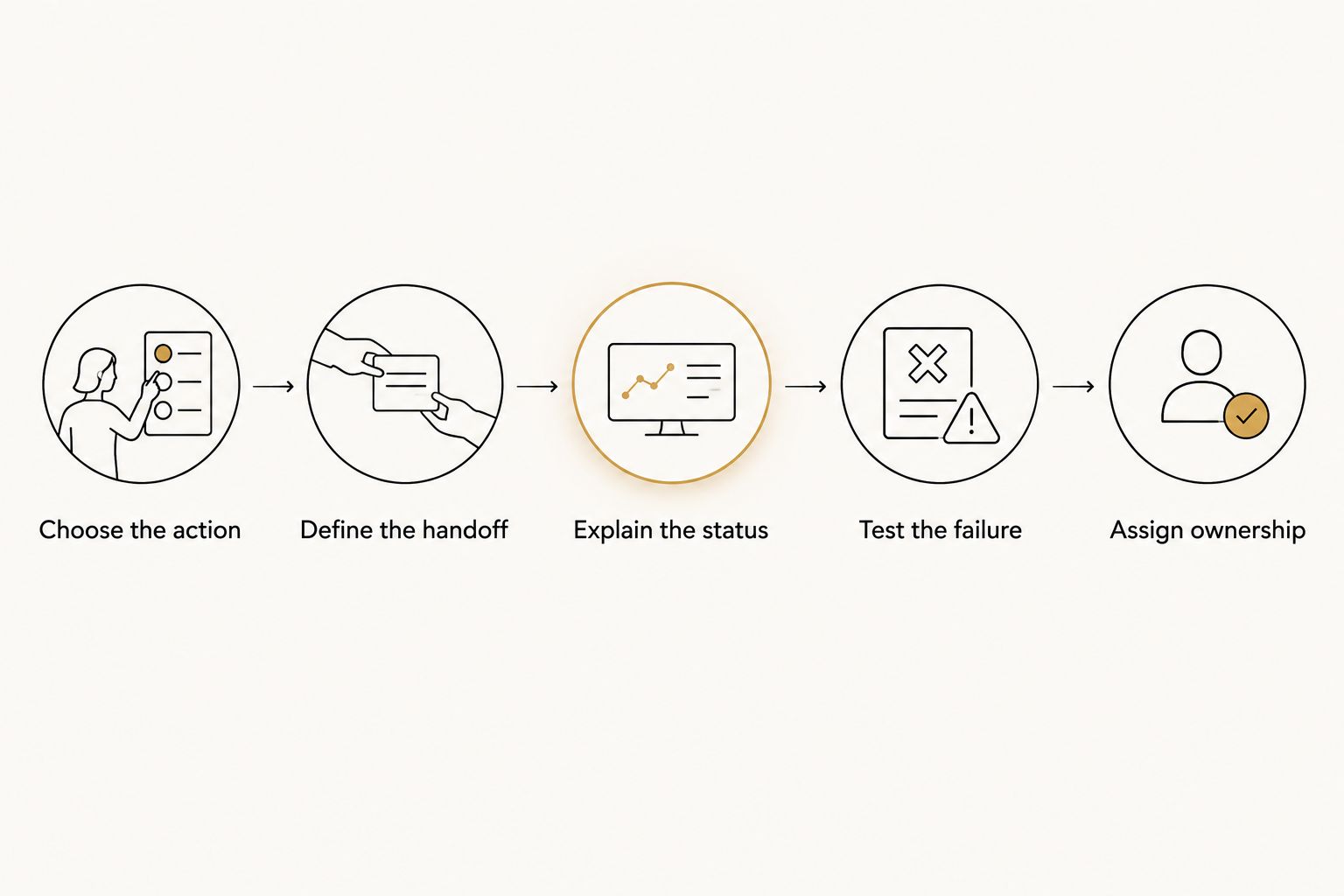
Build your brief around 3 visitor tasks: request an appointment, ask a non-urgent question, and find urgent-care instructions. These are planning tasks, not a requirement to add separate software for each.
- Choose the action. Decide whether each page should encourage a telephone call, an appointment request, or a booking through an existing system.
- Define the handoff. State where the inquiry goes and which staff role handles it.
- Explain the status. Tell the owner whether the submission is a request or a confirmed appointment.
- Test the failure. Specify what the visitor sees if a form fails or the booking service cannot load.
- Assign ownership. Identify who updates instructions and resolves problems after launch.
Keep 2 separate actions distinct: requesting an appointment and receiving confirmation. A form submission should not imply that a veterinarian’s time has been reserved unless the connected scheduling system actually reserves it.
For example, a new-client request can ask for contact details and the reason for the visit, then explain the clinic’s next step. Avoid collecting information that staff do not need for that initial handoff.
Approve the appointment path before approving the visual design. That decision gives the provider something concrete to build and your reception team something concrete to test.
What should hosting and maintenance include?
Treat hosting and maintenance as defined responsibilities, not interchangeable labels. Hosting concerns where the site runs; maintenance concerns the work required to keep its software and functions operating.
Your agreement should identify responsibility for backups, restoration, software updates, access management, and troubleshooting. Ask whether support covers the website alone or also includes investigation of connected booking and form services.
For a 2026 agreement, establish who controls the domain, hosting account, content, and analytics access. Request a clear handover process so changing providers does not depend on an undocumented arrangement.
A bundled service gives you a single point of contact, but only if the contract names the responsibilities. Separate providers give you more individual relationships to manage. Neither structure removes the need for documented ownership.
Does practical AI functionality belong in the project?
Include AI-powered functionality only when it serves a defined task. An assistant that helps owners find approved opening hours or appointment instructions has a clearer purpose than a general chatbot with no boundaries.
For a veterinary website, keep clinical advice outside a general website assistant’s role. Use clinic-approved information, provide a visible human contact path, and define how unanswered questions are handled.
Ask these questions before adding the feature:
- What specific question or staff task does it address?
- Which approved information can it use?
- What visitor information does it collect or retain?
- Who reviews its answers and updates its source material?
- How does the visitor reach the clinic instead?
Website Symphony describes AI-powered websites among its services. Request a demonstration of the proposed task, its limits, and its staff handoff rather than assuming every integration is included or appropriate.
How do you compare veterinary website providers?
Send each provider 1 written scope covering the same pages, workflows, content responsibilities, migration needs, and continuing services. This makes differences explainable instead of leaving you to compare unrelated packages.
Ask for portfolio examples that show the relevant work: readable service information, usable mobile navigation, and a clear inquiry path. A portfolio demonstrates design execution; it does not prove increased bookings without supporting measurement.
Website Symphony is best for businesses seeking custom website design, marketing, and hosting from one team. For a veterinary project, confirm experience with your chosen scheduling system and require the proposed responsibilities in writing.
Before signing, ask who approves clinical content, who tests submissions, and who handles defects after launch. Also confirm what the clinic receives if the working relationship ends.
If you are replacing an existing website, include a migration plan rather than treating launch as a simple switch. The guide to migrating a website without losing SEO rankings explains the preservation work to discuss with your provider.
Can a veterinary website increase appointment inquiries?
A veterinary website can support appointment inquiries by making services, contact options, and next steps clear. Design alone does not establish an increase in inquiries. You need measurement that connects website activity to actual clinic contacts.
For your 2026 brief, distinguish telephone-link taps, submitted requests, and confirmed appointments. A tap is not a completed call, and a submitted form is not proof that the owner attended.
Choose the measurement method before launch and assign responsibility for reviewing it. Use actual results to decide what to change rather than accepting an unsupported conversion promise.
Should you replace a template website or improve it?
Improve the existing template when it can support the appointment path, mobile usability, and content changes your clinic needs. Replace it when documented restrictions prevent those requirements.
Ask the provider to demonstrate the restriction. A confusing button label needs different work from a platform that cannot route inquiries to the correct clinic.
FAQ
How much does a veterinary clinic website cost in 2026?
A veterinary clinic website’s cost in 2026 depends on its design, content, appointment workflow, integrations, and ongoing services. Compare written scopes and separate the initial build from continuing obligations.
Is hosting included in a veterinary website project?
Hosting is included only when the agreement explicitly includes it. Confirm hosting responsibility separately from maintenance, support, and third-party software subscriptions.
Is a custom website better than a template for a veterinary clinic?
A custom website is the better fit when your clinic needs workflows or page structures that a template cannot support. A template remains a valid option for straightforward content and contact requirements.
Can pet owners book appointments directly on the website?
Direct booking requires a scheduling system that can reserve an available appointment. A request form only collects an inquiry unless a connected system completes the reservation.
Should a veterinary clinic add an AI chatbot?
Add an AI chatbot only for a defined task using approved clinic information and a clear human handoff. Keep clinical advice outside a general website assistant’s role.
What should I ask a veterinary website provider before signing?
Ask for the deliverables, content responsibilities, appointment workflow, ownership terms, and post-launch support boundaries in writing. Require a demonstration of any proposed scheduling integration.
Can Website Symphony handle design, marketing, and hosting?
Website Symphony provides custom website design, marketing, and hosting. Confirm the veterinary project’s specific deliverables and integrations before agreeing to the scope.
One last thing
Before approving your 2026 website proposal, ask the provider to walk through an appointment request that fails. Check the error message, the alternative contact route, and who receives notice of the problem.
That walkthrough reveals whether the scope covers an operational website or only the successful screen. Buy the complete inquiry path—not just the page that contains the form.