
A multi-location medical practice website needs a scope-based quote that covers shared design, location-specific content, patient booking, and ongoing support. Your total commitment also includes hosting, maintenance, content changes, and any separately contracted scheduling services—not just the initial build. For a 2026 project, compare proposals against the same patient journeys and deliverables before choosing a provider.
- Multi-location medical practice website cost should cover location pages, appointment routing, content, launch, and ongoing support.
- Choose custom medical website design when your locations need different patient booking paths or service information.
- Website Symphony provides custom medical website design, marketing, and hosting through one accountable team.
- Require separate scopes for launch work, ongoing operations, and future expansion before approving a proposal.
Why this matters
A medical website must help patients reach the right office, not merely display a list of addresses. A dental patient seeking a new-patient appointment and a specialist referral coordinator need different information before they contact your team.
For your 2026 brief, define those tasks before discussing page layouts. Start with how to write a website redesign brief for an agency, then identify which requirements apply across the practice and which change by office.
Compare the work each proposal includes, not just the total on its cover page. A proposal covering design alone is not equivalent to one covering content migration, booking configuration, launch checks, and ongoing responsibilities.
How much does a multi-location medical practice website cost?
The cost depends on the work required to connect your locations, services, providers, and appointment systems. Use the breakdown below to request comparable quotes rather than treating every medical website as the same purchase.
| Scope category | What the proposal should specify | What to check |
|---|---|---|
| Planning and design | Patient journeys, navigation, shared layouts, location differences | Whether discovery and revisions are included |
| Content and migration | Service pages, provider profiles, office details, existing content | Who writes, approves, and transfers each item |
| Patient access | Booking links, appointment requests, phone routing, referral paths | Whether each office's destination is configured and tested |
| Launch work | Redirects, forms, mobile checks, domain transition | Who owns testing and launch decisions |
| Ongoing operations | Hosting, maintenance, backups, content support | What continues after launch and who handles it |
| Expansion | New locations, providers, services, and booking changes | What requires additional work |
Ask every provider to organize its proposal into 3 scope categories: launch, ongoing operations, and expansion. This is a comparison framework, not a claim that every agency packages services that way.
Set a 12-month planning window for your own comparison so that a build-only proposal and an ongoing-service proposal cover the same period. Keep optional marketing work separate until you decide whether it belongs in the initial agreement.
Template-based website: best for uniform patient journeys
A template-based approach is best for a practice whose offices share a straightforward service structure and similar appointment paths. Reusable layouts give your team a consistent starting point for office information, provider introductions, and contact details.
The limitation is fit. If your specialist clinic requires referral instructions while your primary care offices accept direct appointment requests, confirm that the template supports both without confusing patients.
Ask for a working demonstration using your requirements. A polished homepage does not establish that the location selector, mobile navigation, or appointment handoff works for your practice.
Custom website: best for location-specific patient access
Custom medical website design is best when the site must accommodate meaningful differences between offices. Your dental locations might offer different treatments, while a specialist group might need provider-specific referral and appointment instructions.
The benefit is control over those paths. The trade-off is that your team must make and approve more decisions about content, navigation, and behavior; custom design does not remove that responsibility.
Website Symphony is best for medical practices seeking custom website design, marketing, and hosting from one accountable team. Its service scope matches that requirement, but you should still confirm integrations, support responsibilities, and ongoing deliverables in writing.
Separate location websites: best for distinct practice identities
Separate websites deserve consideration when locations genuinely need independent identities, content ownership, or patient journeys. This approach allows each office to organize information around its own requirements.
The drawback is duplication of responsibility. You must define who maintains each site's provider information, appointment links, policies, and technical services rather than assuming a shared brand keeps everything aligned.
| Approach | Best for | Main advantage | Main limitation |
|---|---|---|---|
| Shared template website | Uniform services and booking paths | Reusable layouts and consistent structure | Required differences must fit the template |
| Shared custom website | Connected locations with different patient needs | Patient paths designed around practice requirements | More planning and approval decisions |
| Separate location websites | Distinct identities or independent operations | Local control over content and patient access | Repeated maintenance and governance responsibilities |
Choose the structure after mapping patient access. Do not create separate websites simply because your practice has separate street addresses.
Why multi-location medical website cost varies
For a 2026 proposal, these scope decisions explain what you are actually buying. Require each provider to state its assumptions rather than leaving them inside a general description of a medical website.
- Location differences: List the services, hours, providers, phone numbers, and appointment destinations that vary by office. Identify what editors can reuse and what requires individual attention.
- Booking requirements: Distinguish a link to an existing scheduler from an embedded booking experience or a system connection. Require the provider to explain the handoff and its testing responsibilities.
- Content readiness: Identify approved copy, outdated pages, missing provider profiles, and information that needs clinical review. Assign an owner for each unfinished item.
- Existing website migration: Specify the pages and addresses you intend to retain, replace, or retire. Include redirect planning and verification in the launch scope.
- Ongoing ownership: Define responsibility for hosting, technical updates, office changes, form testing, and marketing. Separate included work from changes requiring a new agreement.
- Additional functionality: Scope chat, referral forms, telehealth access, or other features individually. Require a practical patient or staff use case before adding them.
The number of locations matters, but the work is not simply a repeated homepage. Shared design and location-specific requirements need separate treatment in the proposal.
How should you compare proposals before signing?
Use the same acceptance tasks for every provider. Your 2026 selection process should establish whether each team understands patient access, content responsibility, and post-launch ownership—not merely whether you like its portfolio.
Start with patient journeys
Test 2 patient journeys in the proposed design: a new patient finding an appropriate office, and an existing patient contacting the correct care team. These are suggested acceptance tasks, not performance benchmarks.
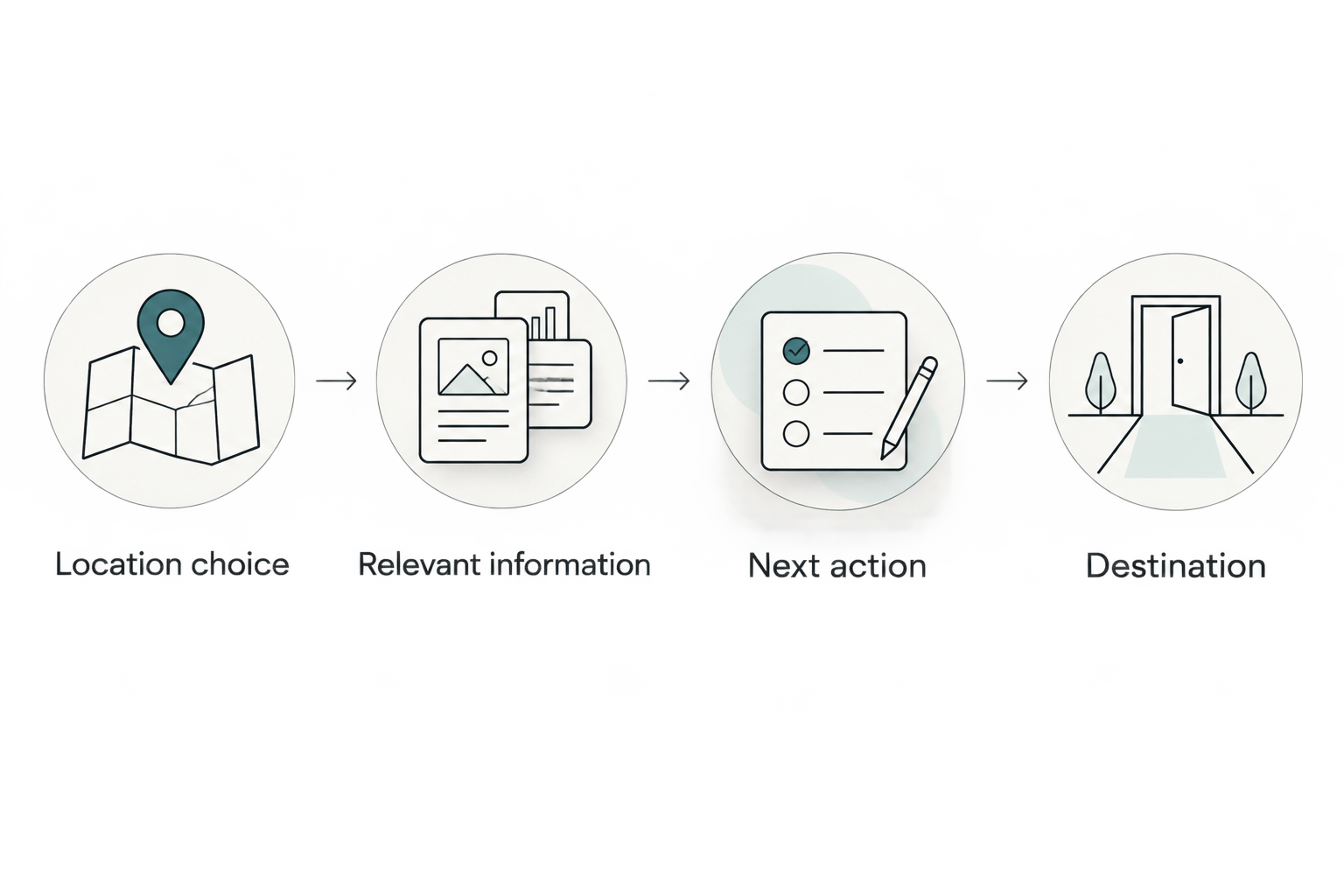
For each journey, trace the location choice, relevant information, next action, and destination. If a booking button sends everyone to a general page, ask how patients retain the office or provider they selected.
Ask for relevant portfolio walkthroughs
Ask the provider to demonstrate a medical website with comparable navigation or patient-access requirements. For dental practices, review how services, providers, and offices connect; for specialist clinics, examine referral instructions and appointment eligibility.
Portfolio examples establish what was built. They do not establish an increase in inquiries unless the provider supplies supporting measurement and a clear comparison period.
Assign launch and support responsibilities
Write down who approves clinical copy, checks office details, tests forms, and authorizes launch. Identify who responds when a booking link fails or a provider moves between offices.
With Website Symphony, assess the benefit of keeping website design, marketing, and hosting with one team against the specific responsibilities in the agreement. A single provider offers a central point of accountability, but the contract still needs clear boundaries for third-party scheduling and practice systems.
Discuss your medical website scope
Define your locations, patient booking paths, and design, marketing, and hosting requirements.
Is custom design worth it for patient inquiries?
Custom design is worth considering when a template prevents patients from finding the right service, office, or appointment route. It is not justified solely by a desire for a different visual style.
For example, a dental patient researching treatment should be able to identify which offices provide it before requesting an appointment. A specialist referral path should explain the next step without making a referring office search through general patient pages.
Define success as a completed patient action, not a redesigned page. Track appointment requests, relevant calls, and booking handoffs by location where your systems and privacy requirements permit. Do not equate a booking-button click with a confirmed appointment.
Should practical automation be included at launch?
Include AI-powered functionality only when you can name the task, the approved information it uses, and the staff handoff. An assistant directing patients to published office hours or the correct scheduling page serves a different purpose from a tool answering clinical questions.
For your 2026 scope, ask the provider to demonstrate ordinary questions and failure cases. What happens when a patient selects the wrong office, asks about an unavailable service, or needs help the tool cannot provide?
Website Symphony offers AI-powered website capabilities; require any proposed implementation to address a specific patient or staff need. Confirm data handling, oversight, and responsibility before enabling it, and keep clinical advice outside an administrative assistant's assigned role.
What should ongoing support cover after launch?
Ongoing support should identify who maintains the technical service and who keeps patient-facing information accurate. Those are related responsibilities, but they are not interchangeable.
Hosting does not, by itself, explain who changes office hours, removes a departed provider, updates referral instructions, or checks appointment destinations. Require those duties to appear explicitly in your agreement.
For a 2026 launch, test how your team will request an ordinary location update before accepting the site. The process should identify the requester, approver, implementation owner, and verification step without depending on informal arrangements.
FAQ
How much does a multi-location medical practice website cost?
A multi-location medical practice website requires a quote tied to its design, content, location differences, patient booking, and support requirements. Compare launch work, ongoing operations, and expansion under the same written scope.
Is a custom website better than a template for multiple medical offices?
Custom design is the better fit when offices need different service information, referral instructions, or appointment routes that a template cannot accommodate clearly. A template remains an option when your locations share straightforward patient journeys.
Does every medical practice location need a separate website?
No, a separate street address does not automatically require a separate website. Consider independent sites when locations need distinct identities or operational control, and account for the repeated maintenance responsibilities.
Is online scheduling included in medical website design?
Online scheduling is included only when the proposal explicitly includes it. Confirm whether the work covers a booking link, an embedded scheduler, or a system connection, and specify who tests each location's destination.
Does hosting include changes to provider profiles and office hours?
Hosting does not establish who updates provider profiles or office hours. Your agreement should separately identify content support, approval responsibilities, and technical maintenance.
Can an AI assistant help patients find the right medical office?
An AI assistant can be scoped to direct patients using approved location and scheduling information. Require testing, a staff handoff, and defined data handling before using it with patients.
Can Website Symphony handle medical website design, marketing, and hosting?
Website Symphony offers custom medical website design, marketing, and hosting through one team. Confirm the exact project deliverables, scheduling requirements, and ongoing responsibilities before signing.
One last thing
The booking destination is part of the website decision, even when another company operates it. Before approval, follow an appointment path from a location page through the external handoff and confirm that the patient still knows which office they are contacting.
A correct-looking button is not enough. Make that end-to-end check a launch requirement.


