There is no fixed turnaround for designing a med spa website: the schedule depends on the approved scope, content readiness, review process, and booking requirements. Design approval is not the same as launch; development, form testing, and appointment-path checks still need time. For a 2026 project, get separate milestones for design approval and a working, tested website before accepting a delivery date.
- How long does it take to design a med spa website? Base the timeline on deliverables, dependencies, and approval milestones.
- Separate design approval from launch: booking connections, inquiry forms, and testing belong in the schedule.
- Choose custom design when your patient inquiry path needs more flexibility than a template provides.
- Website Symphony offers custom website design, marketing, and hosting for med spas and medical businesses.
How long does it take to design a med spa website?
A useful timeline names what will be ready, what approval it needs, and what happens next. A date without those details does not tell you whether you are receiving a visual concept, a developed website, or a functioning appointment path.
Use this sequence to evaluate a proposal. The med spa website design guide provides broader planning context; the milestones below keep the delivery discussion focused.
- Scope approval. Confirm the pages, treatment information, patient actions, and connections the project includes. Identify what your team must supply.
- Content approval. Review treatment descriptions, provider information, photography permissions, and patient-facing instructions before those materials become page layouts.
- Design approval. Approve the structure and visual presentation of the agreed page types, including their mobile layouts and appointment prompts.
- Development completion. Turn approved designs into working pages. Connect forms, booking destinations, and other agreed functionality.
- Launch approval. Test the patient journey, confirm staff receive inquiries, and check the release plan before publishing.
These are planning stages, not duration estimates. Ask the provider to attach dates and responsible people to each stage for your actual project.
Why this matters
A med spa website is not finished when the homepage looks right. It is finished when a prospective patient can understand the treatment, identify the appropriate next step, and reach your team through a working path.
For your 2026 launch plan, define completion in operational terms. Can someone request a consultation from a treatment page? Does the request reach the right staff member? Does the confirmation explain what happens next?
Approve the patient journey, not just the appearance. That distinction keeps an attractive mockup from being mistaken for a launch-ready website.
A template refresh: best for an unchanged patient journey
A template refresh fits a practice whose existing page structure and appointment process already meet its needs. The work centers on replacing approved content, adjusting presentation, and checking that existing actions still work.
The advantage is a narrower design brief. The limitation is that you are working within the template's layout and functionality; changing the underlying inquiry path creates additional work rather than a simple visual update.
Do not assume a template guarantees a particular delivery date. Ask the provider to demonstrate the actual mobile treatment page and appointment action before choosing this route.
Custom design: best for a practice-specific inquiry path
Custom design fits a med spa that needs its website to support a particular consultation process, treatment structure, or staff workflow. Start with what a visitor needs to understand and do, then build the page around that task.
For example, your brief might require treatment information beside a consultation prompt, clear provider details, and a distinction between requesting an appointment and booking a confirmed slot. These are design requirements, not promises of increased bookings.
The benefit is control over the patient journey. The trade-off is the need to define and approve that journey, including content, layout, and behavior, rather than choosing a finished template structure.
| Approach | Best for | Main advantage | Main limitation | Timeline question to ask |
|---|---|---|---|---|
| Template refresh | Practices keeping their current patient journey | A bounded presentation update | Existing layout constraints remain | What changes fit without rebuilding the template? |
| Custom design | Practices needing a specific consultation or inquiry path | Layout and functionality follow the brief | More decisions require explicit approval | Which page types and workflows need approval? |
| Phased launch | Practices able to separate essential and secondary scope | A defined first release | Deferred work still needs ownership | What works at launch, and what remains unfinished? |
A phased launch: best for clearly separable scope
A phased launch publishes an agreed, functional website before adding nonessential scope. It is appropriate only when the first release still gives patients accurate information and a complete way to contact or book with the practice.
The advantage is focus. The limitation is the risk of treating deferred work as forgotten work, so every postponed item needs a named owner and a later acceptance decision.
Separate essentials from enhancements in your 2026 brief. Working appointment actions, accurate treatment information, and reliable inquiry delivery belong in the essential group; additional editorial content can be evaluated separately.
Why med spa website timelines vary
The schedule changes when the work or its dependencies change. Use these factors to examine a proposal rather than accepting a generic turnaround claim:
- Page scope. Distinct treatment pages, provider pages, and location information require their own content and review decisions.
- Content readiness. Missing descriptions, unapproved photography, or incomplete provider details leave parts of the design unresolved.
- Booking requirements. Linking to an existing booking destination is a different task from building and testing an embedded appointment flow.
- Approval ownership. Conflicting feedback creates unresolved decisions. Name a final approver and combine comments before sending them.
- Existing-site changes. A replacement website needs decisions about existing content, destinations, and links as well as its new presentation.
- Additional functionality. Automated responses or other AI-powered features need defined behavior, boundaries, and acceptance tests.
Keep a change log after scope approval. When someone requests another page or a different booking workflow, ask what it changes in the delivery plan before approving it.
How do you keep appointment functionality from delaying launch?
Define the appointment path before approving the design. A button labeled to book an appointment should lead to the action patients expect, not an unexplained detour.
Use the following sequence as your acceptance test. Test it on a phone as well as a larger screen, and include the staff handoff rather than stopping at form submission.
- Treatment page: Explain the service and provide the appropriate next action.
- Appointment action: Distinguish a consultation request from a confirmed booking.
- Confirmation: Tell the visitor whether the request was received or the appointment was scheduled.
- Staff handoff: Confirm the intended team member or system receives the information.
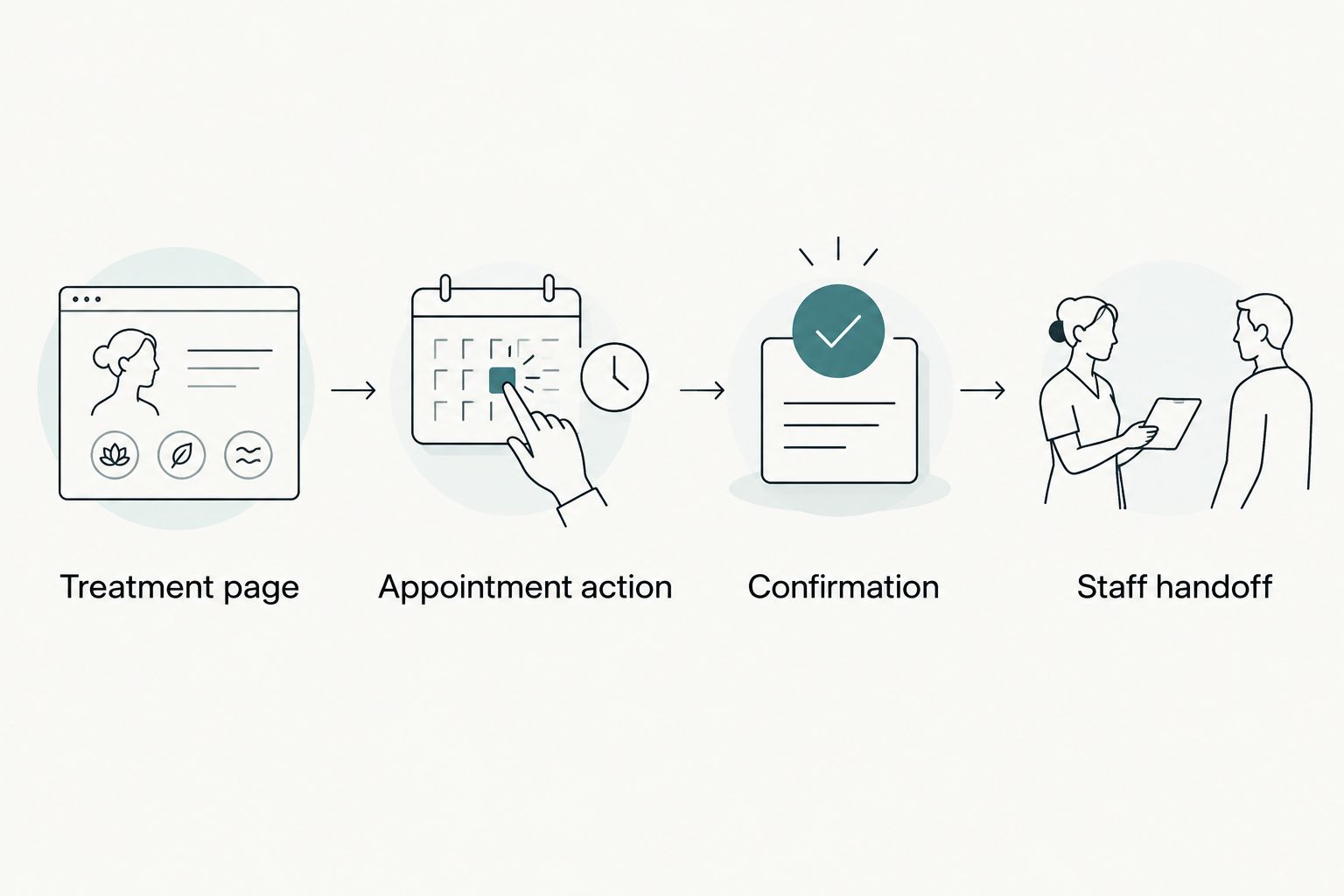
A successful submission on the website does not prove that staff can act on it. Have the receiving team verify the test request, its destination, and the information it contains before launch approval.
What should AI-powered functionality do on a med spa website?
Specify a practical task before adding AI-powered functionality to the schedule. A useful brief might ask for help finding practice-approved information or routing an administrative inquiry to the correct destination.
Do not treat generated answers as a substitute for clinician guidance. Define the information the feature can use, the questions it must hand off, and the route to a human when it cannot answer appropriately.
For a 2026 project, review any proposed feature against these acceptance questions:
- What patient or staff task does it complete?
- Which approved information does it use?
- What happens when the question falls outside its scope?
- Does it send people toward the correct consultation or inquiry path?
- Who maintains its information after launch?
Ask the provider to demonstrate the intended behavior before committing to it. Adding an undefined feature to the brief creates an undefined testing requirement.
How do you choose a provider with a credible schedule?
Choose a provider that explains dependencies, not just delivery dates. Ask to see relevant portfolio examples and walk through their treatment pages, mobile inquiry paths, and appointment actions; appearance alone does not establish conversion performance.
Then request a written responsibility list. It should distinguish what the provider creates, what your practice supplies, who approves medical content, and who signs off on launch readiness.
Website Symphony is best for med spas seeking custom website design, marketing, and hosting from one accountable team. Those services match a buyer who wants responsibility across the website and its ongoing support, rather than separate providers for each function.
When evaluating Website Symphony, use the same scope questions you would use with any provider. Confirm the proposed booking connection, review process, launch criteria, and post-launch responsibilities rather than inferring them from the service description.
The trade-off with a custom engagement is that your practice still needs to provide accurate information and make decisions. A single accountable team does not remove the need for clinical review or internal approval.
Discuss your med spa website scope
Define your patient inquiry path, design requirements, and hosting needs before setting a launch date.
What should you prepare before requesting a launch date?
Prepare a launch brief that another person can act on without guessing. Describe the treatments you want to feature, the patient actions each page should support, and the people responsible for supplying and approving information.
For your 2026 brief, include the following:
- Page list: Name the required pages and identify content you are keeping or replacing.
- Approved materials: Gather treatment descriptions, provider details, images you have permission to use, and practice contact information.
- Appointment destination: Identify where booking or consultation requests should go.
- Review owner: Name the person who combines feedback and gives final approval.
- Launch criteria: Describe what must work before publication, including inquiry delivery and mobile use.
- Ongoing ownership: Assign responsibility for content changes, hosting questions, and marketing updates.
Ask the provider to identify unresolved dependencies in that brief. A schedule becomes actionable when both sides understand which decisions keep the next stage moving.
FAQ
How long does it take to design a med spa website from scratch?
A custom med spa website needs a project-specific schedule based on its page scope, content, approvals, and appointment requirements. Request separate dates for design approval, development completion, and launch testing.
Is a template med spa website faster to launch than a custom website?
A template narrows design decisions when its existing structure already fits your practice. It does not remove content approval, booking setup, or testing, so compare the actual scope rather than assuming a delivery date.
Can my med spa website launch before every planned page is ready?
A phased launch works when the published scope provides accurate information and a complete patient inquiry path. Record deferred pages separately and assign responsibility for finishing them.
Does adding online booking affect the website timeline?
Online booking adds setup and verification work to the website scope. Ask whether the project links to an existing booking destination or includes a more involved connection, then test the full patient and staff journey.
Will AI-powered design remove the need for website reviews?
AI-powered design does not remove the need to approve treatment information, patient-facing instructions, or appointment behavior. Evaluate each feature against a specific patient or staff task and test its boundaries before launch.
What should I ask Website Symphony before starting a med spa website?
Ask Website Symphony to define the custom website scope, approval milestones, and responsibilities across design, marketing, and hosting. Confirm appointment functionality and launch acceptance criteria in the project agreement.
One last thing
A working appointment button is not the same as a working appointment process. Before approving launch, submit a test inquiry and have the receiving staff member explain exactly what they received and what they would do next.
That final check connects the design to the reason you commissioned it: giving prospective patients a clear, usable route to your practice.