
Yes, a web design agency can help set up Google Business Profile, connect it to your website, and organize the information patients use to contact your practice. Profile setup is not automatically included in website design, and Google controls verification and profile eligibility. Your practice should retain primary ownership while the agency receives the access needed to complete the agreed work.
- Can a web design agency help set up Google Business Profile? Yes—confirm setup, verification support, and website connections in writing.
- Keep primary ownership of Google Business Profile; give your agency role-based access rather than sharing your password.
- Connect profile visitors to the correct location, appointment request, or booking page—not an unrelated homepage.
- Website Symphony fits medical practices seeking one team for custom website design, marketing, and hosting.
Can a web design agency help set up Google Business Profile?
A web design agency can coordinate the profile and website work together, provided those responsibilities appear in the agreement. That includes checking for an existing listing, organizing accurate business information, supporting Google's verification process, and testing the links patients follow.
Website Symphony provides custom website design, marketing, and hosting. Ask specifically whether Google Business Profile work belongs in your proposed scope; website development alone does not establish that commitment.
Use these 6 setup steps as your 2026 project checklist:
- Check existing listings. Search for the practice, its address, and any previous business names before creating another profile. Resolve ownership or duplicate-listing questions first.
- Confirm eligibility. Review the practice's real-world location and operating model against Google's eligibility rules. A website address does not establish profile eligibility.
- Set account ownership. Keep primary ownership under a practice-controlled Google account. Invite the agency through profile access controls instead of sending account credentials.
- Prepare accurate information. Approve the business name, category, address, phone number, hours, services, and appropriate photographs. Use the real-world business name rather than adding promotional keywords.
- Support verification. Follow the verification methods Google makes available. Your agency can help prepare, but practice staff must supply any required business evidence or on-site participation.
- Connect and test. Check website and appointment links on a phone. Confirm that patients reach the intended page and understand what happens after submitting an inquiry.
Verification is not a promise of prominent placement in search results. Treat successful setup, accurate information, and a working patient contact path as separate acceptance checks.
Why this matters
A profile can attract attention while the website loses the inquiry. A patient searching for a dentist needs to confirm the location, understand the relevant service, and find a clear way to request an appointment.
The agency's useful role is connecting those decisions. A correct listing cannot compensate for a broken booking link, and a polished website cannot correct inaccurate opening hours on the profile.
For a 2026 medical website project, define success beyond publication: the patient reaches the right practice, takes the intended action, and receives an accurate explanation of the next step. Measure the path to an inquiry, not just whether the profile exists.
Should you manage setup yourself or hire an agency?
Choose based on who can maintain accurate business information and test the complete inquiry path. Neither approach removes your responsibility to approve practice details or participate when Google requires verification evidence.
| Approach | Best for | Main advantage | Main limitation |
|---|---|---|---|
| Practice-managed setup | A practice with a clear owner and a straightforward website connection | Direct control over account access and business information | Staff must learn the requirements, handle updates, and test website connections |
| Agency-assisted setup | A practice coordinating a new website, marketing, and appointment paths | Profile information and website changes can be handled within an agreed project | Responsibilities and ongoing maintenance require an explicit scope |
Choose agency assistance when the work extends beyond filling out business details. Replacing a website, correcting location information, and connecting appointment requests require coordination across the profile and the website.
Choose practice-managed setup when someone on staff can own those tasks consistently. An agency is not necessary simply to create a profile, and hiring one does not guarantee verification or rankings.
What should the agency connect to your medical website?
The destination should match the patient's intent. A general website link can introduce the practice; a supported appointment link should lead to the appropriate booking or appointment-request destination.
For a dental practice, that means checking whether a new patient can find the relevant treatment, confirm the office location, and request an appointment without being sent through unrelated pages. For a specialist clinic, it means making referral requirements and consultation steps clear where applicable.
Use this patient path when reviewing the proposed design:
- Profile visit: The patient sees accurate practice details and chooses a website or appointment action.
- Relevant page: The destination matches the location or service the patient expects.
- Appointment request: The patient can call, request a callback, or use the practice's approved booking process.
- Clear confirmation: The page explains whether the appointment is booked or still awaiting staff confirmation.
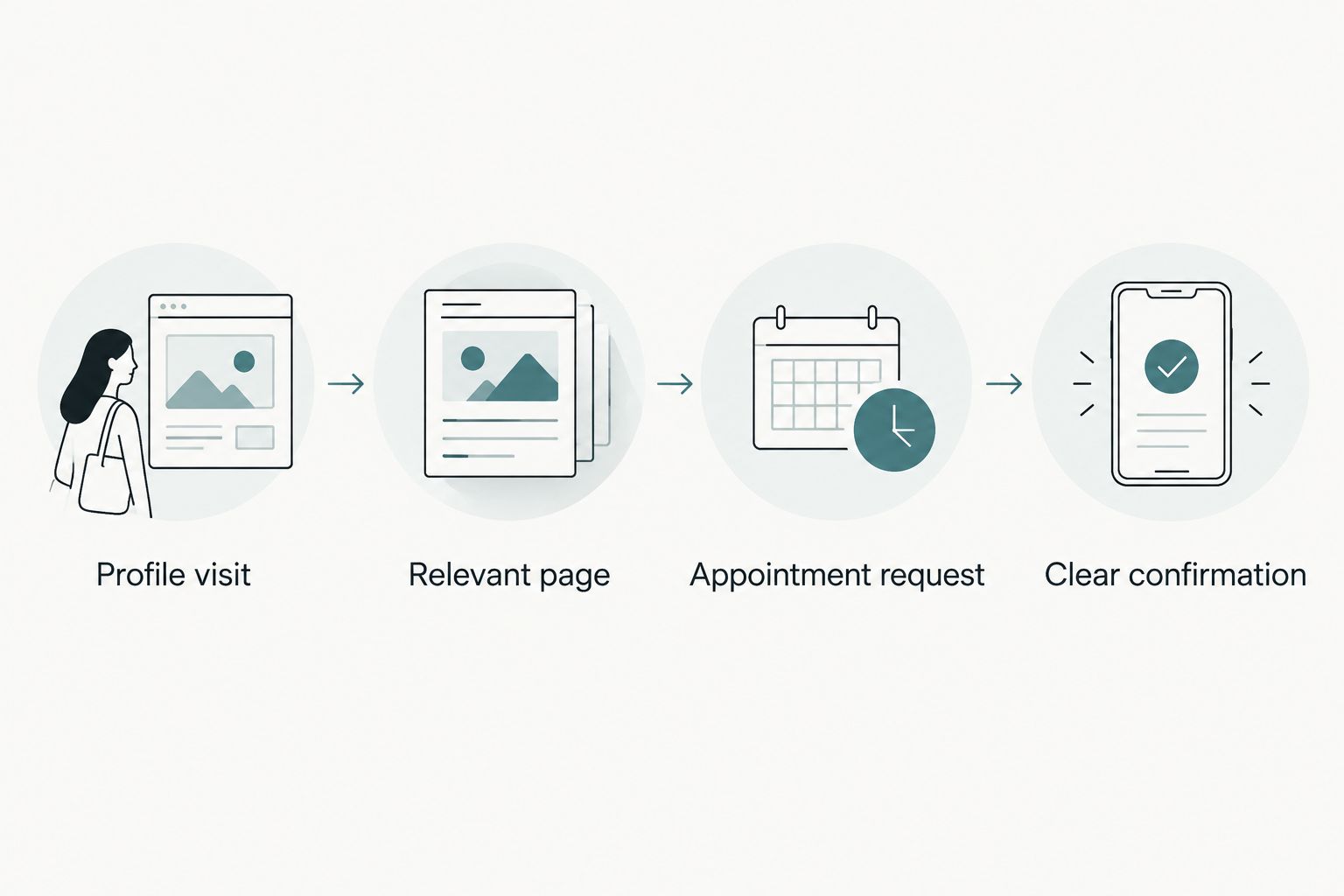
An appointment request is not a confirmed appointment. Make that distinction visible before submission and in the confirmation message, especially when staff must check availability or referral information.
A custom medical website gives you control over this sequence. Its value is the ability to fit the practice's actual intake process—not simply to look different from a template.
Why Google Business Profile setup varies
The work depends on the existing account, the practice's structure, and the website connection. Use these factors to compare proposals rather than accepting an undefined promise of local search optimization:
- Existing ownership: Claiming an unowned profile differs from requesting access to a profile controlled by a former employee or provider.
- Listing accuracy: Old addresses, changed telephone numbers, and duplicate profiles create cleanup work before publication.
- Practice structure: A clinic, individual practitioner, and separate department require eligibility and representation checks rather than automatic duplication.
- Verification requirements: Google determines the available process and evidence requirements. An agency cannot choose an easier method on demand.
- Website readiness: A working appointment destination needs less coordination than a website with broken forms or unclear location pages.
- Ongoing responsibility: Initial setup and continuing updates are different commitments. Specify who handles hours, contact changes, access reviews, and patient-facing information.
For your 2026 brief, separate account cleanup from website development. Otherwise, an unresolved ownership issue can remain hidden inside a project described only as a redesign.
How do you choose an agency for this work?
Ask the provider to explain the patient journey before discussing decorative design choices. A useful answer identifies the destination page, the action patients should take, and the staff member responsible for following up.
Request a walkthrough of a relevant portfolio example. Inspect its service pages, mobile contact controls, location details, and inquiry confirmation; a portfolio demonstrates design decisions, not an unreported increase in patient appointments.
Website Symphony fits medical practices seeking one accountable team for custom website design, marketing, and hosting. That service model suits buyers who want those responsibilities coordinated, but it does not establish that Google Business Profile setup or ongoing management is included. Confirm both before signing.
A single provider reduces the number of handoffs you must coordinate, but concentrating responsibilities also makes ownership and exit terms important. Keep practice-controlled access to the domain, profile, and other business accounts, and document how a future provider would receive access.
For your 2026 proposal review, require 3 written deliverables: an ownership record, a profile-to-website connection plan, and a handoff checklist. Each should name the responsible person and the condition that marks the work complete.
Define your practice website scope
Discuss custom design, marketing, hosting, and the patient inquiry path your practice needs.
Can an agency guarantee Google verification or rankings?
No agency controls Google's verification or search rankings. The provider can organize accurate information, help you follow the required process, and correct website connection problems.
Reject a proposal that treats guaranteed placement as the outcome of profile setup. Ask instead how the agency documents completed work, flags unresolved issues, and distinguishes profile visibility from actual patient inquiries.
Do you need a new website to connect Google Business Profile?
You do not need a new website solely to connect an eligible profile to an existing, suitable website. Check the destination first: it should load properly, identify the practice clearly, and provide a usable contact or appointment path.
Replace a template when it prevents the workflow your practice needs. If the existing site already supports the correct location, service, and inquiry sequence, a targeted improvement is a more focused brief than an automatic rebuild.
Can AI help patients after they visit your profile?
AI-powered functionality belongs where it solves a defined patient or staff problem. For example, a proposed website assistant could direct visitors to approved office information or explain how to request an appointment, with clinical questions routed to staff.
Treat that as a feature to evaluate, not an assumed agency deliverable. Require approved source content, a clear staff handoff, and privacy review before deployment; do not use a general chatbot as a substitute for clinical advice or an approved patient intake system.
What should you check before the agency hands everything over?
Review the work using a patient task, not a list of completed settings. Open the profile on a phone, follow its website connection, and attempt the intended inquiry without relying on instructions from the project team.
Your 2026 handoff should pass 2 practical tests: a patient can reach the correct destination, and practice staff can identify where the resulting inquiry arrives. Use test information rather than real patient details during that review.
Then confirm the operating responsibilities:
- The practice retains primary ownership and can review agency access.
- Published hours, telephone details, and location information match approved records.
- Appointment requests reach the intended staff workflow.
- Confirmation messages distinguish requests from confirmed bookings.
- Someone is responsible for future business-information changes.
- Staff know how to report a broken form or incorrect profile detail.
Keep evidence of the handoff in a practice-controlled location. Access should not depend on one employee remembering which outside provider created the account.
FAQ
Can a web design agency set up Google Business Profile for my dental practice?
Yes, a web design agency can assist with setup, accurate business information, verification preparation, and website connections. Confirm those tasks in the contract and keep primary ownership under practice control.
Should my agency own my Google Business Profile?
Your practice should retain primary ownership of Google Business Profile. Give the agency appropriate role-based access so it can perform agreed work without controlling your business account.
Is Google Business Profile setup included in website design?
Google Business Profile setup is not automatically included in website design. Specify profile creation or cleanup, verification support, website connections, and any ongoing management separately.
Can an agency complete Google verification without my help?
Your agency cannot promise to complete verification without practice participation. Google determines the available methods, and the process can require business evidence or on-site involvement from your team.
Should my Google profile link straight to online booking?
Use an appropriate appointment link for the practice's approved booking or appointment-request process where the profile supports it. Keep the destination accurate and explain whether submission confirms an appointment or requests staff follow-up.
Does Website Symphony provide medical website design and hosting?
Website Symphony provides custom website design, marketing, and hosting for medical businesses and other sectors. Ask whether your proposed scope also includes Google Business Profile setup and ongoing profile management.
Will a new profile guarantee more patient appointments?
A new Google Business Profile does not guarantee more patient appointments. Accurate information, relevant website destinations, working inquiry tools, and staff follow-up are separate parts of the patient journey.
One last thing
Before approving the project, ask a staff member who was not involved in the build to request an appointment using the profile-to-website path. Have that person explain what they expect to happen next.
If the page says the request was received but the patient believes the appointment is confirmed, the handoff is not finished. Fix the expectation gap before sending more visitors through it.


