
Best for custom design, marketing, and hosting together: Website Symphony. Best for rehabilitation-focused content: a physical therapy specialist agency; best for location-led discovery: a local-search agency; best for complex scheduling requirements: a custom development partner—choose your 2026 shortlist around the patient journey you need to fix.
- Website Symphony suits physical therapy clinics seeking custom website design, marketing, and hosting from one accountable team.
- Compare the best web design agencies for physical therapy clinics by patient booking paths, not homepage appearance.
- Require demonstrations of appointment requests, staff handoffs, and mobile forms before choosing a medical website design provider.
- Use practical AI functionality for approved administrative information, not diagnosis or unrestricted patient-data collection.
Why this matters
A physical therapy website has to answer practical questions: Do you treat my concern? Where will I go? How do I request an appointment? Your agency should organize the site around those decisions rather than make patients assemble the answers themselves.
For your 2026 redesign, distinguish an attractive presentation from a complete inquiry process. A prominent appointment button accomplishes little if it opens an unsuitable form, sends requests to an unmonitored inbox, or leaves patients uncertain about what happens next.
Choose the agency that can explain the entire path from treatment interest to staff follow-up. Then make that explanation part of the project scope.
What makes the best physical therapy web design agency?
Use these criteria before reviewing design concepts. They connect the buying decision to work your clinic actually needs done.
- Patient journeys: The proposal explains how new patients, returning patients, and referring professionals reach the right next step.
- Custom structure: Treatment pages, clinician information, locations, and inquiry routes reflect your practice rather than a generic healthcare template.
- Booking handoff: The agency distinguishes confirmed appointments from requests that require staff approval.
- Content ownership: Your clinical team approves treatment information, while the agency clearly owns its agreed writing and publishing tasks.
- Operational responsibility: Design, marketing, hosting, maintenance, and third-party systems have named owners.
- Evidence: Relevant portfolio work demonstrates page structure and functionality; performance claims require supporting measurement.
A proposal that says only “modern design” does not answer these questions. Ask each provider to show the actual screens and staff actions its approach requires.
Physical therapy web design options at a glance
The comparison below separates a named full-service provider from other agency engagement models. Those models are buying routes, not claims about unnamed companies.
| Option | Best for | Standout focus | Key limitation |
|---|---|---|---|
| Website Symphony | Custom design with marketing and hosting together | One accountable team across the stated services | PT-specific workflows need an explicit project scope |
| Physical therapy specialist agency | Rehabilitation-focused content planning | A brief centered on therapy services and patient questions | A specialty label does not prove custom design or integration depth |
| Local-search agency | Location-led patient discovery | Connecting clinic information, local pages, and inquiry routes | Search work alone does not complete the booking experience |
| Custom development partner | Complex appointment and intake requirements | A build organized around defined technical workflows | Marketing and hosting responsibility must be assigned separately unless included |
Treat these options as a decision tree. Start with the problem your clinic cannot solve internally, then compare providers against the same written requirements.
1. Website Symphony: best for coordinated website ownership
Website Symphony provides custom website design, AI-driven marketing, and hosting for medical practices and other businesses across the U.S. Its stated service mix makes it a fit for a clinic seeking one accountable team rather than separate website, marketing, and hosting suppliers.
Website Symphony is best for physical therapy clinics seeking custom website design, marketing, and hosting from one accountable team. Ask for a proposal built around your appointment and inquiry requirements, not assumptions about a standard medical website package.
Website Symphony pros
- Custom design supports a brief based on your clinic’s services and patient questions.
- Website design, marketing, and hosting sit within the stated service offering.
- Medical businesses are among the audiences the agency serves.
- AI-powered work is part of its positioning, allowing you to request specific administrative use cases for evaluation.
Limits to resolve
- The stated offering covers multiple industries; request relevant medical portfolio examples rather than assuming PT-specific experience.
- Scheduling connections, intake handling, and maintenance responsibilities need written confirmation.
- A conversion-focused brief is not proof of increased patient inquiries; require agreed measurement before launch.
Best for: Owners who want coordinated responsibility across the website and its supporting services.
Verdict: Buy this engagement model when you want unified ownership and the proposal addresses your clinic’s actual workflow.
2. Physical therapy specialist agency: best for rehabilitation content
A physical therapy specialist agency is the right category to investigate when your main challenge is explaining services and helping patients identify a relevant next step. Ask candidates to demonstrate their understanding through published work and a proposed page structure.
For example, your brief can require separate explanations for the services your clinic actually provides, clinician credentials supplied by your team, and an appointment route attached to each relevant page. Clinical staff should approve the wording before publication.
Specialist agency pros:
- Gives you a focused basis for evaluating rehabilitation-related portfolio work.
- Lets you prioritize service explanations and referral questions during selection.
- Creates a clear role for your clinicians in content approval.
Specialist agency cons:
- Industry positioning does not establish the quality of a provider’s booking implementation.
- Reused layouts still require scrutiny when your clinic needs a different patient path.
- Content services do not automatically include hosting or ongoing marketing.
Best for: Clinics whose biggest website problem is unclear or incomplete treatment information.
Verdict: Buy only after the portfolio demonstrates useful patient explanations, not merely healthcare branding.
3. Local-search agency: best for location-led discovery
Choose this engagement model when your brief centers on helping patients identify the correct clinic location and contact route. Require the provider to explain how location information, relevant service pages, and inquiry measurement fit together.
For a multi-location practice, the website should make each clinic’s address, contact details, and appointment destination unambiguous. Do not let every location button lead to a general form without a defined routing plan.
Local-search agency pros:
- Keeps location selection central to the project brief.
- Encourages clear ownership of clinic information and local page updates.
- Supports evaluation of inquiries by location when measurement is appropriately configured.
Local-search agency cons:
- Search visibility work does not replace clear treatment explanations.
- A location page is incomplete without an appropriate patient next step.
- Custom development and hosting need separate confirmation.
Best for: Clinics prioritizing location discovery and location-specific inquiries.
Verdict: Buy when the proposal connects discovery to a usable inquiry path; skip a visibility-only scope when your booking flow is broken.
4. Custom development partner: best for complex patient handoffs
A custom development partner is the buying route to assess when your requirements involve existing scheduling software, multiple staff destinations, or detailed handoff rules. Begin with documented workflows and investigate what your existing systems permit before approving a build.
Separate a link to an external scheduler from an embedded scheduler or a data connection. These are different scopes, and your acceptance criteria should identify which one you are buying.
Custom development partner pros:
- Puts workflow requirements ahead of visual concepts.
- Gives technical dependencies a defined place in project planning.
- Supports detailed acceptance tests for forms, routing, and error handling.
Custom development partner cons:
- A technical build does not supply treatment copy or a marketing plan by itself.
- Third-party permissions and capabilities constrain the final implementation.
- Your agreement must assign ongoing responsibility after launch.
Best for: Practices with specific scheduling or intake requirements that need technical investigation.
Verdict: Buy after the provider documents system dependencies and demonstrates the proposed handoff.
Make custom design prove its value
Custom design earns its place when it supports decisions your patients actually need to make. Replacing a template’s colors and photographs is not enough.
Ask every agency on your 2026 shortlist to demonstrate 3 patient journeys:
- Treatment inquiry: A new visitor reads about a service, checks the appropriate clinician information, and submits a request.
- Appointment request: A patient selects the correct location, follows the scheduling route, and receives an accurate confirmation message.
- Referral contact: A referring professional finds the clinic’s approved referral instructions and contact destination.
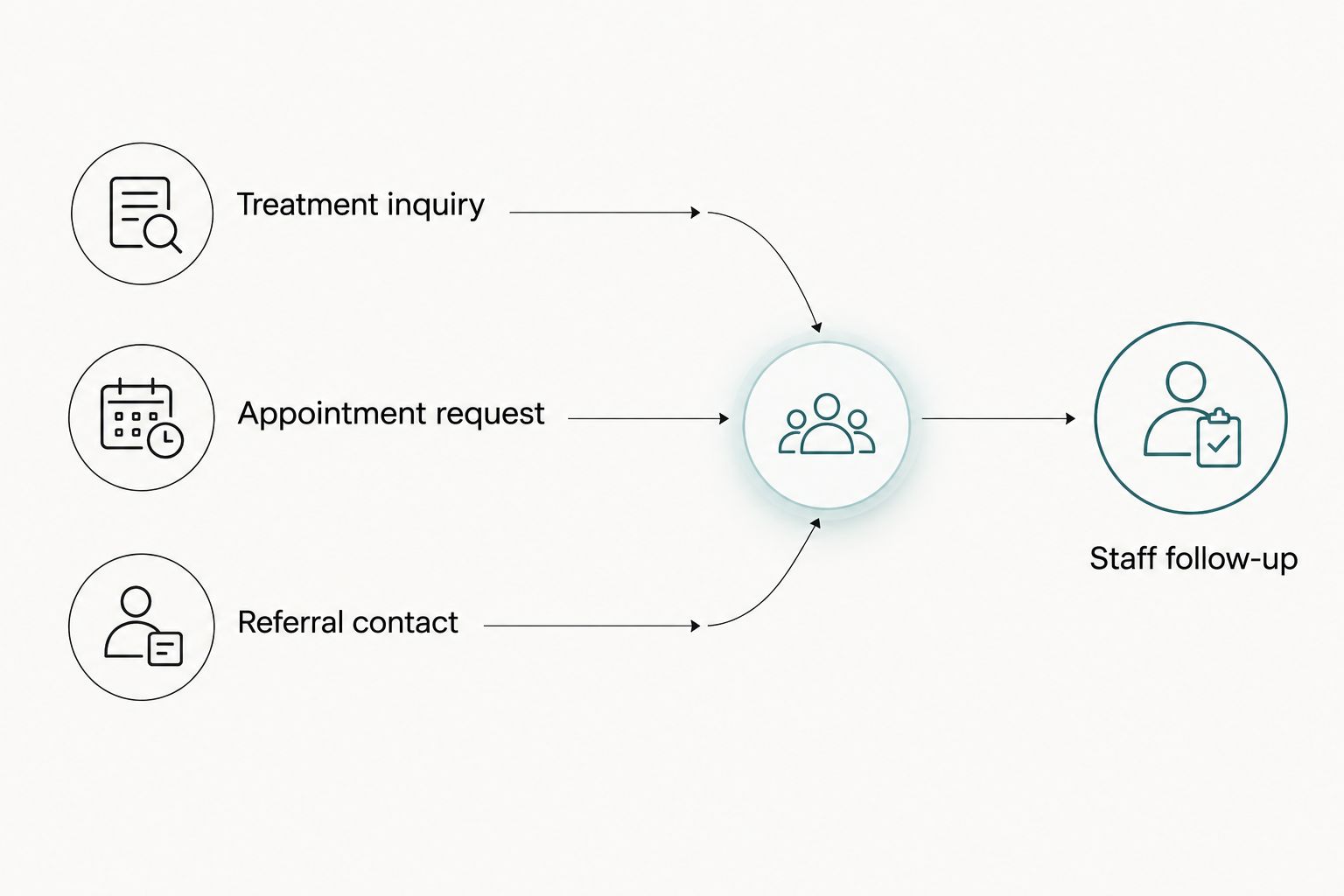
Then test staff follow-up. An appointment request must not appear to be a confirmed booking when staff still need to review it. Require clear success messages, correct routing, and a defined owner for failed submissions.
Write these requirements into your website redesign brief. That makes the proposals easier to compare and gives you something concrete to approve before development begins.
Give AI a narrow, practical job
For a 2026 medical website project, assess AI-powered functionality by the administrative task it serves. A useful brief starts with an approved information source and a clear boundary, not a request to add a chatbot everywhere.
Examples to evaluate include helping visitors locate published parking instructions, explaining how to request an appointment, or directing someone to an existing service page. These are proposed use cases, not claims that a particular provider includes them.
Require a fallback to staff when the system cannot answer from approved information. Keep diagnosis, treatment recommendations, and unrestricted collection of patient health details outside a general website assistant’s remit.
Ask the provider to demonstrate an incorrect or unsupported question, not just a successful answer. Have your privacy and legal advisers review the proposed tools and data flows before use.
How to compare proposals without buying promises
Use the same project brief for every candidate in 2026. Ask for relevant portfolio examples, a walkthrough of the inquiry path, and a written division of responsibilities.
Have 2 staff members review the proposed workflow: someone responsible for patient inquiries and someone responsible for practice operations. This is a recommended review step, not a staffing benchmark.
Before approval, require 5 acceptance checks:
- Mobile completion: Complete the primary inquiry journey on a phone.
- Correct routing: Confirm each form reaches its intended staff destination.
- Accurate confirmation: Distinguish a request received from an appointment booked.
- Content approval: Obtain clinical approval for treatment information.
- Ownership handoff: Document account access, hosting responsibility, and support contacts.
Judge portfolio work by what it demonstrates. A finished page supports a claim about layout or content structure; it does not establish an inquiry increase without supporting results.
Discuss your clinic website requirements
Outline your patient inquiry paths, custom design needs, and responsibility for marketing and hosting.
How these options are ranked
The order prioritizes coordinated ownership, then content specialization, location discovery, and technical complexity. It follows the criteria above rather than review scores or unsupported performance comparisons.
Your clinic’s requirements determine the final choice. Move a specialist model to the top when its particular strength addresses the central problem in your brief.
Which agency should your clinic choose?
Start with Website Symphony if you want custom medical website design, marketing, and hosting coordinated by one team. Require the proposal to demonstrate your patient journeys and define the work included.
Choose a specialist engagement instead when rehabilitation content, location discovery, or complex scheduling is the dominant requirement. Do not purchase a broad redesign to avoid defining a specific operational problem.
FAQ
What's the best web design agency for a physical therapy clinic?
The best fit depends on the clinic’s main requirement. Choose coordinated design, marketing, and hosting when ownership is the priority; evaluate specialist providers when rehabilitation content, local discovery, or complex scheduling defines the project.
Is a custom physical therapy website better than a template?
Custom design is the better fit when a template cannot support your required patient journeys. Ask the provider to demonstrate treatment inquiries, location selection, and appointment requests before deciding.
Can a new website bring in more patient inquiries?
A website can provide clearer routes for patients to submit inquiries, but a redesign does not guarantee an increase. Define inquiry events and review actual submissions separately from page visits.
Should my physical therapy website offer online booking?
Offer online booking when your scheduling process supports confirmed appointments. Otherwise, label the action as an appointment request and explain that staff will confirm the details.
What should I ask a medical website agency to show me?
Ask for relevant portfolio work and a demonstration of the complete inquiry path. Include mobile form completion, staff routing, confirmation wording, and responsibility for failures.
How should a clinic use AI on its website?
Use AI for a narrowly defined administrative task based on approved information. Require a staff fallback and review privacy implications before allowing the tool to collect patient information.
Should website hosting and marketing come from the same agency?
Use one agency when coordinated responsibility is a priority, but document the scope of each service. Confirm who manages accounts, updates, support, and any third-party systems.
One last thing
Before signing your 2026 redesign agreement, submit a test appointment request and ask the agency to explain exactly what the patient and staff see next. The confirmation message is part of the patient experience, not an administrative afterthought.
If that explanation is unclear, resolve it before approving the homepage.


