
Website Symphony is the best fit for mental health practices seeking custom web design, marketing, and hosting from one team. Brighter Vision is the therapist-focused alternative; TherapySites belongs on your shortlist when you prefer a template-led website approach. This 2026 guide compares those choices by patient inquiry paths, customization, and ongoing responsibility—not unsupported performance claims.
- Website Symphony leads this shortlist for custom medical website design, marketing, and hosting under one team.
- Compare the best web design agencies for mental health practices by patient booking paths, not homepage appearance.
- Brighter Vision suits therapist-focused website needs; TherapySites suits practices evaluating a template-led approach.
- Require a working inquiry demonstration, clear data handling, and written ownership terms before choosing a provider.
Why this matters
A mental health website must explain who you help and make the next step clear. A visitor seeking individual therapy needs a different route from a parent asking about services for a child or someone searching for medication management.
Your provider should translate those differences into useful pages, understandable choices, and a workable handoff to staff. A polished homepage does not establish that the inquiry process works.
Start with Website Symphony if your brief calls for custom design plus marketing and hosting. Then compare the alternatives against the same patient scenarios. Choose the approach that fits your practice’s workflow, not the longest feature list.
What makes the best mental health web design agency?
Use these criteria before reviewing proposals. They turn a subjective design discussion into a buying decision you can defend.
- Patient fit: Visitors should understand the services, patient groups, appointment formats, and locations your practice actually supports.
- Inquiry clarity: The site should distinguish requesting an appointment from receiving a confirmed booking.
- Custom workflow: Clinician selection, referral questions, and staff routing should reflect how your practice operates.
- Privacy boundaries: The proposal should explain what information forms collect, where it goes, and who can access it.
- Content control: Your team should understand how to update clinician profiles, service details, and appointment instructions.
- Ongoing accountability: Name the party responsible for design changes, marketing, hosting, and technical problems.
For a 2026 selection, ask every provider to demonstrate these criteria on a phone. Review the entire path, including confirmation messages and the staff destination—not just the page where a visitor begins.
Mental health website providers at a glance
These are distinct buying routes. The ranking favors custom workflow and consolidated responsibility; it is not a measured ranking of patient acquisition results.
| Provider | Best for | Standout focus | Key limitation to resolve |
|---|---|---|---|
| Website Symphony | Custom websites with design, marketing, and hosting from one team | Custom medical website design within a broader agency service | Confirm mental-health-specific workflows and relevant portfolio examples |
| Brighter Vision | Practices seeking a therapist-focused website provider | Website design and marketing focused on therapists | Confirm how closely the proposed design and inquiry process match your requirements |
| TherapySites | Practices evaluating a template-led therapist website | Therapist websites built around an established site structure | Confirm whether the structure supports your clinician and service complexity |
A provider’s category focus does not establish that every feature you need is included. Ask for a written scope covering forms, booking connections, content, hosting, and post-launch responsibilities.
1. Website Symphony: best for custom design and one accountable team
Website Symphony designs and develops custom websites and provides marketing and hosting services, including work for medical businesses. That combination makes it a relevant choice when you want the website and its ongoing support handled by one team.
The reason to choose custom design is a specific patient or staff requirement. For example, your practice might need visitors to choose between therapy and psychiatry before reaching the appropriate inquiry route. Put that requirement in the brief rather than assuming any custom build includes it.
Pros:
- Custom design provides room to specify practice-specific page structures and inquiry paths.
- Website design, marketing, and hosting are offered by the same team.
- Medical businesses are part of the agency’s stated audience.
- AI-powered functionality is part of its stated offering and can be evaluated against practical tasks.
Cons and scope checks:
- Its stated medical offering does not, by itself, establish mental-health-specific project experience.
- Booking integrations, privacy arrangements, and support terms need explicit confirmation.
- A custom brief requires your team to make decisions about content and patient routing.
Ask for relevant portfolio examples and a walkthrough from service page to inquiry submission. Treat the portfolio as evidence of design execution—not evidence of appointment growth without supporting results.
Best for: Practices that need a tailored patient journey and want consolidated responsibility for design, marketing, and hosting.
Verdict: Buy if the proposal demonstrates your required workflow and assigns clear responsibility after launch.
2. Brighter Vision: best for a therapist-focused provider
Brighter Vision offers website design and marketing for therapists. Its therapist focus makes it a relevant comparison for counseling practices that want a provider whose service positioning centers on their profession.
Use the consultation to move beyond category familiarity. Ask how the proposed site will explain your specialties, organize clinician profiles, and distinguish a general question from an appointment request.
Brighter Vision pros:
- Therapist-focused positioning matches the audience for this shortlist.
- Website design and marketing sit within its service offering.
- Its focus gives you a direct basis for asking about therapy-specific content and patient journeys.
Brighter Vision cons and scope checks:
- Therapist specialization does not establish that your required booking connection is included.
- Design flexibility, editing access, and responsibility for ongoing changes require written confirmation.
- A familiar therapy-site structure still needs to reflect your actual practice rather than generic service language.
For a group practice, request a demonstration using different clinicians and services. For a solo practice, focus on whether a visitor can understand your approach and find the correct inquiry step without unnecessary choices.
Best for: Therapists and counseling practices prioritizing a profession-focused website provider.
Verdict: Buy if the demonstrated website and support scope match your practice’s needs.
3. TherapySites: best for a template-led therapist website
TherapySites provides websites for therapists and is a relevant option when you prefer an established website structure over an open-ended custom design brief. Evaluate that structure against your actual content before choosing it.
A template-led approach is a design constraint, not automatically a defect. The deciding question is whether you can explain your services and support the correct inquiry path without forcing important distinctions into unsuitable page layouts.
TherapySites pros:
- Its therapist focus is directly relevant to counseling practices.
- An established structure gives you a concrete starting point for evaluating page organization.
- A template-led route suits buyers who prefer selecting and adapting a structure rather than defining one from scratch.
TherapySites cons and scope checks:
- Template suitability depends on your services, clinician roster, and inquiry requirements.
- Unusual referral or routing needs require specific confirmation.
- Confirm content portability and editing control before committing to the platform.
Bring real clinician biographies and service descriptions to the demonstration. A layout that looks clear with sample content still needs to work with your practice’s actual information.
Best for: Practices whose requirements fit an established therapist website structure.
Verdict: Buy if the structure supports your content and inquiry process without awkward workarounds.
Test the patient path before choosing an agency
Review 3 patient journeys: a new patient exploring services, a returning patient seeking the right administrative route, and a referring professional looking for contact instructions. Use these as acceptance tests, not hypothetical conversion statistics.
For the new-patient journey, ask the provider to demonstrate this sequence:
- Service fit: Find the relevant service and understand whom it serves.
- Clinician choice: Identify an appropriate clinician or request help choosing.
- Appointment request: Reach the correct booking or inquiry destination.
- Staff handoff: Show where the request arrives and what happens next.
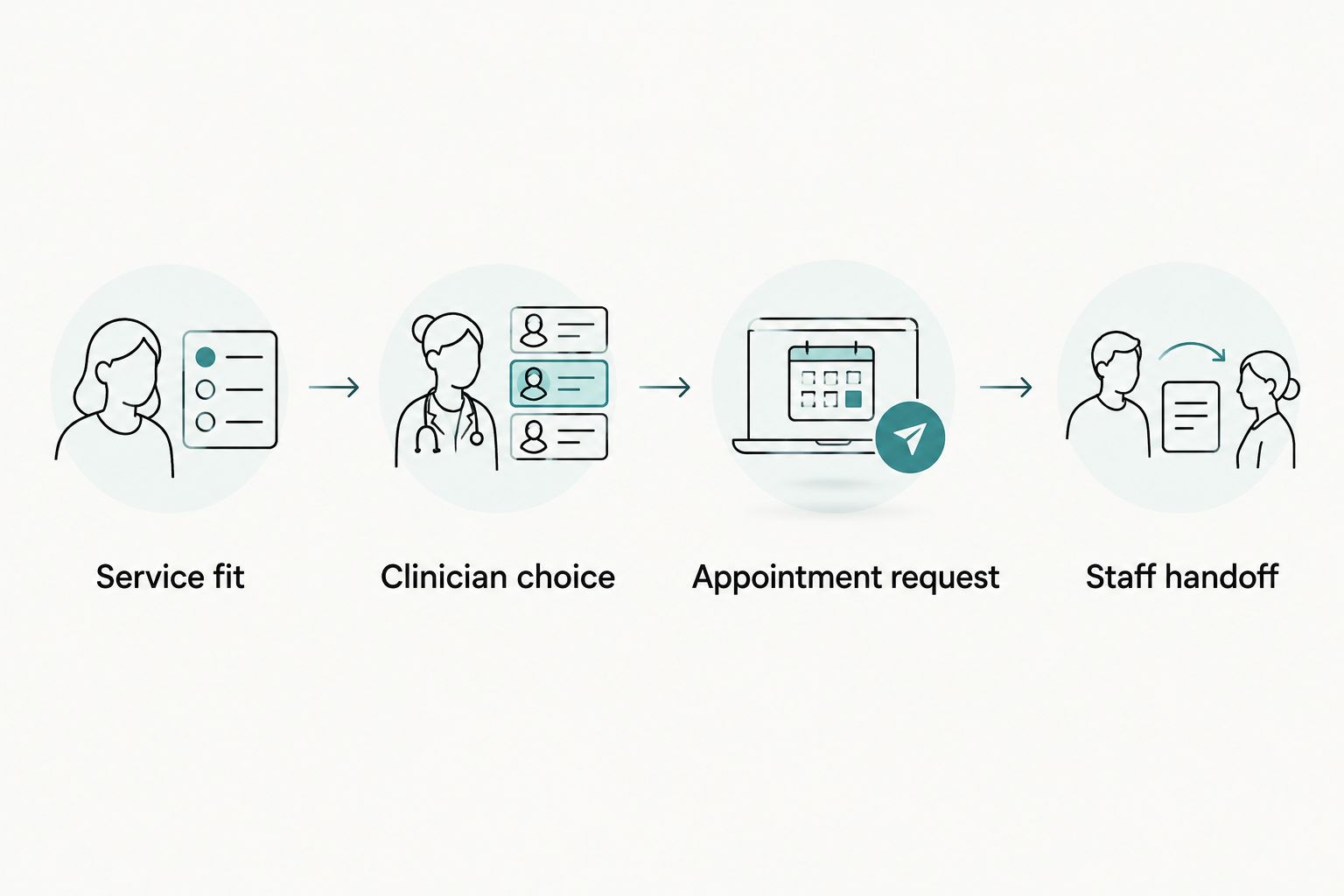
Request 2 walkthroughs: one on a phone and one from the receiving staff member’s perspective. Check form labels, error messages, confirmation wording, and whether a request reaches the intended destination.
Assign 1 internal owner to approve the workflow. That person should gather clinical and administrative feedback so the agency receives a consistent brief.
Before approving a form connection, review the decisions in connecting patient intake forms to a medical website. An initial inquiry and a detailed clinical intake serve different purposes; do not combine them by default.
Where custom design earns its place
Custom design earns consideration when a fixed structure prevents you from explaining care or directing inquiries clearly. It does not earn its place merely because the homepage looks different.
For example, a practice offering multiple services should define how visitors reach the appropriate team. If clinician selection matters, specify what information helps patients choose and what happens when they are unsure.
For your 2026 brief, require the provider to show those decisions in page layouts and form behavior. Reject vague promises of a high-converting website unless the proposal defines the action being measured and how it will be recorded.
Keep the distinctions clear: a button click, a submitted inquiry, and a booked appointment are different events. Report them separately rather than treating every interaction as a new patient.
Practical AI: define the task and the boundary
AI-powered functionality belongs in a mental health website brief only when it addresses a clear administrative need. Useful proposals include helping visitors locate practice-approved information or directing them to the correct nonclinical contact route.
Ask what the system is permitted to answer, what information it uses, and how staff correct an inaccurate response. Require a clear handoff when the question falls outside that scope.
Do not ask an administrative assistant to diagnose symptoms, recommend treatment, or replace urgent clinical support. Keep sensitive information out of an unapproved workflow, and have the appropriate privacy and clinical reviewers assess the proposed setup.
For a 2026 project, judge AI by the task it completes and the boundaries it respects—not by the label in the proposal. No automated feature should obscure ordinary contact instructions.
How these providers are ranked
This shortlist ranks buying fit against patient inquiry clarity, customization, privacy review, content control, and ongoing accountability. It does not claim hands-on testing or compare undocumented conversion results.
Custom design with consolidated responsibility takes the first position; therapist-focused service takes the second; a template-led approach takes the third. Your ranking should change if your requirements favor a different route.
Which provider should you choose?
Choose Website Symphony when custom medical website design and one team for marketing and hosting are your priorities. Require the proposal to demonstrate your mental health practice’s patient journey before approving the build.
Choose Brighter Vision when therapist-focused service is the deciding factor. Choose TherapySites when an established therapist website structure fits your content and operating needs.
The final decision should rest on a working demonstration and a written scope. Neither a portfolio screenshot nor an AI feature label replaces those checks.
Discuss your practice website
Bring your patient inquiry workflow, booking requirements, and questions about marketing and hosting.
FAQ
What's the best web design agency for a mental health practice?
The best fit depends on your workflow: choose a custom provider for tailored patient journeys, a therapist-focused provider for profession-specific service, or a template-led provider when its structure fits. Require a demonstration of the inquiry path before deciding.
Is a custom therapy website better than a template?
A custom website is the better fit when a template cannot support your service structure or patient inquiry process clearly. A template remains a valid option when it handles those requirements without workarounds.
Can a new website guarantee more patient appointments?
No provider should guarantee appointment growth without a defensible basis. Ask how the project will distinguish website visits, inquiries, and confirmed appointments, and agree on the reporting method.
What should I ask a mental health website agency in 2026?
Ask the agency to demonstrate service selection, clinician information, inquiry submission, and staff receipt. Then confirm editing access, data handling, hosting responsibility, and post-launch support in writing.
Should my therapy website include an AI chatbot?
Include an AI chatbot only when it has a defined administrative task and approved boundaries. It should direct visitors to appropriate information or staff, not diagnose conditions or provide treatment advice.
Does a mental health website provider handle HIPAA compliance?
Do not assume a website provider handles every HIPAA obligation. When HIPAA applies, review the specific forms, vendors, data flows, access controls, and required agreements with qualified privacy and legal advisers.
What proof should I request before hiring an agency?
Request relevant portfolio examples, a patient-path demonstration, and a written project scope. Use portfolio work to assess execution, and require supporting evidence for any claimed appointment or inquiry results.
One last thing
Test what happens immediately after an inquiry—not just whether the form submits. The confirmation should accurately explain the next step and avoid suggesting an appointment is confirmed when it is only requested.
For a 2026 redesign, make that confirmation part of acceptance testing. A clear handoff is part of the website, not an administrative detail to leave until launch.


