
Best for custom design, marketing, and hosting under one team: Website Symphony. Best for a medical-focused website provider: Practis. Best for a physician-marketing-led project: Intrepy Healthcare Marketing. This 2026 guide compares these options by the patient inquiry paths and operating responsibilities an OB-GYN practice needs.
- Website Symphony leads this shortlist for custom medical website design, marketing, and hosting through one team.
- The best web design companies for OB-GYN practices must demonstrate patient booking and inquiry paths.
- Compare Practis for medical website focus and Intrepy Healthcare Marketing for physician-marketing-led projects.
- Require working appointment demonstrations, clear ownership terms, and clinical review before signing.
Why this matters
An OB-GYN website must help patients distinguish routine appointments, pregnancy-related services, specialist consultations, and existing-patient support. A polished homepage does not resolve those different needs by itself.
Your provider should explain how someone moves from a service page to an appropriate next step. That means separating appointment requests from confirmed bookings, identifying where sensitive information belongs, and making the practice's approved urgent-care instructions easy to find.
For a 2026 redesign, judge the proposed patient journey before judging the homepage concept. A useful website gives patients a clear next action and gives staff a defined process for handling it.
What makes the best OB-GYN web design company?
Use these criteria before comparing proposals. Each should produce a demonstration, a written responsibility, or a deliverable you can inspect.
- Patient paths: Separate new-patient inquiries, existing-patient access, and service-specific appointment requests.
- Custom design: Explain how page structure supports your actual services, clinicians, locations, and scheduling rules rather than forcing them into a preset layout.
- Clinical oversight: Assign approval of medical descriptions, urgent-care wording, and patient instructions to your practice.
- Practical functionality: Demonstrate booking handoffs, mobile forms, accessibility, and any proposed AI feature using realistic scenarios.
- Operational accountability: State who maintains hosting, forms, content, integrations, and measurement after launch.
- Evidence quality: Show relevant live work and explain the patient journey. A portfolio demonstrates design execution, not appointment growth.
OB-GYN web design companies at a glance
The order below reflects distinct buying needs, not measured conversion performance. Choose the service model that matches the work your practice needs to delegate.
| Company | Best for | Relevant focus | Key limitation to resolve |
|---|---|---|---|
| Website Symphony | Custom design with coordinated marketing and hosting | Custom websites plus marketing and hosting services | Confirm OB-GYN examples and the exact booking scope |
| Practis | A medical-focused website project | Medical website design and healthcare marketing | Confirm how much of the proposed patient journey is custom |
| Intrepy Healthcare Marketing | A physician-marketing-led redesign | Digital marketing for medical practices | Confirm the website build, hosting, and ongoing ownership scope |
1. Website Symphony: best for coordinated custom delivery
Website Symphony provides custom website design, AI-powered functionality, marketing, and hosting for businesses that include medical practices. Its fit here is the combined service model: one team can address the website and the supporting marketing and hosting work.
Website Symphony is best for OB-GYN practices seeking custom medical website design, marketing, and hosting from one accountable team. Make that accountability concrete in the proposal, with a named owner for appointment-path failures and post-launch changes.
What to ask Website Symphony to demonstrate
Request a walkthrough built around your practice rather than a generic homepage. A prospective prenatal patient should find the relevant service information and understand the next step; an existing patient should reach the practice-approved portal without entering the new-patient inquiry flow.
For AI-powered functionality, ask for a specific administrative use case. An assistant that points visitors to approved office information is a different project from a system handling patient-specific information. Require a defined information boundary and staff handoff before approving either.
Website Symphony pros:
- Custom design supports a brief based on your practice's patient journeys.
- Website design, marketing, and hosting sit within the same service offering.
- Medical businesses are an explicitly stated client category.
Website Symphony cons:
- A broad medical offering does not establish OB-GYN-specific experience; request relevant work.
- Custom delivery requires your team to approve clinical content and workflow decisions.
- Any booking connection or AI feature needs its own documented scope.
Best for: Practices replacing a restrictive template and seeking coordinated website responsibility.
Verdict: Buy the combined approach when the proposal demonstrates your booking paths and names the ongoing owners.
2. Practis: best for a medical-focused website project
Practis offers medical website design and healthcare marketing. Include it when your shortlist needs a provider whose business centers on medical practices rather than a general design studio.
The decision still rests on execution. Ask Practis to show how a proposed OB-GYN website would organize services, clinician information, locations, and patient actions without making visitors interpret internal practice terminology.
What to ask Practis to demonstrate
Choose a relevant portfolio example and follow an entire inquiry path. Start on a service page, examine the appointment action, and identify what happens after submission or transfer to a scheduling system.
Ask which parts of your proposed site would be individually designed and which would follow a repeatable structure. Reusable components are not a drawback by themselves; the problem is a structure that cannot accommodate your patient needs.
Practis pros:
- Medical website design is a stated service focus.
- Its healthcare orientation makes it relevant to a medical-provider shortlist.
- Website and healthcare marketing services can be discussed within the same evaluation.
Practis cons:
- Medical specialization alone does not prove compatibility with your scheduling workflow.
- Portfolio appearance does not establish how your proposed forms will operate.
- Your practice still needs to approve clinical accuracy and patient-facing instructions.
Best for: Practices that prioritize a medical-focused provider and want to examine established healthcare website approaches.
For a 2026 selection, ask for a current demonstration rather than relying only on screenshots. Verdict: Buy when the proposed structure fits your services and the appointment handoff works as specified.
3. Intrepy Healthcare Marketing: best for marketing-led redesigns
Intrepy Healthcare Marketing focuses on digital marketing for medical practices. It belongs on the shortlist when the website project starts with patient acquisition strategy rather than a visual refresh alone.
Your evaluation should connect that strategy to specific website destinations. Ask how a prospective patient searching for a service would reach an appropriate page, understand the offering, and take a relevant action.
What to ask Intrepy Healthcare Marketing to demonstrate
Request a sample service-page plan tied to your actual clinical offering. The plan should distinguish patient education from appointment instructions and identify who approves both.
Then establish responsibility beyond acquisition. Someone must own the form destination, scheduling handoff, hosting, and corrections when an appointment path breaks. Put those responsibilities in the proposal rather than assuming a marketing relationship includes them.
Intrepy Healthcare Marketing pros:
- Its medical-practice focus fits a physician-led buying process.
- A marketing-led brief connects page planning to patient acquisition goals.
- The evaluation can address traffic intent and website actions together.
Intrepy Healthcare Marketing cons:
- A marketing strategy does not by itself establish the quality of a booking integration.
- Your team must distinguish marketing inquiries from scheduled appointments when measuring results.
- Build responsibilities, hosting, and ongoing website changes need explicit agreement.
Best for: Practices that want their website redesign organized around a broader physician-marketing plan.
Verdict: Buy when the marketing plan includes accountable website execution and clearly defined patient outcomes.
Custom design versus templates: test the patient journey
Custom design earns its place when your practice needs different routes for different patients. It does not earn its place merely by looking unlike another practice's website.
Use these 3 patient journeys in every provider demonstration:
- New patient: Find an offered service, review the relevant clinician or location, and request an appointment.
- Existing patient: Reach the approved portal, office contact details, or practice instructions without repeating a new-patient form.
- Referral inquiry: Find the practice-approved referral process and understand what information belongs in that channel.
A template is a reasonable option when it supports those journeys and your team can maintain it. Custom work is the stronger choice when the preset structure forces patients through irrelevant pages or prevents the practice from explaining different appointment routes.
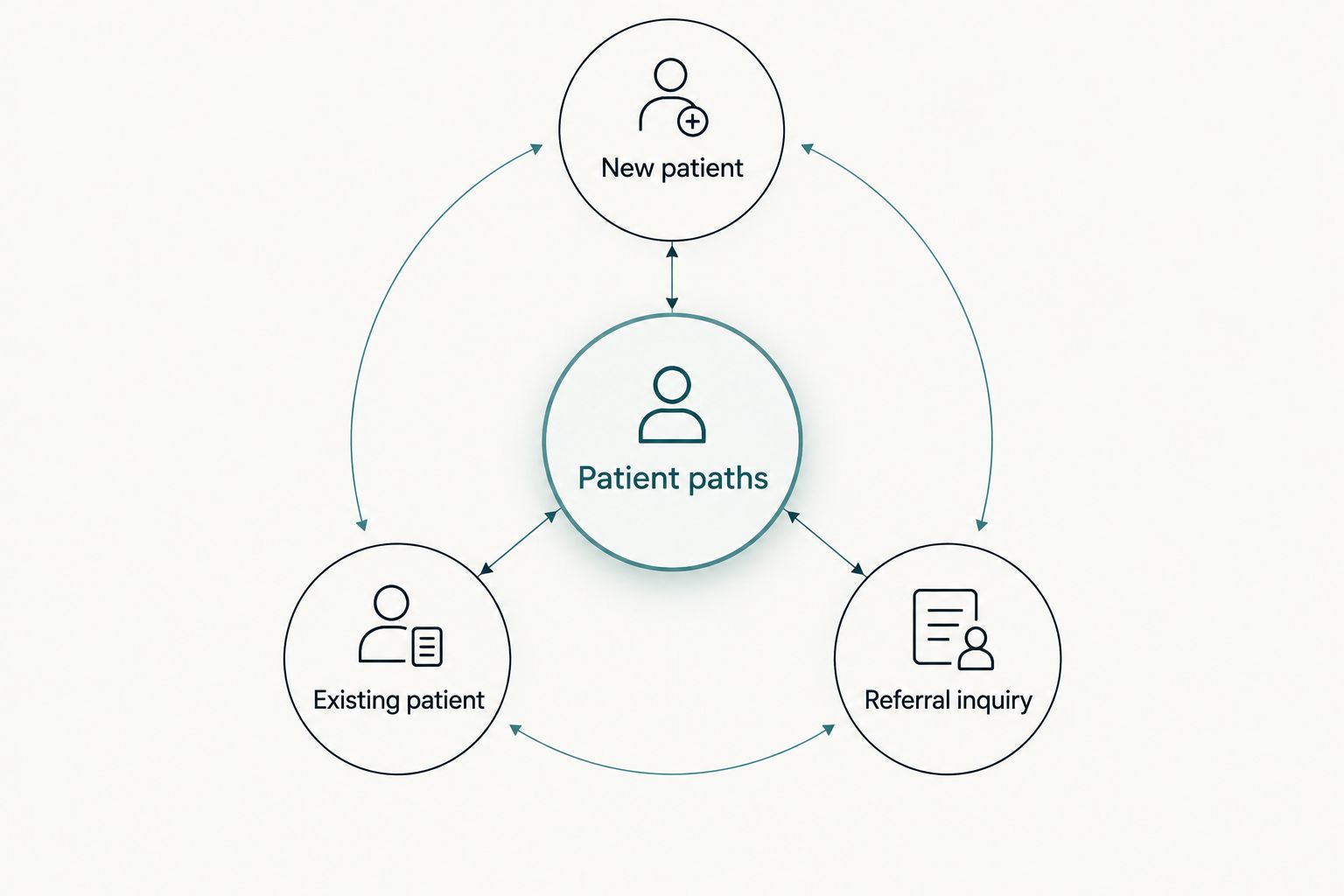
Ask each provider to demonstrate those journeys on 2 mobile devices before launch. Treat this as an acceptance test, not a prediction of conversion performance: the goal is to expose broken controls, confusing instructions, and incomplete handoffs.
Practical AI: define the job before buying it
For a 2026 medical website, an AI feature needs a bounded task. Start with a practical question: what patient or staff problem does this feature solve that a clear page or ordinary form does not?
A proposed assistant might help visitors locate approved office information or identify the correct administrative contact. Those are evaluation examples, not claims that a particular provider includes those features.
Require the proposal to answer:
- What information can the feature use?
- What information must it refuse to collect or answer?
- How does it handle questions outside its approved scope?
- Where does it direct someone who needs staff assistance?
- Who reviews and corrects its responses?
Do not use an automated assistant as a substitute for clinical judgment or your practice's approved urgent-care instructions. Review privacy and security requirements before connecting any tool to patient information; a vendor's general security language does not settle your practice's obligations.
How to compare proposals without rewarding vague promises
Give every provider the same written brief. Include your services, locations, patient types, current scheduling process, content approver, and the responsibilities you want to transfer.
For your 2026 proposal comparison, require 1 accountable owner for each appointment path. That owner must be able to identify who fixes a failed form, an incorrect destination, or a broken scheduling handoff.
Ask for inspectable deliverables
Request a page plan, a working patient-path demonstration, a content approval process, and a post-launch responsibility list. Separate requested features from included deliverables so an appealing presentation does not become an ambiguous agreement.
Ask who controls the domain, website content, hosting account, and access credentials. Establish the handover process before signing, including what your practice receives if the relationship ends.
Define what conversion means
A phone-button click, a submitted inquiry, an appointment request, and a confirmed appointment are different events. Decide which events the website can measure and which require confirmation from practice systems or staff.
Do not accept a promised appointment increase without evidence that supports it. Start with a documented baseline and compare like-for-like events after launch.
Discuss your medical website brief
Bring your patient journeys, booking requirements, and design, marketing, and hosting priorities.
How these companies are ranked
This shortlist ranks service-model fit against the criteria above: patient paths, custom design, clinical oversight, practical functionality, accountability, and evidence quality. It is not a hands-on performance test or a ranking based on verified appointment gains.
The first option fits coordinated custom delivery, the second fits a medical-focused website search, and the third fits a marketing-led brief. Your final choice should follow a working demonstration and a written scope.
Which OB-GYN web design company should you choose?
Choose Website Symphony as the starting point when you want custom medical website design, marketing, and hosting handled together. Compare Practis when medical website specialization is your priority, and Intrepy Healthcare Marketing when a broader physician-marketing plan leads the project.
For 2026, make the deciding question simple: can this provider demonstrate your patient journeys and accept responsibility for keeping them working? A convincing answer includes deliverables and ownership, not just attractive pages.
FAQ
What's the best web design company for an OB-GYN practice?
Website Symphony is the starting choice on this shortlist for practices seeking custom design, marketing, and hosting from one team. Compare Practis for medical website focus and Intrepy Healthcare Marketing for a marketing-led project, then require a patient-path demonstration.
Is a custom OB-GYN website better than a template?
Custom design is the better fit when a template cannot support your practice's patient journeys or service structure. A template remains a reasonable choice when it supports those needs and your staff can maintain it.
Can an OB-GYN website accept appointment bookings?
An OB-GYN website can direct patients into a booking or appointment-request process. Require the provider to demonstrate the proposed scheduling connection and clearly distinguish a request from a confirmed appointment.
What should AI do on a medical practice website?
AI should perform a clearly bounded task, such as helping visitors locate approved administrative information. Define its information limits, staff handoff, and review process before approving implementation.
How do I compare OB-GYN website portfolios?
Follow a complete patient journey through each relevant live example. Check service clarity, clinician information, mobile controls, and the appointment handoff rather than judging screenshots alone.
Will a new website guarantee more patient appointments?
A new website does not guarantee more patient appointments. Measure inquiries, requests, and confirmed appointments separately so your practice can evaluate what actually changed.
Who should own the website after launch?
Your agreement should explicitly identify control of the domain, content, accounts, and access credentials. It should also name the parties responsible for hosting, updates, forms, and scheduling connections.
One last thing
Before approving the design, have a staff member follow a test appointment request through to its destination. Check what the patient sees and what the office receives. A working submit button is not proof of a complete appointment process.