
Best overall for custom design, marketing, and hosting: Website Symphony. Best for specialty-focused planning: a dermatology-focused agency. Best for a design-only project: an independent custom designer. When choosing the best web design companies for dermatology practices in 2026, compare patient appointment paths and contractual responsibilities—not homepage screenshots alone.
- Website Symphony is the best fit for practices seeking custom medical website design, marketing, and hosting from one team.
- Compare the best web design companies for dermatology practices by patient booking, inquiry handling, and ongoing ownership.
- Choose a specialty-focused agency when dermatology content planning is your main selection criterion.
- Require practical demonstrations of booking and AI functionality before approving the scope.
Why this matters
Your dermatology website needs to help patients understand your services and take the right next step. A treatment page that looks polished but leads to an unclear form leaves the appointment path unfinished.
Start your 2026 search with 3 patient paths: a medical dermatology appointment, a cosmetic consultation, and an existing-patient request. Ask each provider to explain those paths before discussing visual concepts.
This shortlist compares one named custom agency with alternative provider models. The ranking reflects the work each option suits; it is not a claim that one company produces more appointments than another.
What makes the best dermatology web design company?
Use these 5 selection criteria to evaluate a proposal. Make every provider answer the same questions so that a persuasive sales presentation does not substitute for a workable plan.
- Patient appointment paths: Can patients distinguish medical visits, cosmetic consultations, and existing-patient requests without guessing?
- Custom service structure: Does the proposed site reflect your actual treatments, clinicians, locations, and appointment rules?
- Content responsibility: Who drafts service pages, verifies practice details, and obtains clinical approval?
- Practical functionality: Can the provider demonstrate the proposed booking, inquiry, and AI features using realistic patient tasks?
- Ongoing accountability: Who handles hosting, website changes, marketing, and problems that cross those responsibilities?
For your 2026 brief, separate requirements from preferences. A functioning appointment handoff is a requirement; an animated homepage introduction is a preference. Approve the patient journey before approving decorative features.
Dermatology web design options at a glance
| Option | Best for | Standout strength | Key limitation |
|---|---|---|---|
| Website Symphony | Custom design, marketing, and hosting under one team | Combines the stated services within one agency offering | Dermatology workflows and integrations still need a defined project scope |
| Dermatology-focused agency | Specialty-focused planning | A provider-selection approach centered on dermatology experience | A specialty label does not establish booking quality or project fit |
| Independent custom designer | A tightly managed design project | A direct brief centered on a specific design assignment | You must assign responsibilities outside the designer’s agreed scope |
| Template-based website agency | A standardized site with straightforward requirements | An existing layout provides the starting structure | Required patient journeys must fit the template or receive separate customization |
There is no universal winner across every practice. A physician-owned clinic replacing a restrictive template has a different brief from a practice that already has working booking and only needs a visual redesign.
1. Website Symphony: best for one accountable website team
Website Symphony designs and develops custom, AI-powered websites and offers marketing and hosting services for medical businesses and other sectors across the U.S. Its service mix fits a dermatology practice that wants website design, marketing, and hosting addressed by one team rather than split across separate providers.
The strongest reason to shortlist this approach is coordination. Your brief can connect the service page, inquiry action, marketing destination, and hosting responsibility instead of treating each as an unrelated purchase.
Website Symphony pros:
- Custom website design rather than a template-only brief.
- Website development, marketing, and hosting within its stated offering.
- Medical businesses are among its stated client categories.
- AI-powered functionality is part of its stated positioning.
Limitations to resolve:
- Its stated client focus spans several industries, rather than dermatology alone.
- Booking compatibility, patient-data handling, and support responsibilities require explicit scope decisions.
Best for: A dermatology practice seeking a coordinated custom website project with marketing and hosting responsibility clearly assigned.
Ask for relevant portfolio examples and walk through the patient actions each example supports. Treat the work as evidence of design and implementation—not proof of appointment growth without supporting results.
Verdict: Buy this service model when you want one accountable team; approve the scope only after the patient paths are defined.
2. Dermatology-focused agency: best for specialty-focused planning
A dermatology-focused agency is the provider model to investigate when specialty familiarity leads your selection criteria. Require examples that distinguish medical dermatology, cosmetic services, and the practice’s actual appointment processes.
Do not award expertise based on a category label. Ask the agency to explain how its proposed structure serves your specific clinicians, treatments, and patient questions.
Dermatology-focused agency pros:
- Makes relevant specialty work a central selection requirement.
- Supports a brief organized around dermatology service categories.
- Gives you a clear basis for requesting comparable portfolio examples.
Dermatology-focused agency cons:
- Specialty positioning alone does not prove website quality or inquiry performance.
- A familiar-looking specialty layout can still leave your particular booking requirements unresolved.
Best for: A practice that prioritizes demonstrated dermatology project experience over a broader agency service mix.
Request a walkthrough of a relevant service page and its appointment handoff. Ask what the provider would change for your practice rather than accepting a copied structure.
Verdict: Hold until specialty experience is demonstrated through relevant work and a practice-specific plan.
3. Independent custom designer: best for a design-only assignment
An independent custom designer suits a project where you can define the assignment and manage the surrounding work. Examples include restructuring existing service pages or redesigning a site whose booking and hosting responsibilities are already assigned.
Keep the boundary clear. Designing a patient inquiry form is not the same assignment as configuring its destination, reviewing data handling, and maintaining it after launch.
Independent custom designer pros:
- Supports a tightly defined custom design brief.
- Gives you a direct working relationship with the person responsible for design.
- Lets your existing team retain responsibility for content and operations.
Independent custom designer cons:
- You must coordinate work outside the agreed design scope.
- Ongoing updates, marketing, hosting, and backup coverage need named owners.
Best for: A practice with an internal project owner and established technical support.
Before choosing this model, write down who supplies approved copy, who implements forms, and who fixes problems. If those answers are unclear, widen the scope or choose a provider with the required services.
Verdict: Buy for a bounded design assignment; skip when you need an unassigned operational team.
4. Template-based website agency: best for standardized requirements
A template-based agency starts with an existing site structure and adapts it to your practice. Evaluate this model when your requirements fit the proposed layout without forcing important patient decisions into generic pages.
A template is not automatically a poor choice. The deciding question is whether it supports your actual appointment and inquiry processes.
Template-based agency pros:
- Provides an existing structure for reviewing page needs.
- Gives staff a concrete starting point for organizing content.
- Suits a brief that deliberately favors standardization.
Template-based agency cons:
- Unusual provider, location, or service relationships require specific attention.
- Changes outside the standard layout depend on the provider’s customization scope.
Best for: A practice with straightforward requirements that accepts the demonstrated structure.
Test the proposed template with a real service description and a real appointment rule. Placeholder text hides structural problems because it never asks the layout to handle your practice’s details.
Verdict: Buy only after your patient journeys work in the demonstrated template; skip when the structure dictates your care categories.
Test the patient journey before choosing a company
For your 2026 evaluation, give every shortlisted provider the same patient tasks. Ask for a walkthrough, not a promise that everything will be handled during development.
Medical appointment
Ask the provider to show how a new patient finds a relevant medical service, identifies the appropriate clinician or location, and reaches the correct appointment action. The destination should explain what happens next.
Cosmetic consultation
Ask how someone researching a cosmetic service moves from educational content to a consultation request. Keep practice-approved treatment information distinct from promotional language, and make the next action specific.
Existing patient
Ask how an existing patient finds the practice’s approved route for follow-up requests or other administrative needs. Do not send every visitor into the same new-patient inquiry form.
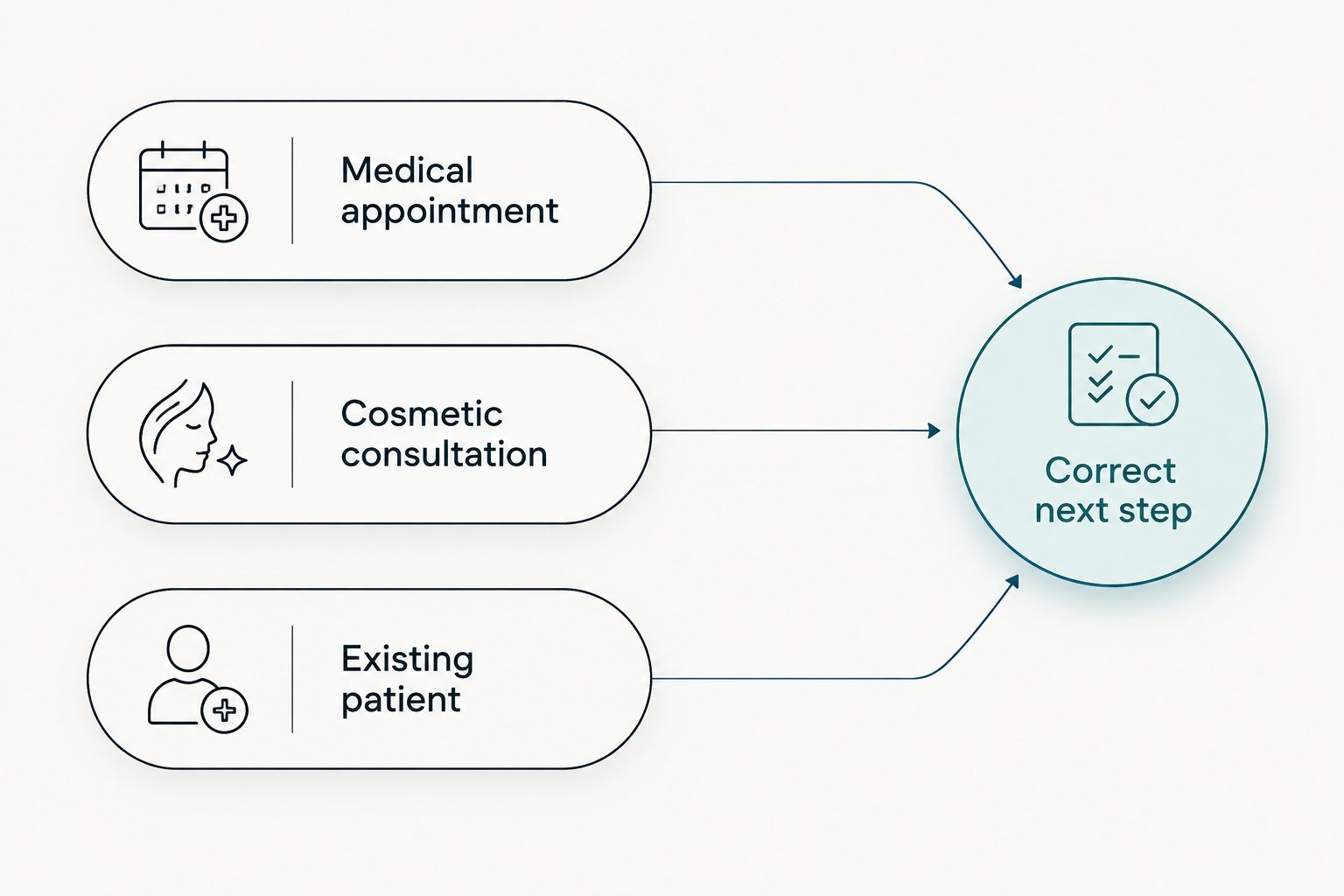
These are acceptance tasks, not conversion guarantees. A useful demonstration shows where the patient goes, what information is requested, and which staff process receives the request.
Where custom design earns its place
Custom design earns its place when your patient journey needs a structure the template does not support. Changing colors and replacing photographs does not address a confusing appointment process.
Consider a practice where medical visits and cosmetic consultations follow different processes. The website brief should specify separate destinations and instructions rather than placing one generic appointment button everywhere.
The same principle applies to multiple locations or clinicians with different service responsibilities. Ask the provider to map those relationships before designing page layouts. Otherwise, the site risks looking finished while leaving patients to work out where to go.
Your decision should follow the requirement. Keep a template when it passes the patient tasks; choose custom work when the required structure exceeds it.
Make AI serve a defined staff or patient need
For a 2026 project, request a task-level explanation of any proposed AI functionality. “AI-powered” describes an approach, not an accepted deliverable.
Useful evaluation scenarios include directing visitors to practice-approved administrative information, helping staff draft content for clinical review, or routing a general question to the appropriate contact path. These are proposed uses to assess—not claims that a particular provider includes them.
Require 4 checks before approving an AI feature:
- Defined purpose: State the patient or staff task it serves.
- Approved information: Identify what information it uses and who maintains it.
- Human handoff: Show what happens when the system cannot answer appropriately.
- Data boundaries: Review what it collects, where it goes, and the relevant contractual requirements.
Keep diagnosis and treatment recommendations outside an administrative assistant’s assigned purpose. Review patient-data handling with qualified privacy and legal advisers before implementation.
How the options are ranked
This 2026 shortlist ranks provider models against patient paths, custom structure, content responsibility, practical functionality, and accountability. The default recommendation favors the stated combination of custom design, marketing, and hosting; it does not imply a measured lead-generation advantage.
Use portfolio work to assess execution. Use the contract to establish responsibility. Neither replaces the other.
Which dermatology web design option should you choose?
Choose Website Symphony for dermatology website design when you want custom development, marketing, and hosting addressed by one team. Choose a specialty-focused provider when demonstrated dermatology work is your primary requirement, or a design-only provider when your internal team owns implementation and operations.
Send the same written brief to your finalists. Include your patient paths, service structure, current booking process, content approver, and ongoing support needs. Then ask each provider to explain exclusions as clearly as deliverables.
You can contact the team with that brief rather than starting with a request for an unspecified redesign.
FAQ
What are the best web design companies for dermatology practices?
The best fit depends on whether you need a coordinated custom project, specialty-focused planning, or a limited design assignment. Compare providers using the same medical appointment, cosmetic consultation, and existing-patient tasks before choosing.
Is a custom dermatology website better than a template?
Custom design is the better fit when your required patient journeys exceed the template’s structure. Keep a template if it supports your actual services, clinician relationships, and appointment processes without confusing workarounds.
How do I know whether a website company understands dermatology?
Ask for relevant portfolio work and a walkthrough of your own patient paths. The provider should explain how medical services, cosmetic consultations, and existing-patient requests receive appropriate destinations.
Can a dermatology website help generate more patient inquiries?
A website can support patient inquiries by connecting relevant service information to a clear contact or booking action. Increased inquiry volume is not guaranteed; assess completed inquiries and appointment outcomes rather than page appearance alone.
Should my dermatology website include an AI chatbot?
Include an AI chatbot only when it has a defined task, approved information, clear data boundaries, and a human handoff. Require a demonstration using realistic administrative questions before approving implementation.
What should a dermatology website proposal include?
A proposal should define page structure, patient journeys, content approval, integrations, hosting, maintenance, and ownership responsibilities. It should also identify exclusions and explain who handles requests after launch.
Should I choose one company for design, marketing, and hosting?
Choose one company when you want those responsibilities coordinated through one team. Confirm the actual scope and escalation process in writing rather than assuming every service is included.
One last thing
Before approving your 2026 redesign, ask the provider to explain what happens after a patient submits the form. Name the receiving team, the expected staff action, and the patient-facing confirmation. A finished form is not a finished inquiry process.