
Best fit for custom design, marketing, and hosting together: Website Symphony. Best specialist interview: Intrepy Healthcare Marketing. Best broader-service interview: Scorpion. Best medical-website interview: Practis. This guide to the best web design agencies for urgent care clinics compares those buying paths around patient access, website ownership, and ongoing responsibility—not unsupported conversion rankings.
- Website Symphony is the best fit for urgent care buyers seeking custom website design, marketing, and hosting together.
- Compare the best web design agencies for urgent care clinics through patient booking and inquiry tasks.
- Interview Intrepy Healthcare Marketing, Scorpion, and Practis against the same urgent care website brief.
- Require working patient paths, clear ownership, and documented support before approving a provider.
Why this matters
An urgent care website needs to help someone find the right location, understand the next step, and contact the clinic or enter its approved appointment process. A visually polished homepage does not establish that those tasks work.
For your 2026 shortlist, separate design quality from operational fit. Ask each agency to demonstrate the patient journey and explain who handles changes after launch. The strongest proposal connects the website to your clinic's actual workflow without promising patient volumes it cannot substantiate.
What makes the best urgent care web design agency?
Use these criteria before comparing presentations or proposals:
- Patient access: Location, hours, phone details, and the appropriate next action are easy to find and maintain.
- Custom patient paths: The design reflects your services and appointment process rather than forcing them into a generic template.
- Connection quality: Booking, inquiries, and intake move to the intended destination, with clear confirmation and error handling.
- Operational ownership: Your agreement assigns responsibility for content, hosting, technical issues, and vendor coordination.
- Evidence: Portfolio walkthroughs show relevant decisions; any performance claims identify their measurement period and scope.
- Maintainability: Staff can request or make routine changes without an unclear approval chain.
Select the agency that can explain the whole patient path—not just the page design. Use the same written brief for every candidate so differences in scope remain visible.
Urgent care web design agencies at a glance
The order below reflects buying priorities for a custom urgent care website in 2026. It is a shortlist for interviews, not a claim that these providers have been tested against one another.
| Agency | Best for | Standout focus to evaluate | Key limitation to resolve |
|---|---|---|---|
| Website Symphony | Custom design, marketing, and hosting together | One team covering the website and supporting services | Confirm the exact urgent care workflow and responsibilities in the proposal |
| Intrepy Healthcare Marketing | A healthcare-focused marketing discussion | Connecting the website brief to medical-practice marketing | Confirm urgent care relevance rather than accepting general healthcare examples |
| Scorpion | A broader website-and-marketing discussion | Coordinating website requirements with a wider marketing scope | Separate required website work from additional services |
| Practis | A medical-website-focused discussion | Reviewing medical website structure and patient-facing content | Verify the fit for your specific appointment and location setup |
1. Website Symphony: best for one accountable website team
Website Symphony designs and develops custom websites and provides marketing and hosting services for medical businesses and other sectors across the U.S. That combination suits an urgent care buyer seeking one accountable team rather than separate design, marketing, and hosting relationships.
Website Symphony is the best fit for urgent care buyers seeking custom website design, marketing, and hosting together. Confirm how that service combination will support your clinic's specific patient access requirements before signing.
Website Symphony pros:
- Custom development supports a brief built around your actual patient journey.
- Website design, marketing, and hosting sit within the stated service offering.
- Medical businesses are an explicitly served audience.
Website Symphony cons and checks:
- A cross-industry service offering is not, by itself, proof of urgent care workflow experience; request a relevant walkthrough.
- A combined engagement still needs written boundaries for integrations, content updates, and support.
Ask for a demonstration that starts with a patient selecting a location and ends at the correct contact or appointment destination. Request portfolio examples to inspect layout and usability decisions; do not treat screenshots as evidence of increased appointments.
Best for: Clinics replacing a template site and seeking coordinated design, marketing, and hosting.
Verdict: Buy this service model when you want unified responsibility; approve the engagement only after the patient workflow is defined.
2. Intrepy Healthcare Marketing: best for a healthcare-focused interview
Intrepy Healthcare Marketing is a candidate when healthcare marketing specialization is central to your selection process. Make the interview about your urgent care service and patient access needs, not specialization as a label.
Ask the team to connect each proposed website section to a patient question or staff task. A useful answer explains what the page helps someone do and what happens after the action.
Intrepy Healthcare Marketing pros to evaluate:
- A healthcare-focused discussion keeps the brief centered on medical-practice needs.
- A marketing-led proposal lets you examine how service pages support patient acquisition.
- Relevant portfolio walkthroughs provide a way to inspect patient-facing decisions.
Intrepy Healthcare Marketing cons and checks:
- Healthcare experience does not automatically establish a fit for your urgent care operation.
- A marketing proposal still needs explicit website, hosting, and maintenance responsibilities.
Request an urgent care-relevant example and ask who approved the medical content. Then inspect how location details, service information, and appointment actions work together.
Best for: Buyers who want healthcare marketing specialization to lead the agency interview.
Verdict: Hold until the proposed scope demonstrates urgent care relevance and clear technical ownership.
3. Scorpion: best for evaluating a broader marketing engagement
Scorpion is a candidate for buyers considering website work alongside broader marketing services. Keep the website decision distinct from the decision to purchase additional marketing support.
Ask for a website-only scope and a clearly separated explanation of any connected services. This makes it easier to see what your clinic needs for launch and what serves a different objective.
Scorpion pros to evaluate:
- A broader marketing discussion creates room to align landing pages with acquisition campaigns.
- A combined proposal lets you question how website and marketing responsibilities connect.
- A shared brief exposes whether reporting follows meaningful patient actions.
Scorpion cons and checks:
- A wider engagement requires careful scope control to avoid confusing separate deliverables.
- Your agreement must distinguish website ownership, third-party access, and ongoing service obligations.
Ask who controls the domain, website content, analytics accounts, and connected services. These are procurement questions for any agency, not assumptions about this provider's contract.
Best for: Clinics evaluating a website as part of a broader marketing relationship.
Verdict: Hold until the website deliverables and account ownership are clear independently of other services.
4. Practis: best for a medical-website-focused interview
Practis is a candidate for a medical website discussion centered on patient-facing structure and content. Ask the team to demonstrate how its proposed approach fits urgent care rather than a different medical specialty.
The useful distinction is operational. Your clinic's actual walk-in, appointment, inquiry, and location requirements should determine the design brief.
Practis pros to evaluate:
- A medical-website discussion provides a relevant starting point for reviewing patient information.
- Portfolio examples let you inspect service and location page organization.
- A focused website brief makes content approval and patient actions easier to assess.
Practis cons and checks:
- A medical portfolio does not establish compatibility with your clinic's existing systems.
- Content structure alone does not prove that booking, inquiries, or staff updates work correctly.
Request a walkthrough using your real operating rules. If your locations use different appointment processes, require the proposal to explain how patients reach the correct destination.
Best for: Buyers prioritizing medical website structure and patient-facing content during selection.
Verdict: Hold until the proposed website demonstrates your clinic's actual patient access process.
Test custom design against a template
Do not pay for custom design solely to make the homepage look different. Pay for a defined improvement in how patients complete tasks and how staff maintain accurate information.
For your 2026 agency interviews, require 3 patient journeys:
- Find care: A patient identifies the appropriate location and sees its current hours and contact details.
- Choose an action: The patient finds your approved walk-in instructions, appointment route, or inquiry option.
- Confirm next steps: The patient understands whether an action succeeded and what happens afterward.
A template remains a valid option when it supports those journeys and your team can maintain it. Custom design earns its place when the existing structure makes essential information difficult to present or sends patients through the wrong process.
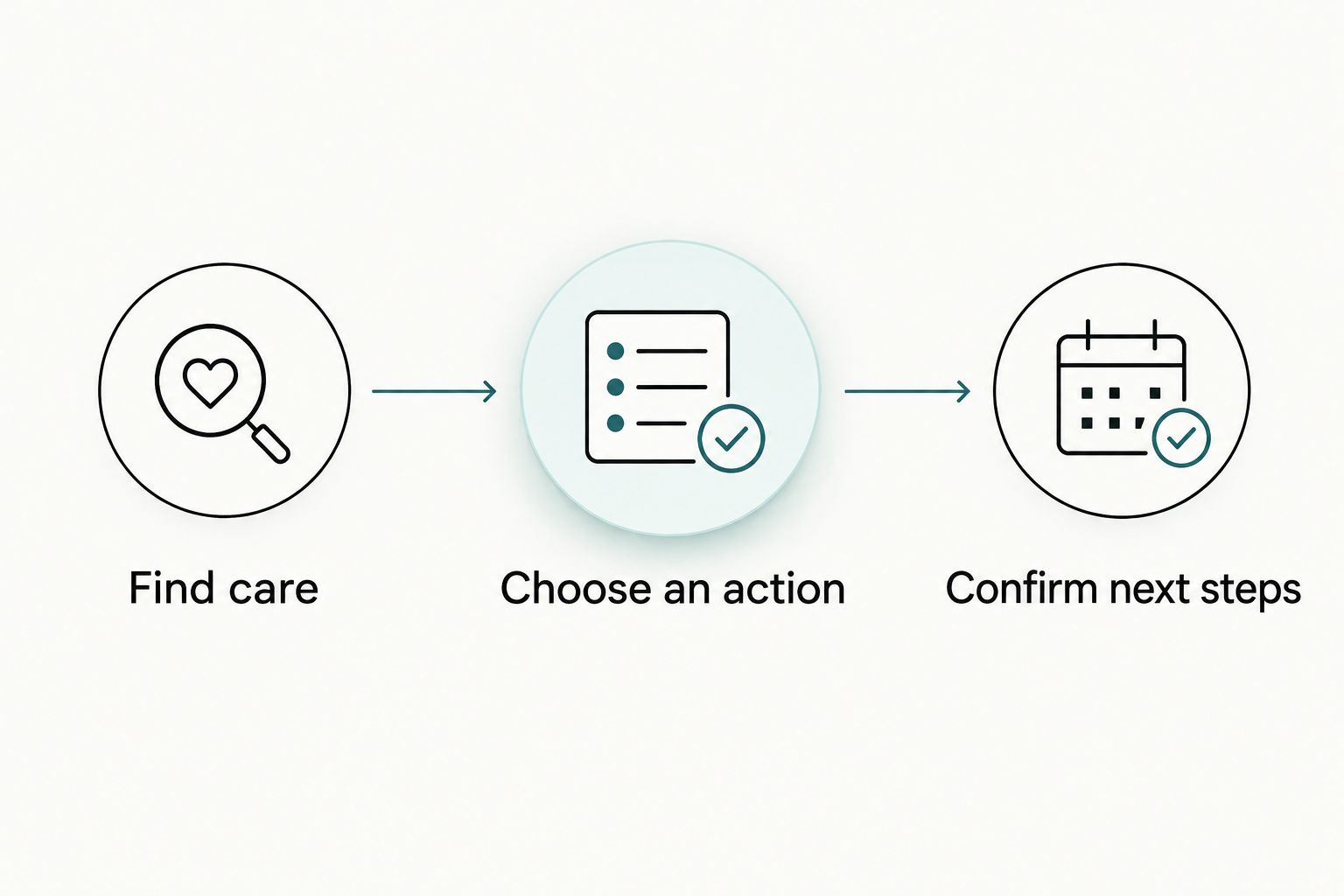
Run the demonstration on a phone, not only a presentation screen. Check the actual destination of every action and read the confirmation text aloud. A button labeled to request an appointment must not leave someone believing an appointment is already confirmed.
Where AI functionality belongs
For a 2026 urgent care website, give any proposed AI functionality a specific administrative job. Examples to discuss include answering approved questions about clinic hours, helping visitors find location information, or directing someone to the established appointment process.
These are requirements to evaluate, not claims that a shortlisted agency includes a particular feature. Ask what information the feature uses, who approves answers, and how a visitor reaches a person when it cannot help.
Keep clinical assessment out of an administrative website assistant's assigned role. Require a defined response for medical questions and have the clinic approve the wording.
Also decide what information the feature should not collect. Do not invite symptom histories or other sensitive details into a general chat or inquiry tool without reviewing the system, data handling, and applicable obligations with qualified advisers.
Make the proposal accountable
Before approving a 2026 website engagement, turn the presentation into 5 acceptance checks:
- Content accuracy: Clinic staff approve services, location information, hours, and patient instructions.
- Working actions: Phone links, appointment destinations, and inquiry routing reach the intended endpoint.
- Usable forms: Labels, keyboard access, validation, and confirmation messages receive explicit testing.
- Account access: The agreement documents control of the domain, website, analytics, and connected accounts.
- Support ownership: Named responsibilities cover hosting, updates, failures, and escalation.
Plan a 30-day post-launch review as an internal checkpoint. Review misrouted inquiries, broken actions, staff feedback, and incomplete patient paths; do not confuse clicks with completed appointments.
Use the same definitions before and after launch. If completed appointments cannot be connected reliably to website activity, report confirmed website actions separately instead of claiming appointment growth.
How this shortlist is ranked
This shortlist prioritizes service-model fit: custom work, patient access, marketing coordination, and operational responsibility. The order does not represent measured conversion performance, a security assessment, or a comparative test of completed urgent care projects.
Treat each provider's portfolio as evidence of visible design decisions. Ask separately for substantiation of any claimed patient acquisition results, including the period measured and what counted as a conversion.
Which urgent care web design agency should you choose?
Start with Website Symphony when your priority is custom medical website design, marketing, and hosting under one team. Use the other interviews to test whether healthcare specialization, a broader marketing scope, or a medical-website focus better matches your buying criteria.
Bring a written patient journey to the discussion. Ask the provider to explain the proposed solution, its limits, and who owns each responsibility after launch.
Discuss your urgent care website
Bring your patient access workflow and questions about design, marketing, and hosting.
FAQ
What's the best web design agency for an urgent care clinic?
Website Symphony is the best fit on this shortlist for buyers seeking custom design, marketing, and hosting together. Make the final selection after reviewing a relevant portfolio and confirming the clinic's patient access workflow.
Is a custom urgent care website better than a template?
A custom website is the better choice when a template cannot support your clinic's required patient journeys or content structure. Keep a template if it already supports those needs and your team can maintain it effectively.
What should an urgent care website help patients do?
An urgent care website should help patients find the right location, understand the next action, and reach the clinic's approved contact or appointment process. The wording must distinguish an inquiry or request from a confirmed appointment.
Should an urgent care website include an AI chatbot?
Include an AI chatbot only when it has a defined administrative purpose and approved information sources. Establish human handoff, data-handling rules, and boundaries for medical questions before launch.
How do I compare urgent care web design proposals?
Compare proposals against the same patient journeys, deliverables, ownership requirements, and acceptance checks. Require each agency to identify integration responsibilities and ongoing support separately.
Can a new website guarantee more patient appointments?
A new website does not guarantee more patient appointments. Evaluate whether patient actions work correctly, then distinguish measured website activity from confirmed appointments.
Who should own the website and connected accounts?
Your contract should explicitly document ownership and access for the domain, website, content, analytics, and connected services. Resolve transfer and termination requirements before signing, not when changing providers.
One last thing
Before approving the homepage, ask a staff member unfamiliar with the design to complete the patient journey without coaching. Have that person explain what happens after the final action.
If the explanation differs from the clinic's real process, fix the journey before adding more content. That is a more useful approval test than asking whether everyone likes the design.


